Selva Oscura: The Dantean Structure of Hell
Explore Dante’s Inferno through its nine circles of Hell, moral symbolism, and timeless vision of sin, power, and human corruption.
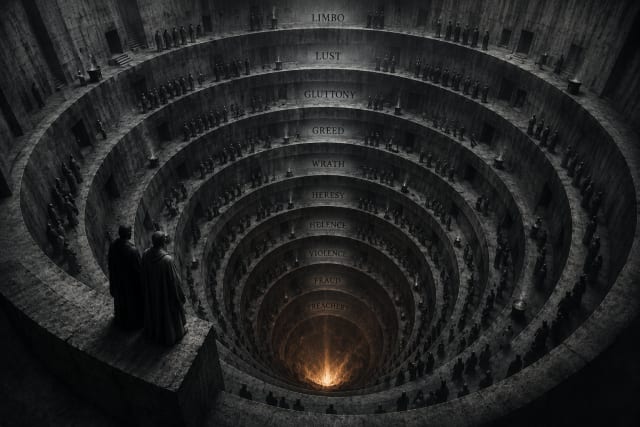
The gates of Hell in Inferno do not open with screams. They open with a sentence. “Abandon all hope, ye who enter here.” In most literature, Hell exists as spectacle. In Dante’s imagination, it exists as structure. The damned are not randomly tortured by a sadistic universe. They inhabit the final shape of their own moral choices. Inferno therefore becomes less a fantasy about the afterlife and more a terrifying philosophy of human character. Dante does not ask what evil deserves. He asks what evil eventually becomes. The answer is chilling because it is not chaos. It is permanence.
Written in the early fourteenth century by Dante Alighieri, the poem follows Dante himself as he journeys through the nine circles of Hell guided by Virgil. Yet the journey is never merely geographical. Every descent is psychological. Every circle strips away another illusion about human beings. Medieval theology becomes moral anatomy. The dark forest at the beginning of the poem is not simply wilderness. It is confusion itself. Dante awakens midway through life spiritually disoriented, trapped between appetite and meaning. Hell begins not beneath the earth but inside the lost self.
The structure of Hell reveals Dante’s deepest insight. The upper circles punish weakness of appetite. Lust, gluttony, greed, and wrath dominate the earlier levels. The lustful are swept endlessly through violent storms because passion once swept them beyond reason. The gluttonous rot in foul rain because they transformed consumption into identity. Dante’s punishments operate through contrapasso, the principle that punishment mirrors sin itself. A soul becomes trapped inside the logic of its own corruption. Sin is therefore not merely rule-breaking. It is self-distortion repeated until it hardens into destiny.
Hell, in Dante’s vision, is not merely punishment. It is identity hardened into eternity.
As Hell deepens, however, the sins become colder and more intellectual. Violence gives way to fraud. Fraud gives way to treachery. This progression matters enormously. Dante does not consider uncontrolled emotion humanity’s greatest danger. He fears the deliberate corruption of intelligence. The flatterer, the hypocrite, the false prophet, and the political manipulator occupy lower circles than the merely angry man because deception weaponizes reason against truth itself. Evil becomes more calculated as one descends. The deepest crimes are committed not by passion but by people who understand morality clearly and betray it anyway.
The final revelation shocks modern readers expecting infernal chaos. Hell grows colder, not hotter. At the bottom lies Satan frozen waist-deep in ice, endlessly chewing traitors in mechanical silence. There is no triumphant rebellion here. Dante refuses to romanticize evil. Satan is powerless, trapped by the very emptiness he helped create. Hell culminates not in fire but in isolation, paralysis, and spiritual sterility. Sin ultimately destroys movement itself. Evil does not liberate the self from order. It imprisons the self inside its own exhaustion.
Some critics argue that Dante’s vision feels excessively rigid or vindictive. After all, Inferno often resembles a cosmic settling of scores. Dante places political enemies, corrupt clergy, and ideological rivals into eternal torment with astonishing confidence. Yet reducing the poem to medieval revenge misses its enduring philosophical force. Dante is not merely condemning individuals. He is diagnosing civilizations. The corrupt popes buried upside down in stone and the fraudulent advisers consumed by flames symbolize institutions hollowed from within. Hell becomes a mirror held before society itself.
What makes Inferno timeless is its unsettling proximity to modern life. Dante understood that societies collapse gradually through spectacle, vanity, propaganda, and moral exhaustion. Social media outrage, performative virtue, political manipulation, and algorithmic tribalism would not have surprised him. The machinery has changed. The psychology has not. Inferno therefore endures because it transforms abstract ethics into unforgettable images. Dante does not lecture about moral decay. He dramatizes it. The damned become metaphors for the ways human beings slowly surrender freedom through repetition, compromise, and appetite. Hell, in Dante’s vision, is the moment a person becomes incapable of becoming anything else.
Discussion · 1
The passage discusses about Dante's Inferno where Hell exists in structure and where humans become what they perform; how souls are trapped between appetite and meaning, and how Hell is not really chaos but more like isolation, depression, and impiety. However, some argue Dante’s vision is vengeful, but still in the contemporary world, Inferno endures because Dante understood the collapse of society, where humans slowly surrender freedom through addiction, appetite, and compromise.
Sign in to join the discussion.
More in Existentialism

The Prince Who Never Became King
Neymar's career reveals why talent alone never guarantees greatness, and why unrealized potential often leaves a more enduring legacy than victory.

The Library of Unlived Lives
Every choice creates a future and erases countless others. Explore regret, freedom, identity, and the hidden cost of living a single life.
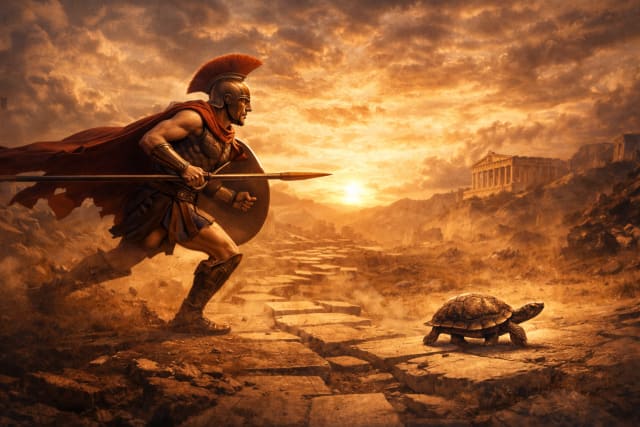
Infinite Loops: From Zeno's Paradox to Modern Sci-Fi
An exploration of infinite loops from Zeno's paradox to modern science fiction, arguing that repetition is not a trap but a structure.
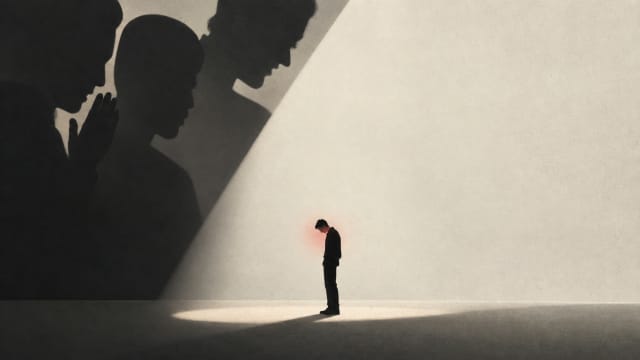
The Phenomenology of Embarrassment
Embarrassment is not shame. It is not guilt. It is the moment the self discovers, with retroactive mortification, that it has been visible all along, and that visibility was never chosen.