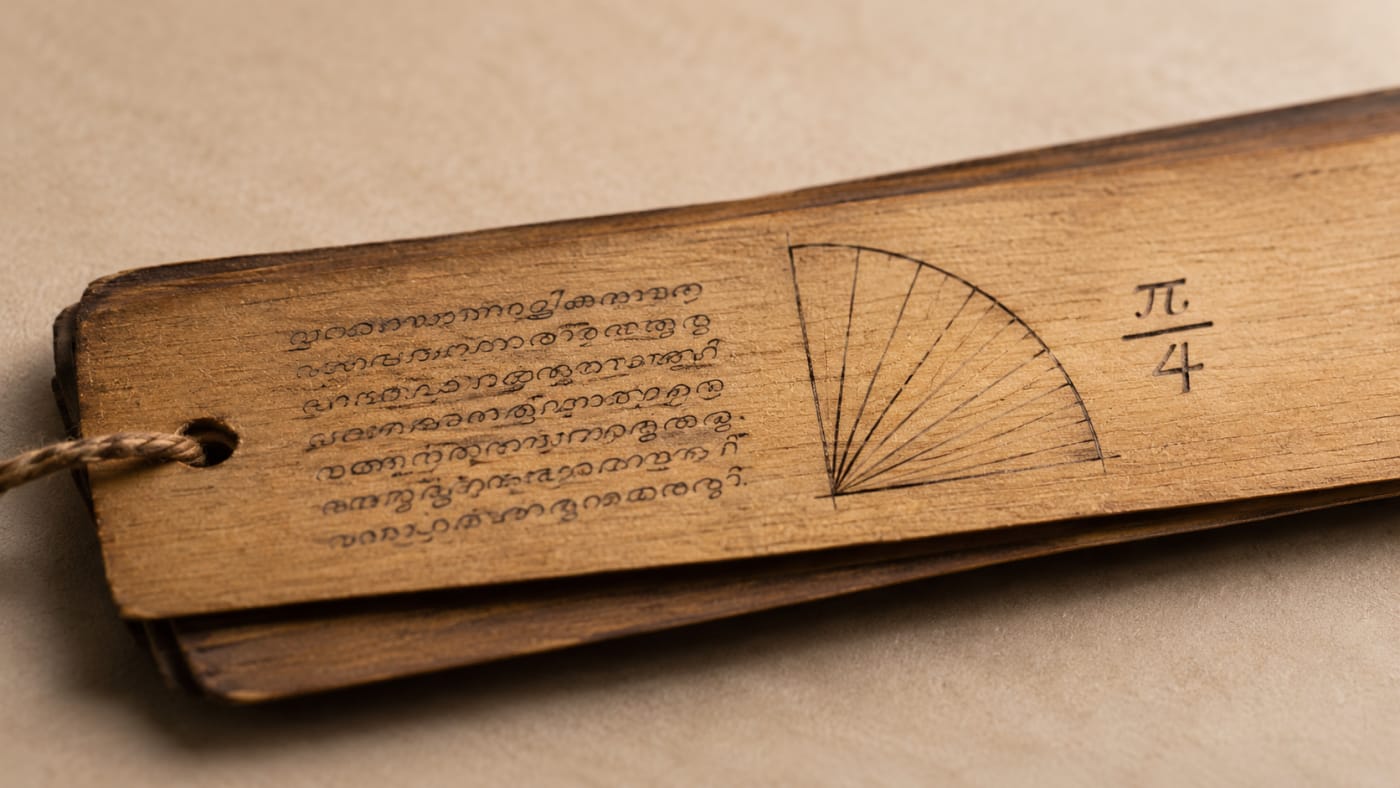
Somewhere in a library there is a bundle of palm leaves, each about the length of a forearm, tied between two wooden boards. The writing on them is Malayalam, scratched in with a stylus and darkened with soot. If you could read it, you would find a teacher talking to a student. He is not issuing rules. He is arguing. He takes a quarter of a circle, cuts its edge into smaller and smaller pieces, adds up what each piece contributes, and shows why the sum must settle on a single number. The number is the one we call π divided by four. The text is the Yuktibhāṣā, written by Jyeṣṭhadeva around 1530, more than a century before Isaac Newton was born.
The title means, roughly, "the language of reasons". It is a book of justifications. Its stated job is to explain why the results in an earlier astronomical work, Nīlakaṇṭha Somayājī's Tantrasaṅgraha of 1501, are true. Among those results are infinite series for the sine, the cosine and the arctangent, and the series for π that Europe would later name after James Gregory and Gottfried Leibniz. The ideas go back to Mādhava of Saṅgamagrāma, who worked in Kerala in the late fourteenth and early fifteenth centuries and left behind a line of students who treated his discoveries the way a family treats an heirloom.
And yet, for most of the last two centuries, educated people in Europe and in India itself repeated a simple claim about Indian mathematics. The Indians, it was said, were brilliant calculators who never proved anything. They had rules and recipes, tables and tricks. The Greeks had proof. That distinction, the story went, was the line between computing and mathematics proper.
So here is the question this essay wants to follow down. If a manual of proofs existed in Malayalam in 1530, why did the belief that Indians never proved anything survive so long? And underneath that, a harder question that the first one keeps tripping over. What exactly do we mean by a proof?
How a myth gets its evidence
Myths about the past are rarely invented out of nothing. They are usually built honestly from the evidence that happens to be on the table, and then kept alive long after the table has changed.
The first Sanskrit mathematics that British scholars read closely came through translation. In 1816 John Taylor published an English version of Bhāskara II's Līlāvatī, and in 1817 Henry Thomas Colebrooke published a large volume of algebra, arithmetic and mensuration drawn from Brahmagupta and Bhāskara. These were serious pieces of scholarship. They were also translations of a particular kind of text.
The classical Sanskrit mathematical work is written in verse. A rule is compressed into a few lines of metre so that a student can memorise it, and then an example follows, often charming, sometimes about bees, peacocks, monkeys or a broken necklace of pearls. A reader who has only these verses sees result after result with no visible argument. To a European reader raised on Euclid, where every proposition marches from definitions and axioms in plain sight, the absence looked like a lack. It looked as though the Indians had simply never thought to ask why.
That reading was not stupid. It was partial. The verses were never meant to stand alone. In the Indian tradition the verse is the part that gets memorised, and the reasoning lives in two other places. It lives in the classroom, where a teacher explains, and it lives in commentaries, the long prose works written to unpack a terse original. The word for the reasoning was upapatti, which can be translated as demonstration or rationale. Bhāskara himself, in his own works, signals that a result should be understood and not merely used, and sixteenth century commentators on his books, such as Gaṇeśa Daivajña, wrote out upapattis for his rules at length.
The verses were never meant to stand alone.
So the early translators saw the part of the tradition designed to be carried in the head, and concluded that the tradition had nothing else in it. It is a little like judging a cricket team by its scorecards. Everything on the card is accurate. None of the batting is there.
The Kerala files
The Kerala material should have changed the picture early. In the 1830s an East India Company official named Charles Whish wrote about the Kerala series in the Transactions of the Royal Asiatic Society, pointing out that texts in the south contained infinite series for the circle. His work was noticed and then, for the most part, set aside. The idea that a tradition of verse calculators had arrived at infinite series before Europe was, to many readers, too strange to absorb, and Whish was not a famous mathematician whose word carried weight.
It took more than a century for the Kerala school to return to the centre of the conversation, through the work of Indian historians of science in the twentieth century and then through careful editions. In 2008 the Yuktibhāṣā appeared in a full English translation with explanatory notes, prepared by K. V. Sarma, K. Ramasubramanian, M. D. Srinivas and M. S. Sriram. Anyone who now wants to see how Jyeṣṭhadeva argues can open it and watch.
What they will see is not a list of rules. The chapter on the circle and its diameter begins with the geometry of a square drawn around a circle. It divides one side into many equal segments, draws lines from the centre to each division point, and estimates the small arcs these lines cut off. The estimates produce a sum. The sum depends on how many pieces you take. Then the text asks what happens when the number of pieces is made very large, and argues that certain terms become negligible while the rest settle into a pattern. The pattern is the series one, minus a third, plus a fifth, minus a seventh, and so on, which approaches a quarter of π.
It helps to picture how this knowledge moved. It did not travel through journals or universities. It travelled through households and temples in a small region of central Kerala, along a chain of teachers and pupils. Mādhava taught Parameśvara, Parameśvara taught his son Dāmodara, and the line continued to Nīlakaṇṭha and to Jyeṣṭhadeva. Each generation inherited results, checked them, extended them, and explained them to the next. A tradition that works this way has every reason to write down its justifications, because the justification is what lets a pupil trust a result he did not discover. In a sense the Yuktibhāṣā is that chain of trust, finally put into one book, in the everyday language of the region rather than in Sanskrit, so that more people could follow it.
Then comes the part that a modern reader tends to find most surprising. The Kerala mathematicians knew that this series converges painfully slowly, so they worked out correction terms, small fractions to add at the point where you stop, which make a short sum give a very accurate answer. The Yuktibhāṣā explains where those corrections come from. A people who only collected recipes do not, as a rule, sit down to explain why a recipe needs adjusting at the end.
The objection, taken seriously
A careful sceptic will not be moved by any of this yet, and the sceptic deserves a hearing.
The argument goes like this. Yes, the Kerala texts contain reasoning. But reasoning is not the same as proof in the strict sense. A Euclidean proof begins from stated definitions and axioms and derives each step by rules everyone can check. The Yuktibhāṣā does not begin from axioms. It appeals to geometrical pictures, to what happens "when the divisions are made very small", to patterns that hold for the first few cases and are then assumed to continue. By the standard of modern analysis, with its limits defined in the language of epsilon and delta, these arguments have gaps. So perhaps the old myth was crude but not entirely wrong. Perhaps Indian mathematics had explanation without rigour.
This objection is worth answering properly, because the answer is more interesting than either side's slogan.
First, the standard it applies is anachronistic for everyone, not only for Kerala. Newton and Leibniz, in the late seventeenth century, also argued with infinitely small quantities that they could not define to the satisfaction of their critics. The philosopher George Berkeley mocked those quantities in 1734 as "the ghosts of departed quantities". The modern epsilon and delta definitions were built in the nineteenth century, by Cauchy, Weierstrass and others, precisely because the calculus everyone was already using did not meet the standard the sceptic now demands. If gaps of this kind disqualify Jyeṣṭhadeva, they disqualify the founders of European calculus too. Nobody says that Newton never proved anything.
Second, Euclid is not the only shape a proof can take, even in Europe. Much of the mathematics that working mathematicians actually trust is established by arguments that would never be written out in full from axioms. They are proofs because a competent reader can see that each step could be filled in, not because every step has been. The Kerala arguments include a style of reasoning that looks very much like what we now call mathematical induction. Show that a pattern holds, show that if it holds for one case it holds for the next, and conclude. That is a proof technique, not a guess.
Third, and most important, the purpose of the Indian upapatti was different from the purpose of the Greek demonstration, and that difference explains the different look of the texts without implying that one is a failed version of the other. Greek geometry, at least in the form we inherited through Euclid, cared a great deal about certainty from first principles. The Indian tradition, as historians such as M. D. Srinivas have argued, cared about removing doubt in a learner's mind and showing that a result follows from accepted procedures and pictures. Those are both reasonable things for a proof to do. They produce different documents.
If gaps of this kind disqualify Jyeṣṭhadeva, they disqualify the founders of European calculus too.
So the sceptic is right that the Yuktibhāṣā is not a nineteenth century textbook of analysis. The sceptic is wrong to conclude that it is therefore not a book of proofs. The more precise statement is that it is a book of proofs written for a different idea of what a proof is for.
Why the myth survived anyway
None of this was impossible to see. So the survival of the myth needs explaining, and three explanations seem to carry most of the weight.
The first is the shape of the archive. Commentaries in Malayalam and Sanskrit, many of them in manuscript, were far harder to reach than printed translations of famous verse texts. Most historians of mathematics in Europe could not read either language. A claim that rests on the only sources you can read will feel like a claim about the whole tradition, because from where you sit it is the whole tradition.
The second is the story Europe told about itself. From the eighteenth century onwards, a powerful account of history placed Greece at the origin of rational thought and modern Europe as its heir. In that story, deductive proof was one of the proud markers of the line. A body of Indian work that seemed to calculate without proving fitted neatly into a picture of a clever but prerational East. Evidence that complicated the picture was not suppressed so much as left unread, because it did not answer any question the picture was asking.
The third explanation is less comfortable for Indians. The myth was repeated inside India, by Indians, long after independence. School textbooks taught the Greek origin of proof and treated Indian mathematics, where they mentioned it at all, as a list of firsts, such as zero, the decimal system and a value of π. That approach turned an argumentative tradition into a trophy cabinet. It celebrated Indian results while quietly accepting the claim that Indians had never argued for them. A tradition defended only by its trophies is a tradition that has already conceded the main point.
There is also a newer temptation running in the opposite direction. Once the Kerala work became better known, some writers began to claim that Indian ideas were carried to Europe by Jesuit missionaries in Kerala and became the secret foundation of European calculus. The historian George Gheverghese Joseph, whose book The Crest of the Peacock did a great deal to challenge Eurocentric histories of mathematics, has argued that such transmission is plausible and worth investigating. But plausibility is not evidence, and the documentary trail that would settle the matter has not been found. Replacing one myth with its mirror image is not a correction. It is the same mistake facing the other way.
What a proof is for
If we strip away the national pride on both sides, the Kerala story leaves us with a genuinely philosophical question, and it is not only about India.
We usually speak of proof as though it were a single thing, a chain of logic that either holds or breaks. In practice, mathematicians mean several things by it. A proof can be a guarantee, so that once it is checked the result is certain. A proof can be an explanation that shows why the result is true, so that you understand it rather than merely accept it. A proof can be a tool whose method can be reused to discover new results. And a proof can be a social act, the argument that persuades the community of competent people that a result can be added to what everyone may now take for granted.
Greek geometry, as Euclid presents it, put the guarantee first. The Kerala upapatti seems to put explanation and method first. The Yuktibhāṣā does not only tell you that the series is right. It shows you how someone could have found it, and how you could find the next one. In that sense its proofs are closer to what a good teacher does at a blackboard than to what a logician does on paper, and there is a respectable argument that this is what most mathematicians have always valued most.
Modern mathematics has its own version of this tension. Proofs checked by computer can now guarantee results that no human fully understands, and some mathematicians are uneasy about them for exactly that reason. A proof that guarantees without explaining feels incomplete to them, even though it meets the strictest standard of rigour ever devised. The Kerala tradition would have recognised that unease. So, one suspects, would Euclid.
This is why the myth matters beyond the question of who deserves credit. It was built on the assumption that there is one correct shape for a proof, and that a culture either finds it or does not. The palm leaves suggest something different. They suggest that proving is a family of practices, each answering a slightly different need, and that a tradition can be rigorous in ways that another tradition's textbooks are not designed to detect.
The student on the other side of the leaf
Go back to the bundle of palm leaves. Somebody copied those lines by hand, probably more than once, because palm leaf does not last forever in a humid climate and texts survived only if people cared enough to recopy them. Somebody sat across from a teacher and heard the argument about the quarter circle out loud before ever seeing it written. Somebody, at some point, did not understand a step and asked about it, and the text we have is partly the residue of that question being answered.
That student did not need to be told that a proof existed. The student was inside one. What the student could not have imagined is that, four centuries later, people in another part of the world, and in the student's own country, would look at the short verses at the top of the tradition and conclude that nothing lay beneath them.
The interesting question is no longer whether Indian mathematicians proved things. They did, in their own idiom, and the evidence is printed and translated. The interesting question is the one the myth leaves behind for all of us. When we look at a way of knowing that does not resemble ours, how often do we mistake the part designed to be remembered for the whole of what was understood?