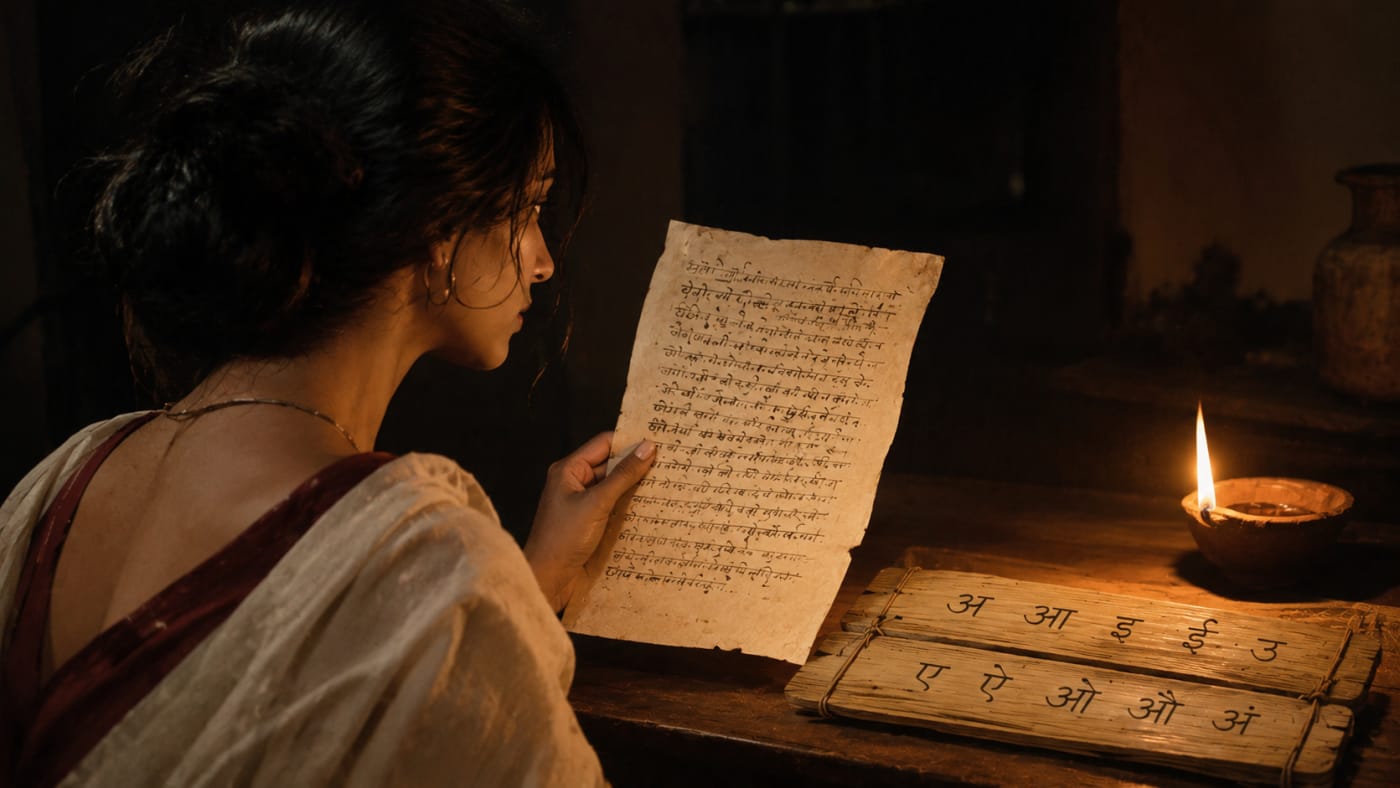
The page was hidden in the kitchen. It had been taken from a manuscript copy of the Chaitanya Bhagavata, the Vaishnava life of the saint, which belonged to the master of the house and was not meant for the woman who cooked his meals. She was in her twenties, the mistress of a landowner's household in Ramdia, in Faridpur, and she had already borne several of the twelve children she would eventually have. She could not read. What she had was a memory of letter shapes, picked up as a small girl while boys chanted their lessons in a village pathshala, and a son who was now learning his alphabet on a palm leaf.
So she did the obvious thing, which in her world was also the dangerous thing. She looked at the boy's palm leaf, then at the stolen page, and matched one to the other. A letter here, the same letter there. She did it in the gaps of days given over to cooking for a large household. Nobody taught her. She seems to have been about twenty five.
Her name was Rassundari, and decades later she wrote a book called Amar Jiban, "My Life". Its first part was finished in 1868 and it was in print within a few years after that, with most sources giving 1876. It is often described as the first full autobiography in Bengali, and it is certainly the first by a woman. That fact is the kind that ends up on quiz cards. The more interesting fact is what she said about how it happened. She did not say that she wanted to read and so taught herself. She said, in effect, that God had taught her.
This essay is about that sentence, and about the sentences that sat in the same place for the women who came after her. My question is simple to state. When women in colonial India first began to write their own lives in prose, each of them seems to have needed a licence to say "I". It could be devotion, or penance, or a grievance too sharp to swallow. Were these licences masks over a self that already existed, or were they the very frame that let a self be written at all? And what did each licence cost the woman who used it?
Rassundari Devi was born around 1809 in Potajia, a village in Pabna, and married at twelve. In Amar Jiban she describes being sent away to her husband's home as a child, homesick for her mother, and slowly discovering that the household expected her to run it. Before she turned sixteen she more or less did. Much of the book is about the work of that household, told without complaint and without much ornament.
A page that had to be stolen
It helps to be exact about what was forbidden, because the prohibition was not written down anywhere. No law in Bengal stopped a married woman from reading in the 1830s. What stopped her was a belief, widespread in Bengal in those decades, that a woman who learned letters would become a widow. Reading was not a skill. It was an omen. To be caught with a book was to be caught wishing your husband dead.
That is why the theft matters. She did not borrow the page. She removed it, and she hid it where only she went. The kitchen was the one room in the house that was unambiguously hers, and it was also the room where no man would look for a book. There is a small, exact irony in that. The space that defined her confinement became the only private reading room she had.
She learned slowly, and it is worth noticing what she learned first. Not a primer, not arithmetic, but the life of Chaitanya, the saint of the sixteenth century whose followers in Bengal had for three centuries treated devotion as a form of intense, almost erotic, love. When she finally could read, the first thing she could read was a book about how a human being might be wholly overtaken by God. Writing came much later. By her own account she was nearly fifty before she learned to form letters herself, at the urging of one of her sons. She was widowed at fifty nine.
Read quickly, Amar Jiban looks like a pious woman's thanksgiving. Its chapters are punctuated with praise of the Lord, and the second part, added for an enlarged edition in 1897 when she was nearly ninety, drifts into retellings of the lives of Krishna and Chaitanya as if they were simply further chapters of her own story. The historian Tanika Sarkar, whose 1999 book Words to Win is still the best thing written on it, chose to translate almost all of the first part and only selections from the second, which she found repetitive. Most modern readers make the same choice without being told. We read the woman and skip the saint.
God as a permission slip
Here is the difficulty. If you skip the saint, you misread the woman. Rassundari's central claim about her own literacy is that it was a miracle. She gave herself a title for it, jitakshara, roughly "one who has conquered the letter". In Sarkar's translation, she says it was as if the Lord himself had taught her to read.
On one reading this is modesty, the conventional humility of a devotee. On another it is something sharper. If God taught her, then nobody in the household can be blamed for allowing it, and she cannot be blamed for wanting it. The miracle relocates the agency. It takes an act that her world treated as transgressive, a wife reaching for a book, and turns it into an act of grace that her world was obliged to respect. You cannot punish a woman for something God did.
The same logic runs through the book's structure. A life story by a woman was not a recognised genre in Bengal at the time. A devotional narrative, in which an ordinary soul is drawn by stages toward God, very much was. By shaping her life on that pattern, Rassundari found a form that already existed and could be read without alarm. Her suffering, her loneliness as a child bride, her twelve confinements, her inability to visit her dying mother, could all be told because they were steps on a spiritual path. A grievance becomes a trial. A trial is allowed.
You cannot punish a woman for something God did. Rassundari seems to have understood this better than any of her later admirers.
The 1897 edition came with a preface by Jyotirindranath Tagore, Rabindranath's elder brother, which tells you how far the book had travelled from the kitchen in Ramdia. By then Calcutta's reformers were busy arguing about women's education, and an old woman who had taught herself to read in secret was useful evidence. The licence she had given herself, devotion, was now joined by a second one, granted by men, which made her a specimen of progress. Neither licence quite fits what is on the page, which is a woman watching herself with unusual coolness. Sarkar points out how little sensory detail the book contains, and how briefly other people appear in it. It is not a crowded, warm domestic memoir. It is a mind looking for a frame large enough to hold it, and finding that frame in the whole sacred geography of India.
Two centuries earlier, in Marathi verse
An honest reader will object at this point that Rassundari was not the first Indian woman to write "I". She was not even close. Bhakti poetry in half a dozen languages is crowded with women speaking in the first person, often furiously. If what we want is a woman's self in writing, the seventeenth century has one ready.
Bahinabai was born in 1628 at Devgaon, near Ellora, into a Brahmin family, and married at about three to a widower of thirty named Gangadhar Pathak. She grew up to become a devotee of Vithoba and a disciple, through visions, of Tukaram, the poet and saint. Her collected verses, the Bahinabai Gatha, include a long autobiographical sequence, usually called the Atmanivedana, that runs to 473 verses. It narrates her present life and twelve previous ones.
The story she tells is not gentle. Her husband was a scholar who objected violently to his wife following Tukaram, whom he regarded as beneath them in caste. In the account preserved in her verses and the tradition around them, he beat her, confined her, and planned to abandon her while she was pregnant, before a sudden illness changed his mind. What is striking is her conclusion. She did not leave. She argued, in verse, that renunciation was not truly open to a woman, because a woman's body was under the control of someone else, and so her path to God would have to run through service to her husband rather than around him.
So the objection is right, and it is useful. Women speaking in their own voice is an old thing in India. What is new in 1868 is not the "I" but the prose, the print, and the ordinariness of the life described. Bahinabai's "I" is the "I" of a saint, and her autobiography is a sacred text whose authority comes from the visions. Rassundari is not a saint and does not claim to be one. She is a housewife who wants to explain how she learned to read. And yet she reaches for exactly the same scaffolding. Separated by two hundred years, a language, a region and a literary form, both women make the self speakable by making it holy.
That continuity is the real finding. The licence is older than the genre. When print arrived and prose autobiography became possible, women did not walk into it with a new kind of self. They carried in the old permission, and it worked, for a while.
An actress asks to be forgiven
The next licence was very different, because the woman who used it could not plausibly claim to be holy. Binodini Dasi was born in Calcutta around 1862 into a poor family in the city's courtesan quarter, and first went on stage in December 1874, at about twelve, in a small part as Draupadi at the National Theatre. Over roughly twelve years she played more than eighty roles, many of them under the training of the actor and playwright Girish Chandra Ghosh. She was, by any measure, the first great star of the Bengali public stage.
Two stories about her are told in every account, and they belong together. The first is that in 1883, when Girish and his colleagues needed money for a new playhouse, the businessman Gurmukh Rai agreed to finance it on condition that Binodini became his mistress. She agreed, she later wrote, because she was given to understand that the new theatre would carry her name. It opened as the Star. The second story is that in 1884 Ramakrishna came to see her play the saint Chaitanya in Chaitanya Lila, was deeply moved, and blessed her afterwards. One story is about a theatre that used her body and erased her name. The other is about a holy man who looked past both.
She left the stage before she was thirty. In 1912 she published Amar Katha, "My Story", one of the earliest memoirs by an Indian actress, later translated into English by Rimli Bhattacharya. Here the licence is not miracle but confession. The book presents itself as the account of a fallen woman, addressed to a world that will not forgive her and to which she is not, finally, apologising. Its tone keeps shifting. It begins in contrition and becomes an argument. She describes the work of acting, the training, the long hours of rehearsal, with a craftsman's pride. She names what she was promised and what she got.
Confession is a cunning licence. A woman who says "I have sinned" has already conceded the moral case, which leaves her free to tell the factual one. The penitent is allowed to talk about the sin in detail, and the detail is where the truth lives. Binodini used that freedom thoroughly. Her book is less an apology than an itemised bill.
It is worth pausing on how much the Ramakrishna episode does for her. A courtesan who played Chaitanya, and was blessed for it by the most revered holy man in the city, has a sliver of the old devotional licence after all. She did not claim to be a saint, but a saint had touched her. Even here, at the most worldly end of the story, the sacred is the door through which the self comes in.
The doctor who wrote for no one
The third licence belongs to a woman who had trained in science and seems to have had little patience for any of the others. Haimabati Sen was born in 1866 in Khulna district, married at nine to a widower much older than her, and widowed within a year. A child widow in a Hindu family in the 1870s had, on paper, a single future, which was a lifetime of austerity in someone else's house. She refused it. After years of depending on relatives and on reformers' charity, she remarried in 1890, to Kunjabehari Sen, with whom she would raise five children, and enrolled at Campbell Medical School in Calcutta. In 1894 she finished at the top of her class. From 1894 to 1910 she worked at the Lady Dufferin Women's Hospital in Hooghly, then practised privately in Chinsurah until her death in 1933.
In the 1920s she wrote a memoir in Bengali. It was not published in her lifetime. It surfaced decades later, was translated by the historian Tapan Raychaudhuri, edited by him with Geraldine Forbes, and appeared in English in 2000, its title describing her as a child widow who became a lady doctor. A later edition is called Because I Am a Woman. That second title is the licence, stated plainly.
Haimabati's memoir is not devotional and not penitent. It is angry, in a precise, documentary way. She records hostility from men who did not expect to be outdone by a widow, condescension from colleagues, and the gap between what reformers preached about women and how they behaved toward the women in front of them. Her licence is grievance, and grievance is the most modern of the three, because it assumes a self that is owed something. Rassundari asks for nothing and thanks God. Binodini asks for understanding. Haimabati asks for what she was due.
And yet her book, of the three, was the one that nobody read for seventy years. The licence that sounds most like ours was the one with the least purchase in its own time. A devotional memoir could be printed and praised by a Tagore. A courtesan's confession could find buyers who were curious about the sin. A professional woman's itemised complaint against the men of her profession had no obvious audience at all. She wrote it, as far as anyone can tell, for her family and for the record. It waited.
The licence that sounds most like ours was the one with the least purchase in its own time.
Was it ever a mask?
The strongest objection to everything above is that it is condescending. To describe Rassundari's devotion as a "licence", a "permission slip", a clever relocation of agency, is to assume that her real self was secular and modern and that all the talk of God was packaging. It is the reflex of a reader who finds faith embarrassing and wants his heroines to be secretly like him. Rassundari believed in Krishna. Bahinabai had visions. Binodini, by most accounts, treasured Ramakrishna's blessing for the rest of her life. Who are we to call their faith a tactic?
I think the objection is correct about the motive and wrong about the mechanism. Nothing in Amar Jiban suggests that Rassundari was pretending. Her belief that God had taught her to read was, as far as the text shows, entirely sincere. But a sincere belief can still do structural work. The frame was not a mask laid over a self that already existed. It was more like the wall a building leans on while it is still going up. Without it, there is no building, only materials. The devotion did not hide Rassundari. It held her up long enough for her to be written.
Sarkar makes a related point with a pointed word, doublespeak. Within the pious frame, Rassundari places observations that quietly undercut it, small remarks about what the household denied her, about what it means that a boy could learn letters openly and a girl could not, about how a son could fly to a sick mother and a young wife in her husband's house could not. These are not hidden messages smuggled past a censor. They are what a sincere believer notices when she has learned to look at her own life from outside. The frame and the critique coexist because the woman holding them did not experience them as opposites.
The cost, then, is not hypocrisy. It is something quieter. Each licence decided in advance what kind of self could appear. Under devotion, a woman could be a soul on a journey, but not a person with a case. Under confession, she could be a sinner with a story, but not a worker owed wages. Under grievance, she could be a professional with a claim, but she might not be read at all. The licence let the self through the door, and it also trimmed the self to fit the door.
It is tempting to tell this as a story of progress, from God to guilt to grievance, from the saint's licence to the professional's claim, each woman a little freer than the last. The dates almost allow it. Bahinabai in the 1600s, Rassundari in 1868, Binodini in 1912, Haimabati in the 1920s. But the publication history refuses the tidy line. The most devout of the four was printed first and praised loudest. The most modern was printed last, in English translation, three generations after she wrote. If there was progress, it was not in the women. It was in the readers, who slowly became able to hear what the later ones were saying.
Which brings me back to the kitchen, and to the method. Rassundari did not learn her letters from a teacher or a primer. She learned them by comparison, holding two surfaces side by side until the shapes on one explained the shapes on the other. One was the boy's palm leaf, which was permitted. The other was the saint's page, which was not. Every woman in this essay did something like that. She took the form her world allowed and laid it beside the life she had actually lived, and read one by the light of the other.
The question that leaves us with is not whether they were free. It is what we are holding beside their pages when we read them now, which permitted form we are using to decode the stolen one, and which letters on their page we still cannot match to anything on ours.