The Squeak That Was Kept
A student repairs his grandfather's old bicycle over a holiday and learns that the loudest part of a problem is rarely the faulty one.
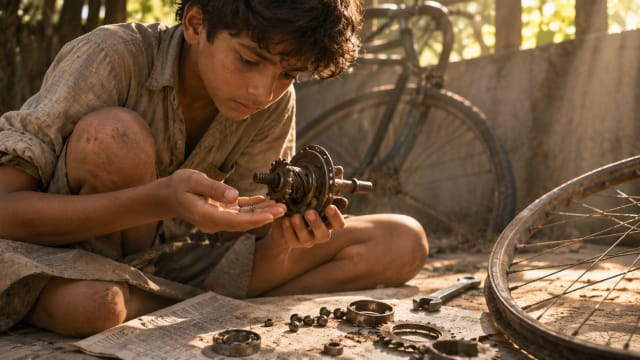
My grandfather's bicycle had stood in the back shed for nine years, leaning against a sack of old newspapers, when I decided during the long holiday after the board exams that I would make it run again. I had never repaired anything more complicated than a pencil sharpener. What I had was a free month, a box of borrowed spanners and a belief, which I now find rather touching, that a machine is simply a problem waiting for a determined person.
The first week taught me humility. I oiled the chain and pumped the tyres and sat on the seat, and the pedals turned with a grinding noise while the back wheel stayed perfectly still. I assumed the chain was at fault and spent two days cleaning every link with a toothbrush. It made no difference. In the end I walked down to the corner shop of Bhaskar uncle, who has repaired cycles in our lane for thirty years, and asked him what I was doing wrong.
He did not look at the chain at all. He spun the back wheel with one finger, listened for a moment, and pointed to a part in the middle of the hub that I had never noticed. The chain is fine, he said. The trouble is inside, and you cannot see it by looking at the outside. He showed me how to open the hub on a sheet of newspaper, and there, among the old grease, lay a tiny spring that had snapped in two.
Replacing it took ten minutes and cost twelve rupees. What had taken me a month, I realised later, was learning where to look. I had treated the cycle as a set of visible parts, whereas it was a set of relationships, and the part that was broken was not the part that was making the noise. The same, I suspect, is true of many things that go wrong, from a quarrel between friends to a bad week of studying. The loudest part is rarely the faulty one.
The loudest part is rarely the faulty one.
The cycle runs now, though it still squeaks a little when I brake. Bhaskar uncle says I should oil the pivot of the brake lever, and I will, but not just yet. I have grown rather fond of the squeak. It reminds me that I made the machine run, and that a machine which works is not always a machine which is quiet.
IPMAT verbal practice
This passage is written in the IPMAT style. Its 6 questions are just below in exam mode.
Discussion
Sign in to join the discussion.
More in Craft & Making
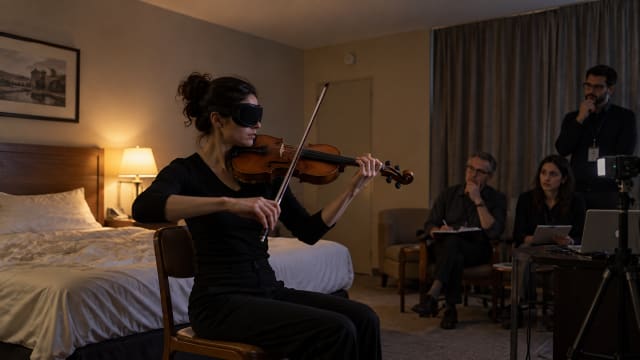
The Violins That Lost the Blind Test
A century of reverence for the Cremonese master met a trial in which the players could not see which violin they held.

The Monkey's Paw
The Monkey's Paw is more than a horror story. It foreshadowed AI alignment by exposing the danger of systems that obey words but ignore intent.

How Fight Club Became the Brand It Tried to Destroy
A film that condemned consumer culture became one of its most successful products, revealing how capitalism can package even rebellion.

Why Victorian England Feared Female Desire More Than Dracula
Beyond Gothic horror, Dracula exposes Victorian anxieties about female desire, agency, sexuality and the uneasy relationship between instinct and culture.