Why Walter Mitty Needed His Fantasies
Walter Mitty reveals that imagination is not an escape from reality but a rehearsal for courage, preparing us to become who we dare to imagine.
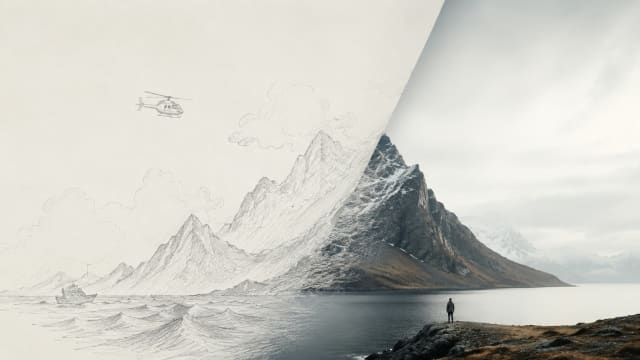
Walter Mitty spends much of his life standing still. A negative assets manager at Life magazine, he disappears into spectacular fantasies while elevators close, conversations continue and deadlines approach. He imagines himself as a fearless mountaineer, an ace pilot, a globe-trotting adventurer. To everyone around him, he is simply distracted. The film invites us to ask a deeper question. What if daydreaming is not the opposite of courage, but its rehearsal?
Modern life has declared war on idle minds. Productivity has become a moral virtue. Every empty moment is expected to be filled with notifications, measurable output or self-improvement. A wandering mind is dismissed as laziness, something to be cured with discipline or efficiency. Yet neuroscience paints a more generous picture. The human brain constantly simulates possible futures, using many of the same neural systems involved in remembering the past. Imagination is not merely entertainment. It is prediction. Before we perform an action in the world, we often perform it in the theatre of the mind.
"Walter does not become courageous because he abandons imagination. He abandons imagination because he no longer needs it. Reality has finally caught up with his inner life."
Walter's fantasies belong to this ancient machinery. They are not lies about who he is. They are hypotheses about who he might become. Every impossible rescue, every romantic conversation and every act of impossible bravery is a rehearsal staged inside a private laboratory. The audience mistakes these performances for escapism because they cannot see what imagination is quietly constructing beneath the surface.
This is why the film's structure matters more than its plot. At first, Walter's imaginary life grows ever more extravagant because his real life offers little room for agency. His fantasies compensate for a reality that feels painfully static. But once he begins chasing an elusive photographer across Greenland, Iceland and the Himalayas, something remarkable happens. The dream sequences almost vanish. The more extraordinary his life becomes, the less frequently his imagination interrupts it. The film does not announce this shift. It simply allows the audience to notice that reality has become just as astonishing as fantasy.
Many viewers interpret this as a simple triumph of action over imagination. The lesson, they argue, is to stop dreaming and start living. It is an attractive reading, but an incomplete one. Walter acts because he once imagined himself capable of acting. His inner adventures did not imprison him forever. They prepared him for release. Fantasy becomes unhealthy only when it refuses to surrender its place to experience. Healthy imagination contains the seed of its own disappearance. It exists to make itself unnecessary.
This also explains why children instinctively fill afternoons with imaginary worlds. They become astronauts, explorers, detectives and kings long before they possess any real power. Adults often dismiss these games as frivolous, yet they are exercises in becoming. Every imagined identity is a prototype awaiting reality. We rehearse difficult conversations before speaking them aloud. We picture ourselves surviving rejection before taking a risk. Athletes visualise victory before stepping onto the field. Surgeons mentally perform procedures before lifting a scalpel. The mind builds futures before the body inhabits them.
The film's quiet revelation arrives near its conclusion. Walter does not become courageous because he abandons imagination. He abandons imagination because he no longer needs it. Reality has finally caught up with his inner life. The fantasies were never the destination. They were the bridge.
Here lies the film's deepest insight. Society treats daydreams as evidence of absence, as though the wandering mind has abandoned the present. Yet the opposite is often true. The mind wanders because it is searching for a version of the future worthy of returning to. Walter's greatest adventure begins not when he boards a helicopter or scales a mountain, but when he finally trusts the person he had already met a thousand times in his imagination. The greatest fantasies are not escapes from reality. They are scaffolding. Once the building stands, the scaffolding disappears, leaving only the life it helped construct.
Discussion · 1
The passage challenges the common belief that daydreaming and fantasies are merely forms of escapism. Using Walter Mitty as an example, the author argues that fantasies often function as mental rehearsals through which individuals explore possible future versions of themselves, build confidence, and prepare for action. Imagination is presented as a constructive psychological process rather than a distraction. Only when fantasies replace action instead of supporting it do they become harmful. Thus, wandering of the mind is portrayed as a search for future possibilities rather than an absence from reality.
Sign in to join the discussion.
More in Cinema

Odysseus and the Arc of the Hero
Odysseus embodies the hero’s journey not through victory alone, but through the losses, disguises and transformations that make returning home possible.

How Fight Club Became the Brand It Tried to Destroy
A film that condemned consumer culture became one of its most successful products, revealing how capitalism can package even rebellion.

Be Careful What you Wish For
Obsession is more than a horror film. It is a meditation on desire, love, fulfilment and the hidden cost of getting what we want.

First They Killed My Father and the Performance of Civilization
Angelina Jolie’s First They Killed My Father reveals how authoritarian societies replace truth with performance and silence with fear.