The Fake Poet Behind an LGBTQ Pioneer Club
A Parisian book of 1894 claimed to translate a Greek poet who never existed, and sixty years later a group of women borrowed her name for themselves.
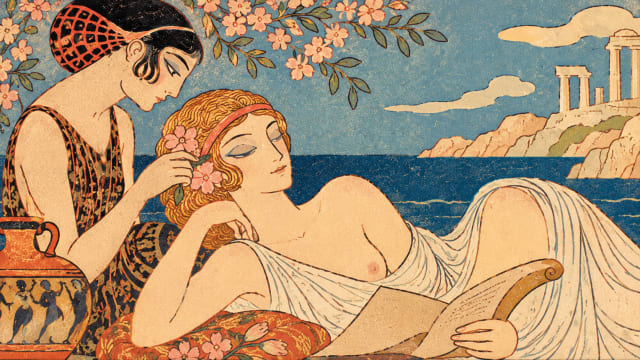
Pierre Louÿs's Les Chansons de Bilitis, published in Paris in 1894, presents itself as a translation. Its preface tells of a German archaeologist, a Herr G Heim, who is said to have found a tomb on Cyprus with over a hundred and fifty poems cut into its walls, the work of a Greek woman named Bilitis who had known Sappho. No such tomb existed. The poems were composed by Louÿs, who drew partly on ancient epigrams, and the book is therefore usually filed as a forgery.
That label may be too blunt. A forger hopes to be believed, whereas the preface carries a clue that clever readers could hardly miss. The name Heim, spoken with a German accent, sounds like Geheim, the German word for secret. A hoax that announces itself to the knowing reader works less like fraud and more like a game played between an author and an audience that shares the joke. The game also had ancient precedent, since Greek epigrammatists sometimes attached famous names to their own verses. The critic must therefore ask what a playful disguise permits that open authorship does not.
The most famous reader to refuse the game was the German philologist Ulrich von Wilamowitz, whose scornful review of 1896 pointed to the book's anachronisms. The review was not only about scholarship. It is plausible, though his motives remain a matter of interpretation, that a scholar who wished to keep Sappho clear of erotic attachment to women found the book's frankness more offensive than its errors. If so, the dispute concerned less whether the songs were genuine than who was entitled to say what Sappho's world had contained. Louÿs answered by quoting the review in a later edition, turning a rebuke into an advertisement.
Louÿs answered by quoting the review in a later edition, turning a rebuke into an advertisement.
The afterlife of the book complicates any simple verdict. Its lesbian eroticism, though written by a man for an audience of men, supplied images that women could not easily find elsewhere. It also belonged to a European taste for an imagined and sensual Greece that treated the desire of women as a spectacle. Both observations are fair, and neither cancels the other.
The strangest chapter came in 1955, when a small group of women in San Francisco formed a social club, and one founder is recalled as proposing the name Daughters of Bilitis, a name that sounded harmless to outsiders. The name of a poet who never lived, taken from a book that began as a joke, became the label of the first lesbian organisation in the United States. It appears that the founders knew Bilitis was invented, and they used her anyway.
What remains open is whether a fiction can honestly serve as an ancestor. The women who took the name invented a tradition, as Louÿs had, but they did so openly and for a purpose that the original game never had, which was to make a community. The question for the reader is whether a past acknowledged as made up gives less support than one that is believed, or more.
CAT VARC practice
This passage is written in the CAT style. Its 4 questions are just below, and you can take them on the real CAT exam screen.
Also writing other exams? Solved XAT verbal PYQs, IPMAT verbal PYQs, CLAT English PYQs and GMAT reading, all free.
Discussion
Sign in to join the discussion.
More in Literary Criticism

The Friend Who Disobeyed Kafka: An RC Inspired by IIM Indore
Franz Kafka asked his closest friend to burn everything he had left unpublished. The friend refused, and the world gained a canon whose existence rests on disobedience.

The Monkey's Paw
The Monkey's Paw is more than a horror story. It foreshadowed AI alignment by exposing the danger of systems that obey words but ignore intent.

How Fight Club Became the Brand It Tried to Destroy
A film that condemned consumer culture became one of its most successful products, revealing how capitalism can package even rebellion.

Why Victorian England Feared Female Desire More Than Dracula
Beyond Gothic horror, Dracula exposes Victorian anxieties about female desire, agency, sexuality and the uneasy relationship between instinct and culture.