The Referee Einstein Did Not Expect
Peer review is spoken of as science's oldest safeguard, yet its routine use is a twentieth century habit, and its authority rests more on custom than on proof.
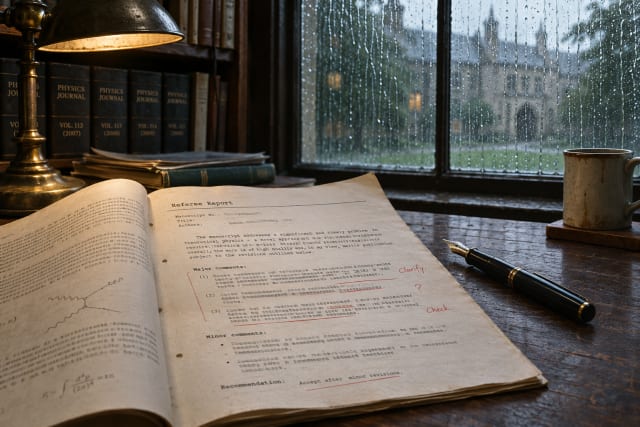
The strongest objection to peer review is not that it sometimes fails, which every defender admits, but that no one can say how often it succeeds. The practice is defended by anecdote. Each scientist can recall a referee who rescued a paper from an error, and each can recall another who delayed a sound paper out of jealousy or fatigue. Because both kinds of story are vivid and neither can be counted, the system has been judged by temperament and not by evidence.
The best known story in its favour involves Albert Einstein. In 1936 he and Nathan Rosen sent Physical Review a paper arguing that gravitational waves could not exist. The editor, John Tate, passed it to the relativist Howard Percy Robertson, who wrote a long report finding that the authors had misread a feature of their coordinates. Einstein protested that the paper had been sent for publication and not for refereeing, and he withdrew it and took it to the Journal of the Franklin Institute. The version that appeared there no longer claimed that such waves were impossible, a change that historians connect to the objection Robertson had raised.
Yet the story proves less than it seems. It shows that a referee caught an error, which is exactly what defenders claim. It also shows that the practice was not yet a settled rule, since one of the most famous physicists alive treated review as an affront and seems not to have expected it. Historians of science describe external refereeing as uneven across journals for much of the first half of the twentieth century, and as becoming routine only gradually afterwards, under the pressure of growing numbers of submissions and public money. If that is right, the institution gained its present authority after science had already produced much of its modern knowledge, which sits awkwardly with the claim that quality control is what made that knowledge reliable.
It also shows that the practice was not yet a settled rule, since one of the most famous physicists alive treated review as an affront and seems not to have expected it.
A defender can answer that earlier science had other filters, such as editors who knew their authors, learned societies and the criticism of rival laboratories, and that formal refereeing simply made those filters wider and fairer. The reply is plausible and should be conceded. But it changes the claim. Peer review then becomes one stage in a longer process of scrutiny that also includes replication, citation and plain neglect, and its own contribution is harder to isolate than its reputation suggests.
The sensible conclusion is therefore modest. Peer review is a reasonable practice whose benefits are real in particular cases, but its present authority is a matter of habit and institutional convenience more than of measured performance. What remains open is whether science would be better served by testing the practice as it tests everything else, by comparing outcomes under different systems, or whether the habit has become so woven into careers and funding that it can no longer be treated as a hypothesis at all.
CAT VARC practice
This passage is written in the CAT style. Its 4 questions are just below, and you can take them on the real CAT exam screen.
Also writing other exams? Solved XAT verbal PYQs, IPMAT verbal PYQs, CLAT English PYQs and GMAT reading, all free.
Discussion
Sign in to join the discussion.
More in Academia

The Hoax That Proved Whatever Its Readers Already Believed
A physicist submitted a deliberate nonsense article to a journal in 1996, and it was published. Thirty years on, both sides of the quarrel still claim the episode as their evidence.

How EdTech Forgot Teaching | The 111th Essay
How online education, CAT coaching, AI summaries, and viral learning frameworks transformed teaching into performance, attention, and endless preparation.

The Comma That Saves Grandma: An RC Inspired by IIM Indore
A tiny mark of punctuation opens into a larger question about how conventions create meaning, coordinate behaviour and quietly hold civilisation together.

The Things We Teach Each Other
I learnt to teach through a fairy without wings. Years later, I understood that learning and teaching may be among our oldest human impulses.