The Things We Teach Each Other
I learnt to teach through a fairy without wings. Years later, I understood that learning and teaching may be among our oldest human impulses.
I was probably a teacher before I knew what a teacher was. I grew up in a Brahmin family in which learning was less a destination than a way of inhabiting the world. I remember sitting with my father and his friends, wrestling with non-verbal puzzles, watching adults turn problems over in their minds. Long before I understood pedagogy, I understood its pleasure. There was something intoxicating about seeing confusion become pattern.
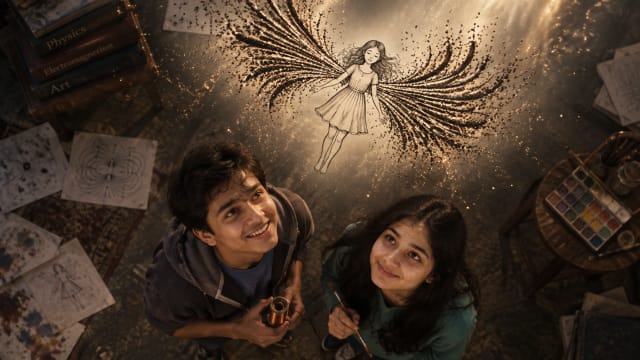
Then, as a child myself, I tried to teach a girl three years younger than me about magnetic lines of force. She loved art and painting. So I did not begin with physics. I drew a fairy without wings. Below her, I placed a solenoid and covered the drawing with iron filings. When I switched on the current, the invisible magnetic field announced itself. The filings curved into patterns around the fairy. She had acquired wings.
I had found, almost accidentally, what would become one of the deepest principles of my life. An idea is not truly taught until it becomes visible to the mind receiving it. The textbook diagram could explain magnetism. But the fairy could make a child feel it.
Looking back, I suspect that learning and teaching are not separate human activities. They are two movements of the same impulse. One begins with curiosity. What is this? Why does it happen? How does it work? The other begins when understanding becomes too large to keep private. "Look. I have found something. Let me show you."
Perhaps this is why human beings teach long before they build schools.
A child discovers fire and warns another not to touch it. A hunter learns where the animals pass and shows the path to his companions. A parent teaches a child which berries nourish and which kill. A craftsman demonstrates how to sharpen a blade. A storyteller preserves what memory alone cannot carry.
Civilisation, in this sense, is accumulated teaching. Each generation inherits a world it did not build and spends its life modifying the inheritance before handing it forward. We learn because survival demands it. We teach because survival alone is not enough. Humans seem unwilling to let knowledge die with its discoverer.
One might object that our deepest motives are more basic. Hunger, reproduction, status, security, pleasure. Certainly they are. But even these drives become strangely human through learning. We teach courtship, cooking, warfare, etiquette, trade, music and mathematics. We do not merely reproduce bodies. We reproduce ways of seeing.
And perhaps that is the more remarkable fact. Other creatures transmit behaviours. Humans transmit possibilities.
A teacher does not merely tell a student what the world is. At their best, teachers reveal what the student might be able to see, question or create within it.
That is why I have never thought of teaching as the opposite of learning. The teacher who stops learning eventually becomes a museum piece. The learner who never teaches remains trapped inside a private understanding. The two complete each other.
The fairy taught me that before I had the words for it. I thought I was showing a child the shape of a magnetic field. Actually, I was discovering something much older. The human story advances whenever one mind manages to place an idea inside another, and once it takes root there, the idea can grow beyond both of them.
Maybe this is our oldest inheritance.
Not knowledge itself.
The desire to pass it on.
Discussion · 2
Learning and teaching are not separate but their roots are entwined. The cycle of learning and teaching is perpetual i.e what we learn is what we pass on to generations. Teachers help explore the unknown within us, creating possibilities and it further advances from one mind to another. This impulse to teach is uniquely human and beyond mere survival. It seeks to preserve and expand knowledge so that what one person discovers can live and grow in another. P.S. Beautiful fairy story! :)
Learning and teaching are not two isolated activities rather they are complementary to each other. where one begins by the curiosity to learn more of what happens around themselves and the other where the knowledge has become too large to just keep it to themselves/ But even with teaching, long before traditional or formal approaches, teaching is considered a natural human instinct which is displayed through the examples of hunters, parents, children discovering fire, etc.
Sign in to join the discussion.
More in Learning & Pedagogy
The Entrance Exam Einstein Failed and the Subject He Did Not
The famous story that Einstein failed mathematics is false, yet it survives because it offers students a comfort that the true story somehow does not.

The Comma That Saves Grandma: An RC Inspired by IIM Indore
A tiny mark of punctuation opens into a larger question about how conventions create meaning, coordinate behaviour and quietly hold civilisation together.

How EdTech Forgot Teaching | The 111th Essay
How online education, CAT coaching, AI summaries, and viral learning frameworks transformed teaching into performance, attention, and endless preparation.
Brahmaganita v1.0: A Philosophy of Patterned Existence
A philosophical exploration of Brahmaganita, where mathematics becomes a lens to uncover patterns, balance, and the hidden structure of reality.