The Women Who Voted in New Jersey
For three decades some women cast ballots in New Jersey. Whether this was a careless loophole or a considered choice is a question that the surviving evidence cannot close.
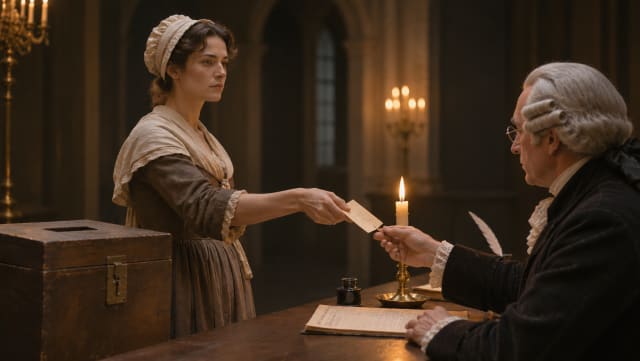
Historians who study the early American republic often warn against cheering too loudly for New Jersey. Their objection is simple. The state constitution of 1776 gave the vote to all inhabitants who were of full age and owned property worth fifty pounds, and nothing suggests that its authors, busy with a war, meant to enfranchise women or free Black residents. On this view the wording was a careless side effect, and the women who voted afterwards were using a loophole that nobody had noticed.
The objection has force. Married women could not hold property of their own, so only widows and unmarried women with the required wealth qualified, which was a small group. Women voting is also not clearly recorded in the early years, and the first explicit recognition in law comes only in 1790, when an electoral act for seven counties referred to voters as he or she.
Yet the loophole account has a weakness. A loophole should be narrow and closed quickly, but this one stayed open for three decades and was widened in 1797, when a new statute extended the same rules across the whole state. Women appear in surviving poll lists, and a survey of eighteen of them by a modern museum estimated that women cast about eight percent of the ballots. Federalists, in particular, are said to have courted them. A mistake that politicians repeatedly chose to keep begins to look like a decision.
Intent may not be the right test in any case. The historian Jan Ellen Lewis has argued that the drafting was careful, noting that early drafts used the word he before a gender neutral phrase replaced it, while earlier scholars such as Irwin Gertzog read the phrase as a reward to men who had backed the patriot side. The two readings explain the same text, and the surviving evidence cannot separate them.
The two readings explain the same text, and the surviving evidence cannot separate them.
The end came in 1807, after a bitterly disputed vote in Essex County over where to build a courthouse, in which fraud was alleged. The legislature answered by limiting the vote to free white male citizens, with broad support from both parties. Women and free Black voters, who had hardly started the quarrel, lost the right, and women in New Jersey regained it only in the twentieth century.
The episode is awkward for both camps. If the clause was an accident, the accident was kept for thirty years by people who understood it. If it was a design, the design was abandoned within a single season of scandal. In neither case does the story show a principle that failed, because no principle was ever clearly stated.
IPMAT verbal practice
This passage is written in the IPMAT style. Its 6 questions are just below in exam mode.
Discussion
Sign in to join the discussion.
More in Democracy & Rights

Equal Votes and Unequal Lives
Ambedkar warned that India was entering a life of contradictions, with equal votes and unequal lives. Seven decades later, the warning has neither expired nor been fulfilled.

The Lottery That Was Democracy
The Athenians who invented democracy filled most offices by lottery, and Aristotle called elections the mark of oligarchy. The word we use for our own system may belong to a different idea.

The World Is Becoming Medieval Again
Is the nation state losing its monopoly on power? Discover why the twenty first century increasingly resembles the political architecture of the Middle Ages.

The Art of Corporate War
An exclusive extract from Abhishek Leela Pandey's The Art of Corporate Power, exploring how capitalism transformed warfare into strategic competition.