Equal Votes and Unequal Lives
Ambedkar warned that India was entering a life of contradictions, with equal votes and unequal lives. Seven decades later, the warning has neither expired nor been fulfilled.

On the evening of 25 November 1949, as the Constituent Assembly prepared to close its work, B. R. Ambedkar rose to deliver a speech that was less a celebration than a warning. The Constitution would come into force on 26 January 1950, and the country would then enter, he said, a life of contradictions. In politics there would be equality, with each adult holding a vote of equal worth. In social and economic life there would continue to be inequality, with a structure that denied most people the standing the vote implied. He asked how long the country could go on denying equality in its social and economic life, and he warned that those who suffered from the inequality would one day blow up the structure of political democracy that the Assembly had laboured to build.
The scale of the wager is easy to forget. India adopted universal adult franchise at the moment of independence, when most of its people could not read, when caste still decided who could draw water from a well, and when the memory of famine and partition was fresh. In older democracies the vote had arrived in stages, extended over generations to property owners, then to men without property, then to women. India granted it to all at once, in the first general elections of 1951 and 1952, to an electorate that ran well past one hundred million and was largely unable to read. Election symbols were devised so that a voter could recognise a party without reading its name. It was an act of faith in ordinary people that few of the older democracies had ever made.
Discussion
Sign in to join the discussion.
More in Democracy & Rights

The Lottery That Was Democracy
The Athenians who invented democracy filled most offices by lottery, and Aristotle called elections the mark of oligarchy. The word we use for our own system may belong to a different idea.

The World Is Becoming Medieval Again
Is the nation state losing its monopoly on power? Discover why the twenty first century increasingly resembles the political architecture of the Middle Ages.

The Art of Corporate War
An exclusive extract from Abhishek Leela Pandey's The Art of Corporate Power, exploring how capitalism transformed warfare into strategic competition.
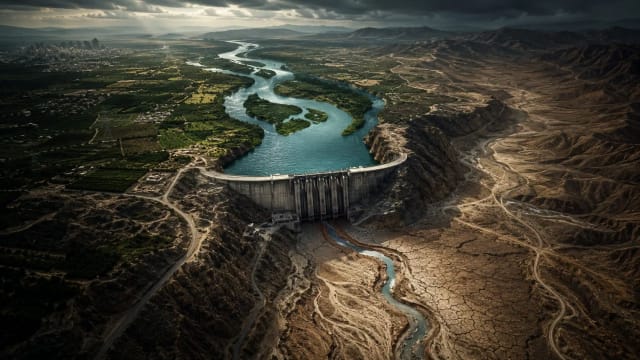
Can Water Become a Weapon?
Water is rarely a weapon by itself. But when control over its flow creates unequal dependence, rivers can become instruments of geopolitical power.