The First Patient of the Talking Cure
The patient who gave psychoanalysis its founding case was said to have been cured by talking. The records tell a more troubled story, and neither version explains what actually helped her.
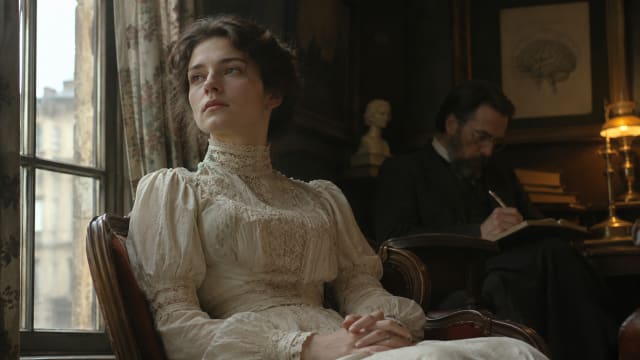
In the history of psychoanalysis the first patient is usually presented as a cure. A young Viennese woman, known in print as Anna O, was treated between 1880 and 1882 by the physician Josef Breuer for paralysis, hallucinations and sudden changes of language. She herself named the method the talking cure, and Breuer wrote that each symptom vanished once she had described its first appearance. The case has often been described as the starting point of Sigmund Freud's own discoveries.
The claim was easy to believe. Breuer published it in the Studies on Hysteria of 1895, written together with Freud, and the account is orderly, with a patient who improves in step with each recalled memory and ends the story healthy. Doctors of the period had few explanations for hysteria and fewer treatments, so a method that seemed to dissolve symptoms by words alone was both new and hopeful.
The woman behind the pseudonym also seemed to confirm it. She was Bertha Pappenheim, born in 1859, who in 1895 became house mother of an orphanage for Jewish girls near Frankfurt and in 1904 founded the League of Jewish Women. She campaigned against the trafficking of women and translated Mary Wollstonecraft into German. A person who built such institutions, the reasoning ran, must have been well, and the case history had said she was.
A person who built such institutions, the reasoning ran, must have been well, and the case history had said she was.
Doubts began in 1972, when the historian Henri Ellenberger, drawing on records from the period, reported that Breuer's picture of her recovery by June 1882 did not match them. At Breuer's request she was admitted to a sanatorium at Kreuzlingen in Switzerland, where she stayed until late October 1882, and her condition had not improved. Later scholars, among them Mikkel Borch Jacobsen, went further and argued that the case should be counted as a failure.
Even this reversal is not tidy. Breuer's text claims a recovery that the records do not support, but the records do not show how she felt by the end of the 1880s, and Pappenheim, by later accounts, refused to speak of the treatment and did not want it discussed. The talking cure was neither a hoax nor a success, and the woman it was named after seems to have recovered by means that nobody wrote down.
What remains is a founding story whose central fact is missing. If her symptoms eased, something other than the telling may have eased them, and if the telling helped, no one recorded how. A method was built on a recovery that cannot be found, and the one person who might have explained it chose silence.
XAT verbal practice
This passage is written in the XAT style. Its 3 questions are just below in exam mode.
Discussion
Sign in to join the discussion.
More in Psychoanalysis

Freud Was Wrong. Electra Was Right.
Psychology discarded the Electra Complex, yet literature never did. Why do daughters still struggle to inherit a father's legacy without losing themselves?

Haunted by Design: Why We See Ghosts in Empty Rooms
Ghosts may not haunt houses, but minds. This essay explores how perception, grief, and memory turn absence into presence.

Sexiness Is Not a Property of the Body
Beauty can be catalogued but desire keeps slipping out of the list, which suggests that attraction lives in a relationship and not in a body.

The Forgotten Third of Our Lives
Why can't we remember our dreams? Discover how REM sleep, memory, and evolution shape the forgotten third of our lives.