Haunted by Design: Why We See Ghosts in Empty Rooms
Ghosts may not haunt houses, but minds. This essay explores how perception, grief, and memory turn absence into presence.

Midnight in an old house is an acoustics experiment. Timber contracts. Pipes murmur. The staircase ticks like a cooling metronome. Yet when the hallway exhales and a shadow hesitates at the door, the mind supplies a tenant, a ghost. The scene feels ordinary, almost mechanical, yet the feeling it produces resists reduction. Sound becomes presence, silence becomes intention, and the empty corridor acquires a gaze that seems to return our own.
People do see ghosts. Across cultures, surveys record apparitions, sensed presences, and the pressure on the chest at 3 a.m. The dispute is not about whether such experiences occur, but about what they mean. Do they justify belief in disembodied persons, or do they reveal something more intimate about the mind that perceives them. A disciplined answer begins with restraint. When explanations compete, the one that requires fewer invisible forces often proves more durable.
Neurobiology and environmental physics offer a dense and persuasive account. Grief heightens the detection of agency, and the bereaved often hear the dead because attachment tunes perception toward what is lost. Sleep paralysis blends dream imagery with waking awareness, holding the body still while projecting a figure at the bedside. Low frequency vibrations from wind or distant machinery can induce unease and visual distortion. Carbon monoxide leaks can produce confusion, dread, and even vivid apparitions. The brain, trained by evolution to detect danger in uncertain signals, prefers false alarms to missed threats. It fills the dark with actors because survival once demanded it.
Believers respond that explanation does not cancel reality. Science has reversed itself before. There was a time when stones falling from the sky were dismissed as superstition, yet meteorites later proved otherwise. Perhaps ghosts are rare events that current tools fail to capture. The caution deserves respect. Yet the comparison strains under scrutiny. Meteorites left physical traces, fragments that could be handled and studied. Ghosts leave testimony, often sincere and deeply felt, but resistant to verification. When instruments enter the haunted room, the phenomena tend to fade. Measurement narrows the space in which spirits appear.
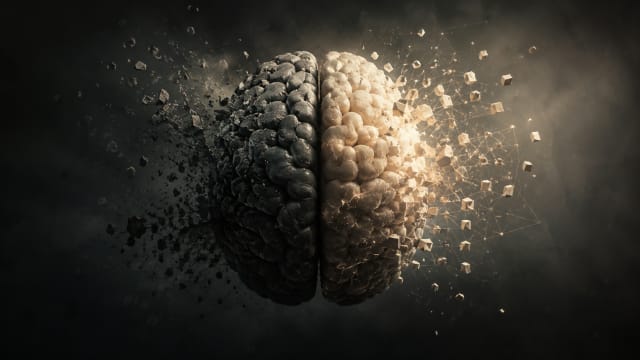
We do not merely encounter ghosts, we construct them, shaping absence into presence through memory and expectation.
Still, reduction can feel insufficient, even cold. After a death, a house does seem inhabited. Objects remain in their habitual places, carrying the imprint of routine. A cup on a table, a chair slightly turned, a silence that seems to listen. Memory rehearses the voice of the absent until it acquires a strange autonomy. In this sense, the ghost becomes a figure that stands in for a life that once animated the space. To say that one is haunted is to admit that attachment resists disappearance. The apparition is not a visitor from elsewhere, but a pattern the mind refuses to erase.
This perspective does not diminish the experience, it deepens it. The wonder lies not in spirits moving through walls, but in the capacity of matter to register loss. Neurons can ache, circuits can simulate presence, and a brain composed of cells can generate the felt reality of someone who is no longer there. The ghost becomes evidence not of another world, but of the depth of this one.
When the hallway exhales, it is worth pausing before surrendering to fear. Turn on the light, observe the angles, listen to the settling of wood and air. Yet keep the poetry intact. The world, even without spirits, remains layered with meaning. What haunts us is not the persistence of the dead, but the persistence of connection, which lingers long after the body has gone.
Discussion
Sign in to join the discussion.
More in Psychoanalysis

Freud Was Wrong. Electra Was Right.
Psychology discarded the Electra Complex, yet literature never did. Why do daughters still struggle to inherit a father's legacy without losing themselves?

The Forgotten Third of Our Lives
Why can't we remember our dreams? Discover how REM sleep, memory, and evolution shape the forgotten third of our lives.
What Happens When You Actually Change Your Mind: An RC Inspired by IIM Indore
Most arguments do not change minds. They change voiced positions. Genuine belief revision is neurologically different, phenomenologically distinct and far rarer than it appears.

I Thought Everyone Saw the World This Way
A reflective essay on teenage love, mathematical thinking, and why I instinctively translated people, emotions, and the world into algebra.