The Soft Tissue in a Tyrannosaur Bone
A fossil bone yielded flexible structures that looked like blood vessels, and the argument over what they are and why they survived has not ended.
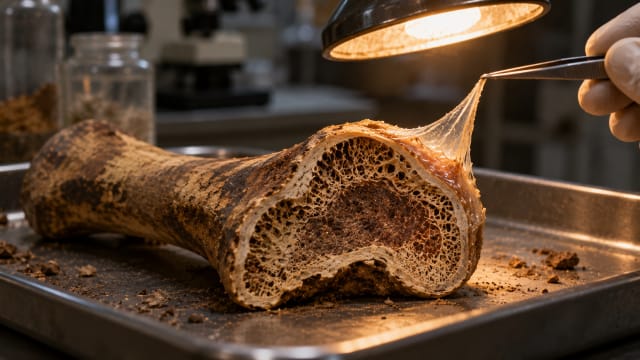
In 2005 Mary Schweitzer and colleagues reported that a thigh bone of Tyrannosaurus rex, dated to roughly 68 million years ago, contained flexible, branching, vessel like structures once its mineral had been dissolved away. The finding was surprising because proteins were expected to break down over far shorter spans. In 2013 Schweitzer's group proposed that iron released from the animal's own blood as it decayed may have bound and stabilised nearby tissue, much as a chemical fixative does. Other researchers have argued that some of the structures could instead be films left by microbes that moved into the bone. The two accounts are not mutually exclusive, and neither has yet explained how often such preservation should be expected.
GRE reading practice
This passage is written in the GRE style. Its 2 questions are just below, and you can take them on a GRE-style exam screen.
Discussion
Sign in to join the discussion.
More in Palaeontology
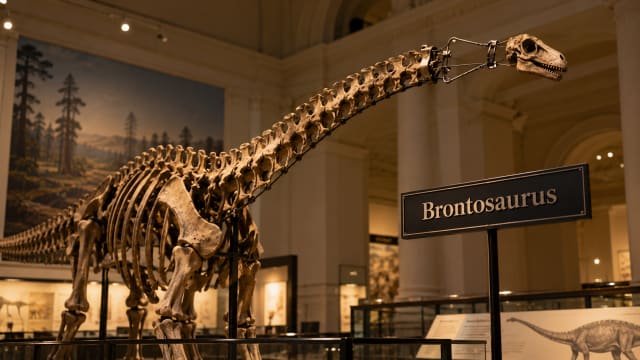
The Dinosaur That Was Struck Off and Brought Back
A famous dinosaur lost its name in 1903 and regained it in 2015. Whether it deserved to depends less on bones than on where scientists draw lines.
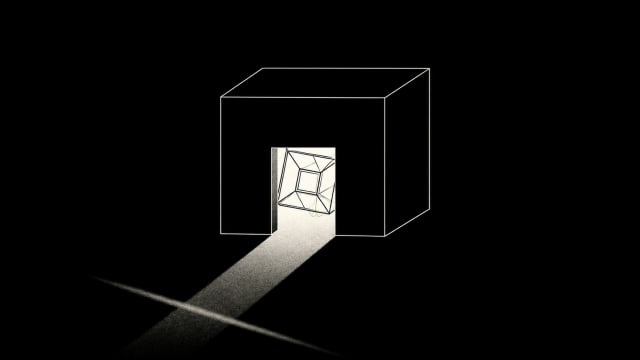
Would a Fourth Dimensional Being Be a God?
A thought experiment in higher dimensions asks whether what looks like a miracle might simply be reality viewed from a geometry we cannot perceive.

Why Humans Have the Largest Penis Among All Primates: An RC Inspired by IIM Indore
Desmond Morris had a simple answer. Modern biology has a more complicated one. What changed between 1967 and now reveals as much about science as it does about human anatomy.

The Exam Einstein Never Failed: An RC Inspired by IIM Indore
The story of Einstein failing his exams has survived a century of correction. The reason it survives tells you more about human psychology than it does about Einstein.