Would a Fourth Dimensional Being Be a God?
A thought experiment in higher dimensions asks whether what looks like a miracle might simply be reality viewed from a geometry we cannot perceive.
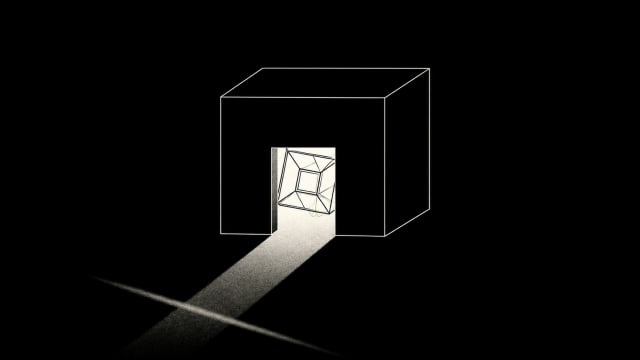
A locked room is a profound thing only if you live in three dimensions. Imagine instead a creature living on a sheet of paper. Its universe is flat. It knows only two directions and its walls are absolute. A sealed square is a prison. Then one afternoon something impossible happens. A strange object appears inside the room without opening the door. It changes shape, grows and shrinks and disappears again.
The creature has witnessed no miracle. It has witnessed a sphere passing through its two dimensional world.
What looks like a miracle may sometimes be nothing more than an ordinary event viewed from the wrong geometry.
Carl Sagan used a version of this thought experiment in Cosmos, drawing on Edwin Abbott's Flatland. His point was not that higher dimensional gods exist. It was that inhabitants of a lower dimensional universe might misinterpret perfectly ordinary events occurring from a dimension they cannot perceive. A sphere crossing Flatland would appear at different moments as a point, then a growing circle, then a shrinking one. The whole object would remain invisible because the Flatlanders could see only its intersection with their world.
Now increase every dimension by one. We become the Flatlanders.
A four dimensional spatial object is as difficult for us to picture as a sphere would be for a perfectly two dimensional creature. Mathematics, however, does not require imagination to operate like eyesight. A tesseract can be defined precisely even though no human observer can look at it in its entirety. We can calculate its geometry, project it into three dimensions and study the shapes that such projections produce. This distinction between seeing and knowing matters.
Our inability to visualise a fourth spatial direction tells us something about our brains and our sensory apparatus. It does not necessarily tell us that such a direction cannot exist. Mathematics can move beyond the architecture of the senses.
Physicists have gone further than thought experiments. The idea of extra dimensions entered modern physics with Theodor Kaluza and Oskar Klein, who explored whether an additional spatial dimension could help unify gravity and electromagnetism. Their original proposal did not become a complete description of nature, but the idea survived. Extra dimensions later became important in string theory and other attempts to understand fundamental physics.
In 1999, Lisa Randall and Raman Sundrum proposed a striking model in which our observable universe could be associated with a three dimensional brane embedded within a higher dimensional spacetime. Their motivation was not theological. They were trying to address a deep problem in particle physics concerning the enormous difference between the strength of gravity and that of the other fundamental forces.
This is where the theological metaphor becomes tempting. A higher dimensional being could possess abilities that would look miraculous to us. Just as we can look down upon a two dimensional drawing and see its entire interior, a four dimensional observer might have a radically different relationship with our three dimensional spaces. A sealed room would no longer be an absolute boundary. An object might appear inside it without travelling through any route available to us.
To the Flatlanders, such a being might look omnipotent. But here the analogy must stop.
A higher dimension does not automatically produce omniscience, moral perfection or infinite power. A four dimensional creature would not therefore be God. It would simply have access to a direction we lack. Physics offers no evidence that supernatural beings inhabit extra dimensions. Research into extra dimensions remains theoretical and experimentally constrained.
Yet the thought experiment leaves behind something more unsettling than proof. Perhaps the real lesson is not that God might live above us. It is that our concept of the impossible may be provincial. A fish might mistake the surface of its pond for the boundary of existence. A Flatlander might mistake its plane for the whole of space. We may be doing something similar when we treat the limits of human perception as the limits of reality.
The fourth dimension does not give us heaven. It gives us a warning.
What looks like a miracle may sometimes be nothing more than an ordinary event viewed from the wrong geometry.
Discussion · 1
Our perception is limited, so we may call unfamiliar things miracles. A 4D being could seem godlike because we cannot perceive its dimension. But higher-dimensional power does not mean divinity. The essay reminds us that reality can be bigger than human senses and imagination.
Sign in to join the discussion.
More in Mathematics

Abraham Wald and the Missing Bullet Holes
The statistician Abraham Wald is credited with telling the military to armour the parts of its bombers that showed no bullet holes. The advice sounds backwards until a reader asks which planes were never seen.

The Number Europe Refused
Indian mathematicians were calculating with zero by the seventh century. Europe's bankers banned the numerals that carried it, and the word for it still holds the suspicion.
The Mathematician Who Said No - An RC Inspired by IIM Indore
In 1990 a magazine columnist gave a correct answer to a game show puzzle and was buried in angry letters from people with doctorates. The mistake that followed reached the greatest mathematicians too.
Before Evolution, Geometry Chose the Winners
Long before natural selection shaped life, the geometry of space had already determined which organisms could exist and which never could.