The Barcode Waited for Agreement and Not for Invention
The patent for the barcode is older than most of the shoppers who have scanned one, and its long delay owed as much to coordination as to technology.
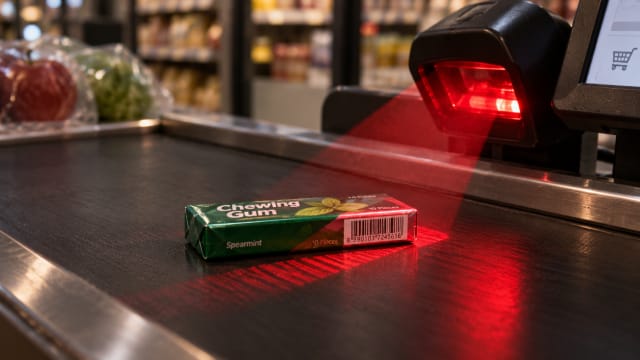
The barcode is usually presented as an invention that arrived ahead of its time. Norman Woodland and Bernard Silver filed their patent in October 1949, and it was granted in 1952, yet the first product scanned at a shop checkout, a pack of Wrigley's gum at a Marsh supermarket in Troy, Ohio, was not rung up until June 1974. The long gap invites the story of a clever idea waiting for better hardware, and hardware did matter, since small computers and lasers made fast scanning practical. But hardware alone does not explain why the idea idled for a generation.
A second obstacle was coordination. A scanner is worthless unless products carry a code, and a code is worthless unless shops own scanners. Manufacturers had little reason to print symbols that no checkout could read, and retailers had little reason to buy machines that read nothing. Rival codes would have made matters worse, since every manufacturer would have printed several versions and every shop would have read several. The breakthrough came in April 1973, when a committee of the supermarket industry chose a design by George Laurer, an IBM engineer, from seven submissions. The scheme worked because every party could now expect the others to move.
The lesson reaches beyond groceries. Where a technology becomes useful only when many independent parties adopt it together, the decisive invention may be the agreement and not the device. Credit given to an inventor for a patent therefore risks hiding the quieter work of standard setting, which in this case was not finished until 1973. Whether the authors of the standard deserve more recognition than they have received is a fair question, but it is plainly the standard, and not the patent, that carried the barcode onto the packaging of most of what shops now sell.
GMAT reading practice
This passage is written in the GMAT style. Its 4 questions are just below, and you can take them on a GMAT-style exam screen.
Discussion
Sign in to join the discussion.
More in History of Technology
The Machine IBM Built and the Standard It Could Not Keep
IBM created the personal computer industry in a year. A decision made to save time left the profits of that industry with two of its suppliers.

The Monk's Error, The Model's Echo
AI systems increasingly learn from text that earlier AI systems wrote. History has seen this error before, in monasteries.

The Loneliest Relationship Is Not With a Robot
Artificial companions do more than imitate intimacy. They expose the hidden assumptions that have always shaped how humans recognise love.

What the Algorithm Cannot Taste
Every major technology company is racing to quantify human experience. The one thing they cannot quantify is the reason the race matters.