What the Algorithm Cannot Taste
Every major technology company is racing to quantify human experience. The one thing they cannot quantify is the reason the race matters.

There is a distinction that the language of data systematically erases. It is the distinction between measuring a thing and knowing it. A spectrometer can analyse the chemical composition of a ripe mango with extraordinary precision, cataloguing its sugars, acids, and volatile compounds down to the parts per billion. What it cannot do is tell you whether the mango is good. That judgment belongs to a tongue, to a memory, to a person standing in a kitchen with the fruit in their hand. The spectrometer produces information. The person produces knowledge of a different kind, embodied, contextual, and stubbornly resistant to being entered into a spreadsheet.
The ideology now dominant in Silicon Valley holds that this resistance is a temporary engineering problem. Given enough data, enough processing power, and enough time, every human preference can be modelled, predicted, and replaced by a more reliable computational proxy. Call it what it is: the belief that subjectivity is a bug, and that the correct version of human experience is one from which the human has been quietly removed. Smart kitchens learn your preferences and cook without you. Recommendation engines decide what you want to read before you have finished wanting it. Each of these is a genuine achievement. Each of them is also a step in the same direction: the progressive substitution of lived judgment with computed output.
The substitution is not neutral. When a platform's algorithm decides which music reaches listeners, it does not merely reflect existing taste. It shapes future taste by amplifying what already performs well and starving what does not yet have an audience. The metric becomes the standard. Virality becomes the definition of quality. This is not an accident of design. It is the logical consequence of treating preference as data: once you can measure something, you can optimise for it, and once you optimise for it, you have changed what it means. The map does not merely represent the territory. In this case, the map redesigns the territory to match itself.
The counterargument should be taken seriously. Computation has extended human capability in ways older methods of judgment could not. A radiologist who examines a thousand scans a year cannot develop the pattern recognition of an algorithm trained on ten million. A music streaming service that knows a listener's history can surface recordings a human curator would never have thought to recommend. These are real gains, and dismissing them as mere efficiency is a form of nostalgia that helps nobody. The question is not whether computation is useful. It is whether usefulness is the only thing that matters, and whether what computation cannot capture is worth preserving.
What computation cannot capture is the experience of encountering something for the first time without having been pre-sorted toward it. The discovery that happens when a reader picks up a novel a friend thrust into their hands, not because an algorithm identified it as compatible with their reading history, but because the friend believed it would change something. These experiences are not merely pleasant. They are the mechanism by which taste develops into something more than preference, into judgment, which is the capacity to evaluate rather than merely respond.
The smart kitchen is a useful lens. An oven that learns to cook a dish to the specifications its owner has historically enjoyed will produce a reliable result. What it will not produce is the meal that departs from those specifications in a way the owner had not known they wanted. It cannot cook towards a preference that does not yet exist. This is not a failure of processing power. It is a structural limitation of optimisation itself: to optimise for a target, you must already know what the target is. Every genuinely new experience is, by definition, outside the training data. The algorithm can reproduce the past with uncanny accuracy. It has no access to the future that has not yet been tasted.
Discussion · 6
The passage begins by discussing how humans measure and understand objects, then shifts to how AI and algorithms process data to predict human preferences through recommendations. The author acknowledges that computation has extended human capabilities but argues that data-driven systems also remove something worth preserving: the possibility of genuinely new experiences. Algorithms can predict the past with uncanny accuracy because they rely on existing data, but they cannot fully predict the future or what we may come to like through new and unforeseen experiences.
Good !! Aaap apne dream B-School aa sakte hai
Good summary. I'd add one subtle distinction, though: the argument isn't simply that algorithms struggle to predict the future because they rely on past data. It's that human preferences can be *created* by experiences we wouldn't have known to seek out in the first place. The problem isn't merely prediction; it's the assumption that what can be measured can also define what is worth experiencing.
The passage begins with introducing the idea of the difference between measuring something and knowing about it, illustrating the idea by the example of the spectrometer and the mango. Then the author introduces the claim by Silicon valley and their ideology that is distinction is nothing but a temporary engineering problem, and with enough time and resources, subjectivity which is a bug will be fixed and lived judgement would be turned into computational output. But the author makes the argument that no matter how much is optimised, we cannot optimise towards targets we dont know yet, the future we havent seen and neither can it recreate the past with absolute accuracy.
Good !! Aaap apne dream B-School aa sakte hai
You've captured the central argument well. One small distinction, though: the passage doesn't suggest that algorithms cannot recreate the past accurately; it explicitly acknowledges that they can. The limitation lies elsewhere: an algorithm can optimise for preferences that already exist, but it cannot know what we might come to value through an experience we would never have thought to seek. The problem isn't the accuracy of prediction, but the limits of treating prediction as a substitute for discovery.
Sign in to join the discussion.
More in Artificial Intelligence
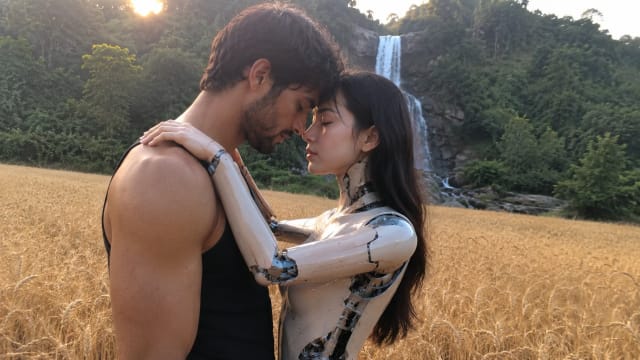
The Loneliest Relationship Is Not With a Robot
Artificial companions do more than imitate intimacy. They expose the hidden assumptions that have always shaped how humans recognise love.

The Monk's Error, The Model's Echo
AI systems increasingly learn from text that earlier AI systems wrote. History has seen this error before, in monasteries.
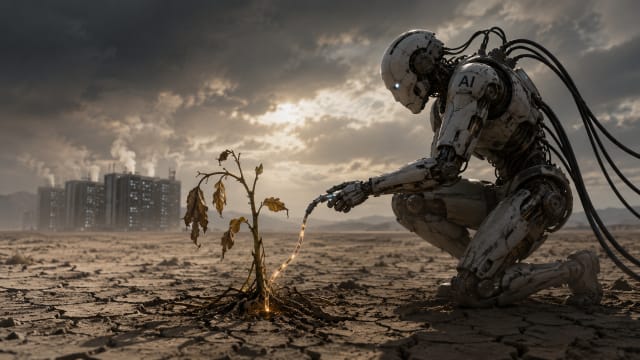
The Cloud Was Always a Factory
Artificial intelligence is reshaping the world, but hidden datacenters, rising energy use, and ecological costs reveal the true price of the AI revolution.

The Myth of the Human Artist
Why does AI art feel inhuman? A philosophical essay on creativity, technology, authenticity, and the shifting meaning of artistic expression.