The Word Nobody Invented
A Disney nanny sang a thirty four letter word in 1964 and the Sherman brothers claimed to have made it up. A court disagreed, and the dispute exposes how little anyone knows about where words come from.
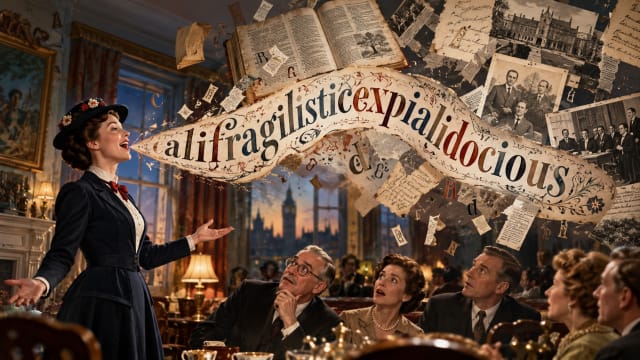
In 1964 a Disney nanny sang a word of thirty four letters to a room of baffled adults, and it later earned a place in major dictionaries. The Sherman brothers, who wrote the song, said they had coined it as boys at summer camp, where long nonsense words were a way of sounding grand. The lyric even supplies a gloss in which cali means beauty, fragilistic means delicate, expiali means to atone and docious means educable. The gloss is a joke about etymology, though it has etymology's confident shape.
The claim of invention did not survive scrutiny. In 1965 the authors of an earlier song containing a nearly identical word sued over the film, and the case surfaced evidence that variants had circulated for years, including a 1931 student newspaper from Syracuse that printed a close cousin. The court concluded that the word was already in public use, so that no one could be said to own it. The Shermans' memory of camp may well be true. It shows only that a boy can reinvent a word that others have also invented, or borrowed, or overheard.
This is stranger than it sounds. Ordinary words come with a family tree that lets a speaker guess the meaning, as unhappiness is built from happy. Here the parts are decorative, and the stated meanings were assigned after the fact to give the sound a pedigree. A word with no parts that anyone can verify still arrives with a meaning that everyone shares. Dictionaries define it as an expression of delight or as something to say when there is nothing to say, and speakers know at once which one is meant.
A word with no parts that anyone can verify still arrives with a meaning that everyone shares.
A sceptic would call all this a novelty. Real words, the objection runs, are used in earnest, whereas this one is almost always quoted, sung or pronounced with a wink. It is a performance of vocabulary and not a member of it. The reply is only partial. Speakers do use it sincerely, in the manner of any interjection, and the habit of quoting is not unique, since plenty of respectable words are spoken mostly with a certain irony. Yet the objection exposes something real, which is that the word's whole meaning is its own display of length. It signifies by being absurdly large and by being said anyway.
The deeper implication concerns every other word. If meaning lives in agreement among speakers and not in parts or authorship, then no word has an inventor in the strict sense, only a first witness whom history failed to record. The Sherman brothers did not create this word so much as catch it in mid flight, much as someone must once have caught the sounds that became okay, a word whose supposed origins are likewise argued over. The song says the word is what to say when you have nothing to say. Yet millions have said it and understood one another perfectly, which suggests that nothing, repeated often enough in the right company, becomes something. When exactly that happened, and who agreed first, is a question that no lawsuit and no dictionary has answered.
Discussion
Sign in to join the discussion.
More in Language & Linguistics

How a Modest Note About Snow Became a Hoax
A careful remark in 1911 about four Arctic roots for snow grew into the belief that whole peoples live in different worlds. The belief is easier to repeat than to test.
The Word We Do Not Have: An RC Inspired by IIM Indore
There is no Hindi word for independence. My mother told me this once, without ceremony. It took years to understand what she meant.
Why Every Language Has a Word for Snow: An RC Inspired by IIM Indore
The Inuit do not have fifty words for snow. But the story refuses to die because it points toward something real. Does the language we speak shape how we think?
Gen Z's New Names for Ancient Problems
A chance encounter with Gen Z slang in Kasol becomes a reflection on language, philosophy, memes, history, and what it means to be human.