Why Festivals Survive Modernity: An RC on Rakshabandhan
Every generation predicts that urbanisation and busy schedules will kill traditional festivals. Every generation is wrong. The reason has less to do with sentiment than with function.
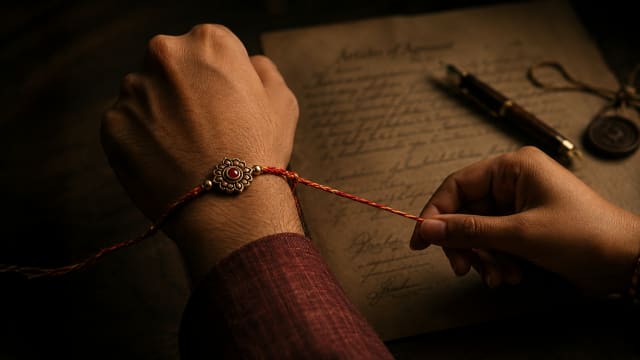
Every generation produces its own version of the same prediction. Urbanisation will dissolve traditional festivals. Nuclear families will make collective rituals impractical. Busy schedules will crowd out ceremonial time. The prediction has been made about Diwali, about Eid, about Christmas, about Rakshabandhan. It keeps being wrong. This persistence requires explanation, but the explanation that comes most readily is also the least satisfying.
The familiar account appeals to sentiment. People maintain festivals because of childhood memory, because of the emotional weight that inherited practices accumulate over time, because discontinuing them would feel like a small act of severance from something larger than the individual. This account has the advantage of being true. It has the disadvantage of explaining too little. Sentiment preserves. It does not by itself sustain active practice. A photograph is cherished. It is not repeated.
What sustains active practice is function. Festivals survive not because people feel warmly toward them but because they continue to do something that needs doing. The question is what, exactly, that something is. Here the answer is less obvious than it appears.
The obvious answer is that festivals maintain relationships. Rakshabandhan creates a fixed point at which siblings separated by distance and absorbed in different lives are expected to make a gesture of connection. The festival does not merely celebrate the relationship. It services it. But this answer, while accurate, does not yet explain why the festival form is necessary. One might equally service a relationship through a phone call or a visit. The festival must be doing something that the phone call does not.
What it does is remove the problem of initiation. A spontaneous contact requires someone to decide that the relationship needs attention, to act on that decision, and to absorb whatever awkwardness attaches to the gesture. The festival externalises this decision. It creates a shared expectation, agreed to in advance, that the contact will happen and will take a particular form. The rakhi is tied. The gift is given. The meal is shared. Nobody had to decide that this was a good moment to reinforce the relationship. The calendar decided.
This is the function that modernity has not weakened but intensified the need for. Traditional joint family structures maintained relationships through proximity. Proximity required no ceremony because the relationship was continuously present. When proximity dissolved, the relationship did not dissolve with it, but it lost its automatic maintenance mechanism. The festival moved from supplementary to necessary. It did not survive despite the change in family structure. It became indispensable because of it.
A festival that survives because it is functionally necessary is not quite the same thing as a festival that is culturally alive.
But there is a complication. A festival that survives because it is functionally necessary is not quite the same thing as a festival that is culturally alive. A practice can be maintained for instrumental reasons while its original meaning drains away. The rakhi sent by courier, the video call timed to the ritual moment, the digital transfer that replaces the pressed note, these are functional equivalents of the original gestures, but they are not identical to them. Whether they preserve the festival or replace it with something that resembles it from the outside is a question the functional account cannot answer.
The festival survives. What survives inside it is less certain.
Discussion · 2
Rc Type: Critical Analysis of festivals and the functionality behind it. Tone: Skeptical and Critical In this passage, the author dwells on the central theme of the functional necessity of festivals in modern society. The author also sound skeptical about the liveliness of a festival against survival of it. Author describes festivals as a solution to the problem of initiation. It helps people to overcome the awkwardness of mantaining relationships and taking ownership to initiate one after a long pause. Festivals being calender bound by default revives bond. Eventually, they become indespensible for long proximate relationships to maintain a bond. However, the author is critical about the real meaning of festivals; as physical presence during such festivals are replaced by digitalization, calling them culturally alive is skeptical. Hence, author is concerned about the soul of the festivals giving way to their functionality.
According to the passage, every generation assumes that urbanisation will enervate the traditional festival, but the prediction keeps being wrong. festivals help in strengthen the relationship and create a space for relationship where it absorbs and externalise the initiation gesture of deciding that the relationship needs attention. In modern society, participation in festival through digital ways is equivalent to original gesture but are not identical. therefore, festival survives, what survives inside it is less certain
Sign in to join the discussion.
More in Sociology

Why Lizzie Borden Was Acquitted: An RC Inspired by IIM Indore
The evidence against Lizzie Borden was strong. The jury acquitted her in ninety minutes. What happened in that room had very little to do with the evidence.

The Blue Tick and the Body
How smartphones, dating apps, and blue ticks changed the grammar of consent in modern intimacy and digital relationships.

The Gothic Geometry: Architecture, Ambiguity, and Cultural Refusal
Gothic fashion returns whenever civilizations grow emotionally exhausted, transforming darkness, grief, and elegance into cultural resistance.

The Lisbeth Salander Paradox: Hacking, Power, and the Failure of the State
Stieg Larsson’s The Girl with the Dragon Tattoo explores surveillance, institutional violence, and Lisbeth Salander’s war on power.