CSAT Comprehension Set on Support Prices, Urban Heat and Mother Tongue Teaching
Three short passages in the style of UPSC Prelims Paper II, on a price guarantee that steers farmers, a city that runs hot, and the language a child first learns in.
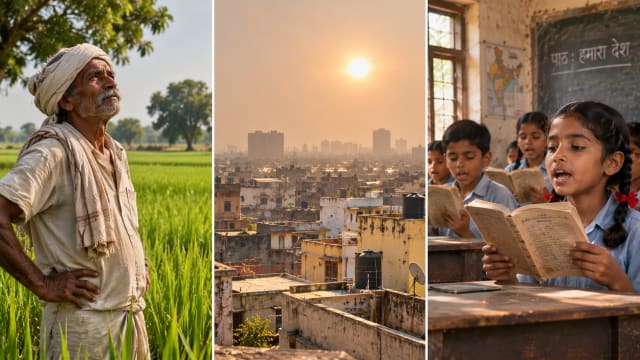
Passage 1
The minimum support price is a promise, not a purchase. The government announces it each season for twenty two mandated crops, but it buys at that price in large volume mainly where it has built procurement machinery, which in practice has meant wheat and rice in a handful of states. A farmer in those states faces a market that is certain, while a farmer growing pulses or coarse cereals faces one that is not. Cropping patterns respond accordingly. Over time the assured crop expands, even where water is scarce, and the uncertain crop shrinks, even where soil and climate suit it. Critics describe this as a distortion, but defenders reply that a farmer cannot be asked to bear a price risk that only the state is able to absorb. The difficulty is that a guarantee offered to some crops and not to others is itself a signal about what to plant, and signals persist long after the conditions that justified them have changed. Extending the promise to every crop would be costly and might distort prices further, whereas leaving it unchanged would preserve the pattern it created.
Passage 2
Cities are warmer than the countryside around them, and the reason lies less in the heat that cities generate than in what they are made of. Concrete, asphalt and dark roofs absorb sunlight by day and release it slowly at night, so the usual overnight cooling is weakened. Trees work in the opposite way, since they shade surfaces and also lose water from their leaves, which draws heat out of the air. Planting trees is therefore often proposed as a remedy for urban heat. Yet trees need water, and in a city where supply is already rationed, a canopy may compete with households for the same resource. Some planners therefore prefer reflective roofs and light coloured pavements, which need no water but provide neither shade nor any benefit for air quality. It would be a mistake to treat these approaches as rivals, because shade, reflection and ventilation act on different parts of the problem, but it would be equally mistaken to expect any one of them to restore the temperature a city would have had without its buildings.
Passage 3
The National Education Policy of 2020 recommends that, wherever possible, the medium of instruction until at least Grade 5, and preferably until Grade 8 and beyond, should be the home language, the mother tongue or the local language. The recommendation rests on a simple observation, that a child learns new ideas more easily in a language she already speaks. Yet the observation does not settle the policy. In many classrooms the home language of the children differs from the regional language of the state, and a single school may serve children of several mother tongues. Parents, moreover, often see English as the gateway to employment and may judge a school by how early it teaches the language, whatever its results. A policy that ignored these views would be resented, and a policy that simply followed them would defeat its own purpose. The more promising path treats the home language as the language in which understanding is built and English as a subject taught well alongside it, so that the child is not forced to choose between comprehension and opportunity.
UPSC CSAT comprehension practice
This passage is written in the CSAT style. Its 6 questions are just below in exam mode.
Discussion
Sign in to join the discussion.
More in Inequality & Development

The Temples of Modern India and the Villages Beneath Them
India built its great dams in the name of the many, and the reservoirs rose over the homes of a few. The question of who may be asked to pay for a public good has never been fully settled.
The Granary and the Water Table
India ended its dependence on imported wheat within a decade, and the methods that delivered plenty are now draining the soil that grew it. Can a nation judge a success whose bill arrives half a century late?

The AI Divide: Who Gets to Design the Future of Work?
As AI reshapes the global workforce, a new inequality is emerging. The real divide is not who uses artificial intelligence but who designs it, and without women in the architect's seat, tomorrow's algorithms may quietly inherit yesterday's biases.

Losing Feels Worse Than Winning Feels Good: An RC Inspired by IIM Indore
Kahneman and Tversky found that losses tend to weigh more heavily than equal gains. How much more is still debated, and economics has not been the same since.