The Granary and the Water Table
India ended its dependence on imported wheat within a decade, and the methods that delivered plenty are now draining the soil that grew it. Can a nation judge a success whose bill arrives half a century late?
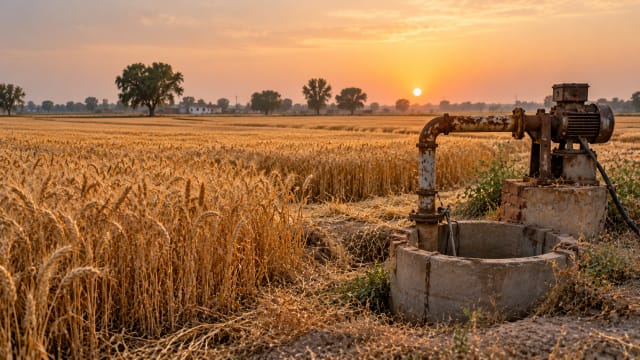
In the autumn of 1965 a war with Pakistan was followed by a failing monsoon, and India's food stocks were thin. The country was importing millions of tonnes of wheat from the United States under the PL 480 programme, and the prime minister, Lal Bahadur Shastri, is reported to have asked citizens to skip a meal each week. His slogan of that season, Jai Jawan Jai Kisan, joined the soldier and the farmer as the two defenders of the republic. Within a decade the country that had waited for foreign grain ships was building reserves of its own.
The change came from a bundle of decisions rather than a single miracle. The food minister C Subramaniam backed the import of high yielding dwarf wheat seeds that drew on the work of the agronomist Norman Borlaug, and scientists such as M S Swaminathan helped adapt them to Indian fields. The state guaranteed a minimum price, promised to buy the surplus, and subsidised fertiliser, electricity and irrigation. Punjab, Haryana and western Uttar Pradesh answered with wheat and later rice, and the national wheat harvest roughly doubled between the mid 1960s and the early 1970s. Famine, which had defined the memory of colonial rule, receded from the national imagination.
Discussion
Sign in to join the discussion.
More in Inequality & Development

The AI Divide: Who Gets to Design the Future of Work?
As AI reshapes the global workforce, a new inequality is emerging. The real divide is not who uses artificial intelligence but who designs it, and without women in the architect's seat, tomorrow's algorithms may quietly inherit yesterday's biases.

The Broken Rung: Where the Gender Leadership Gap Really Begins
The “broken rung” at the first promotion quietly disrupts the leadership pipeline, preventing many talented women from ever reaching the top.
Losing Feels Worse Than Winning Feels Good: An RC Inspired by IIM Indore
Losses hurt twice as much as gains feel good. Kahneman and Tversky called this loss aversion. Economics has not been the same since.

The Paragraph That Moved The Market
A central bank governor says a few sentences about the future, and prices shift before any policy actually changes. Why does mere belief move an economy?