Pirates Were the First Global Freelancers
Pirates built proto-freelance economies that exposed the hidden inequalities and structural failures of early global capitalism.
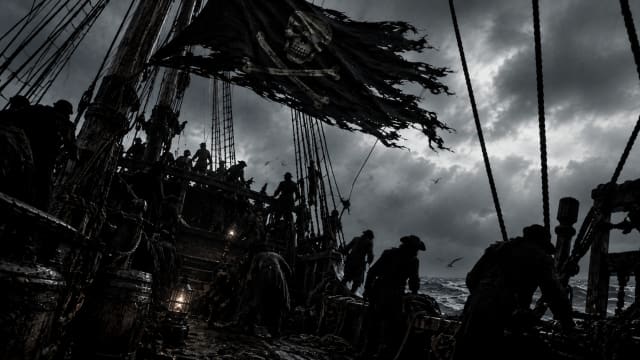
The standard image of the eighteenth-century pirate as a theatrical criminal with a bottle of rum and a pistol obscures a more revealing historical reality concerning labour, risk and the architecture of global trade. European maritime empires operated through highly centralized commercial systems sustained by brutal labour hierarchies. Merchant ships and naval vessels functioned less like workplaces than floating monarchies. Sailors endured starvation wages, disease, arbitrary punishment and near-feudal discipline while transporting the commodities upon which imperial wealth depended. Piracy emerged not outside this expanding global economy but inside its structural fractures. The pirate ship became an unauthorized labour system operating in the blind spots of mercantilist capitalism.
Contrary to the popular mythology of chaos and disorder, many pirate crews organized themselves through surprisingly sophisticated frameworks of collective governance. Captains were often elected and remained removable through majority consent. Loot distribution followed predetermined equity shares rather than aristocratic privilege or rigid naval hierarchy. Some pirate crews even established rudimentary compensation mechanisms for workplace injuries, creating primitive forms of mutual insurance long before industrial labour protections emerged within formal economies. These practices did not transform pirates into moral revolutionaries, but they did reveal a fundamental tension within imperial commerce itself. The institutions claiming to represent civilization frequently offered ordinary workers conditions scarcely distinguishable from coercion.
The pirate ship was not capitalism’s enemy. It was capitalism stripped of institutional decorum.
The rapid spread of piracy across the Atlantic world therefore reflected more than criminal opportunism. Pirate networks expanded because large numbers of sailors regarded imperial order as intolerable. Men rarely defect toward uncertainty unless certainty itself has become structurally oppressive. The pirate crew consequently functioned as a temporary refuge for displaced workers, escaped slaves, indebted sailors and individuals fleeing institutional violence. While pirate economies relied upon theft and coercion, they also exposed the inability of formal systems to distribute risk and survival with sufficient legitimacy to maintain obedience.
This structural contradiction continues to echo within contemporary freelance and platform economies. The modern freelancer does not resemble the pirate superficially, yet the organizational logic remains strikingly similar. Digital labour platforms promise flexibility, autonomy and entrepreneurial freedom while systematically transferring economic instability onto individuals. Workers gain operational independence but lose permanence, institutional protection and long-term security. The risks once absorbed by corporations migrate downward toward isolated workers operating within increasingly fragmented labour markets. Pirates accepted a far more violent iteration of the same bargain. Freedom from imperial hierarchy came paired with permanent precarity.
Some historians reject comparisons between piracy and modern freelance economies because such analogies risk romanticizing violence and criminality. The objection is understandable but ultimately incomplete. The historical significance of piracy lies not in moral legitimacy but in institutional diagnosis. Informal systems become attractive whenever dominant institutions grow too rigid, extractive or unequal to accommodate ordinary human frustration. Piracy revealed the hidden costs of early globalization precisely because it emerged from the same trade networks that enriched imperial powers.
Consequently, illicit economies should not be understood merely as historical anomalies or deviations from order. They represent adaptive responses generated by structural imbalance within larger systems. Whenever institutional frameworks lose the capacity to distribute dignity, risk and survival with perceived fairness, alternative economies emerge along the periphery. These systems may appear unstable or predatory, yet they frequently illuminate failures embedded within the dominant order itself.
Globalization did not merely create empires. It also created the men willing to rob them.
The enduring significance of the pirate ship therefore lies not in romantic mythology but in its diagnostic clarity. Beneath the imagery of black flags and cannon smoke existed an uncomfortable historical proposition. Economic systems rarely collapse because individuals reject order altogether. They fracture when institutional structures cease to offer terms of survival that enough people consider legitimate.
Discussion
Sign in to join the discussion.
More in Work & Labour

The Hawthorne Effect May Not Exist
For decades managers were taught that workers improve simply because they are watched. A reanalysis of the original lighting records in 2011 found little sign of it.

The Broken Rung: Where the Gender Leadership Gap Really Begins
The “broken rung” at the first promotion quietly disrupts the leadership pipeline, preventing many talented women from ever reaching the top.

Losing Feels Worse Than Winning Feels Good: An RC Inspired by IIM Indore
Losses hurt twice as much as gains feel good. Kahneman and Tversky called this loss aversion. Economics has not been the same since.

The Paragraph That Moved The Market
A central bank governor says a few sentences about the future, and prices shift before any policy actually changes. Why does mere belief move an economy?