The Ludovico Paradox
An inquiry into the Ludovico Paradox from A Clockwork Orange, exploring the systemic optimization of behavior versus the architecture of human choice.
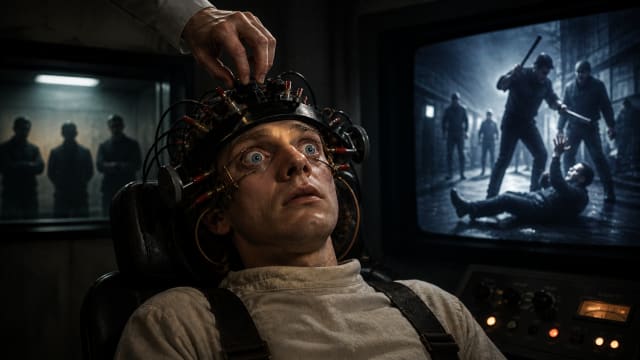
A man sits in a chair, eyelids pried open, not by curiosity but by force. The screen floods him with violence while a sickness coils in his gut. In A Clockwork Orange, this is called the Ludovico Technique, a cure that works by making evil physically unbearable. It is medicine as moral shortcut, therapy as coercion. The question is not whether it works, but what remains of a person once it does.
The technique rests on a simple premise drawn from classical conditioning. Pair a stimulus with pain often enough, and the body learns obedience. Violence becomes nausea, desire becomes dread. Behavior changes, predictably, measurably. The state achieves what prisons fail to do, it produces compliance at scale. Efficiency, finally, enters ethics, wearing the calm mask of science while hiding a deeper intrusion into the private architecture of the self.
But here is the fracture. Morality has never been about mere outcomes. It has always smuggled in choice. A man who refrains from harm because he cannot bear the bile in his throat is not virtuous, he is constrained. The Ludovico subject does not choose good, he is cornered into it. His will has not been educated, only hijacked. The body obeys, the self disappears, leaving behind a quiet mechanical imitation of goodness.
Defenders might argue that society does not need inner virtue, it needs external safety. If conditioning prevents harm, why fetishize freedom. After all, we already accept softer versions of this logic in schools, workplaces, even families, where incentives and punishments sculpt behavior. The difference, however, is one of degree that becomes a difference in kind. Ordinary conditioning leaves space for refusal, for rebellion, for the slow friction of conscience. The Ludovico Technique abolishes that space entirely. It does not guide the will, it replaces it.
This is why the experiment feels less like rehabilitation and more like redesign. The human being becomes a system to be optimized, not a subject to be persuaded. In that shift lies a quiet terror. Because once we accept that goodness can be engineered, we no longer need to ask what goodness is. We only need to enforce it, and enforcement has never been a patient teacher.
The deeper irony is that the technique solves the wrong problem with perfect precision. It eliminates the symptoms of violence while preserving the conditions that produce it, alienation, power, the thrill of transgression. The world becomes safer, perhaps, but also thinner. A society of conditioned citizens may be orderly, but it risks becoming morally illiterate, unable to distinguish between goodness chosen and goodness imposed.
And that is the aftertaste the idea leaves behind. Not horror at violence, but unease at its cure. Because a world without the possibility of evil is also a world without the possibility of meaning. The Ludovico Technique does not just reform the criminal, it quietly abolishes the human, replacing judgment with reflex, and conscience with a carefully engineered fear.
A man who cannot choose ceases to be a man, he becomes an outcome.
Discussion · 1
Wouldn't the world be a safer place if humans were to be conditioned to behave morally ?
Sign in to join the discussion.
More in Cinema

Odysseus and the Arc of the Hero
Odysseus embodies the hero’s journey not through victory alone, but through the losses, disguises and transformations that make returning home possible.

Why Walter Mitty Needed His Fantasies
Walter Mitty reveals that imagination is not an escape from reality but a rehearsal for courage, preparing us to become who we dare to imagine.

How Fight Club Became the Brand It Tried to Destroy
A film that condemned consumer culture became one of its most successful products, revealing how capitalism can package even rebellion.

Be Careful What you Wish For
Obsession is more than a horror film. It is a meditation on desire, love, fulfilment and the hidden cost of getting what we want.