Survival Is Not the Same as Identity
Derek Parfit's Reasons and Persons asks whether staying the same person is what people really want from survival, and the strongest replies to it show how much is left unsettled.

Derek Parfit's Reasons and Persons, published by Oxford University Press in 1984, advances a claim that sounds like an insult to common sense, namely that whether a person will exist tomorrow matters less than it seems. Philosophers had long treated personal identity as a puzzle, and Parfit moved the weight elsewhere. What matters in survival, he argued, is not identity as such but a relation that identity usually brings with it, psychological connectedness and continuity, the overlapping chains of memory, intention and character that link one stage of a life to the next.
His method is the thought experiment. In the best known of these, a traveller steps into a teletransporter, which scans and destroys her body on Earth and builds an exact replica from new matter on Mars. Most readers feel that she has died and that a copy has taken her place. Parfit then alters the case. Suppose the original is left alive on Earth with a damaged heart and a few days to live, while a replica wakes on Mars. Both claim to be her, yet both cannot be identical to her, because identity is a one to one relation. It nevertheless seems odd to say that what the traveller hoped to keep has been lost. If so, Parfit concluded, the thing worth wanting was the continuity, which the replica has in full, and not the strict identity, which it lacks.
A review of this argument must begin with its consolation. Parfit reported that adopting the view felt like leaving a glass tunnel in which he had been moving, and that his fear of his own death grew less. He observed that the view resembles Buddhist teaching on the absence of a fixed self, though his argument rests on reasoning and not on scripture.
The objections are equally serious. Critics have pointed out that the thought experiments depend on intuitions that may not survive the strangeness of the cases, and that a case no one could ever face is a weak guide to how real lives should be valued. Others, among them Marya Schechtman, have argued that a person is not merely a series of connected mental states but a being who lives a life with the shape of a story, in which earlier stages are owned and answered for. A replica that remembers a promise has not necessarily made it. On this view Parfit's reductionism leaves out the feature, responsibility across time, that makes identity matter in ordinary moral life.
Whether that conclusion follows from the metaphysics, or merely accompanies it, is the point the book leaves open.
Parfit anticipated part of this reply. He suggested that his view loosens the special concern a person feels for her own future and strengthens concern for others, and he took this to be a moral gain. Whether that conclusion follows from the metaphysics, or merely accompanies it, is the point the book leaves open. A reader may accept that the traveller on Mars has everything survival offers and still ask what entitles the replica to the debts, promises and punishments of the person who left. The argument that identity is not what matters has not settled what, then, does.
CAT VARC practice
This passage is written in the CAT style. Its 4 questions are just below, and you can take them on the real CAT exam screen.
Also writing other exams? Solved XAT verbal PYQs, IPMAT verbal PYQs, CLAT English PYQs and GMAT reading, all free.
Discussion
Sign in to join the discussion.
More in Metaphysics
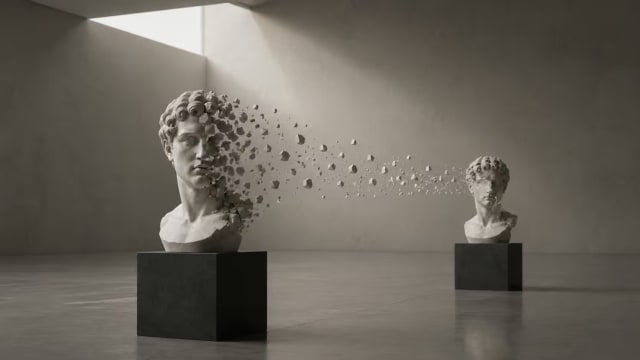
The Identity Hidden Inside a Copy
Copies force us to ask what truly survives through time. The answer may reveal why cultures disagree about authenticity itself.

The Largest Extinction Event Is Happening Right Now
Every choice changes who will exist in the future. A philosophical exploration of possible people, extinction, ancestry, and human destiny.

The Age of Mirrors
How mirrors evolved from mystical objects into digital prisons of identity, vanity, validation, and algorithmic self-surveillance.

The Phenomenology of Embarrassment
Embarrassment is not shame. It is not guilt. It is the moment the self discovers, with retroactive mortification, that it has been visible all along, and that visibility was never chosen.