The Identity Hidden Inside a Copy
Copies force us to ask what truly survives through time. The answer may reveal why cultures disagree about authenticity itself.
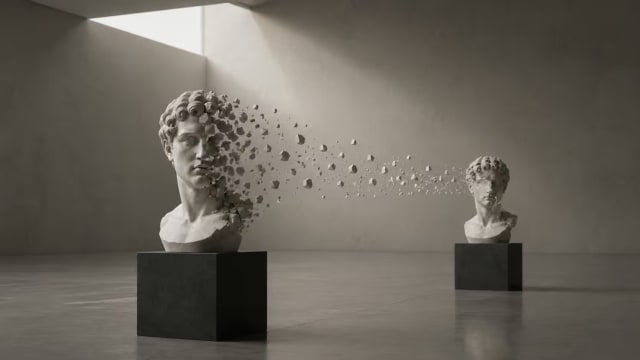
The temple at Ise has burned a thousand times without ever burning down.
Every twenty years, Japanese carpenters dismantle the shrine and rebuild it from fresh timber using centuries-old techniques. To Western eyes, this seems like ritualized replacement. Surely the original vanished generations ago. Yet millions of pilgrims visit a building that they confidently call 1,300 years old. The paradox is ours, not theirs. We inherit a civilization that locates authenticity in matter. They inherit one that locates it in continuity.
The real opposite of an original is not a copy. It is oblivion.
This difference reaches far beyond architecture. It reveals two incompatible philosophies of identity.
The Western imagination prizes the original. A Renaissance painting derives value from the brushstrokes that once passed beneath the artist's hand. Museums surround artifacts with climate control, alarms and insurance because physical continuity guarantees authenticity. Even restoration proceeds cautiously. Every replaced fragment risks diluting the object's historical essence. Walter Benjamin famously argued that the original possesses an "aura" that no reproduction can capture.
East Asia developed a different intuition. Chinese distinguishes between fangzhipin, an obvious imitation, and fuzhipin, an exact reproduction carrying the same value as the original. A museum that receives a perfect replica instead of an ancient artifact may feel deceived. The Chinese institution that sent it often feels equally bewildered by the rejection. If nothing meaningful has been lost, why insist upon decaying atoms merely because they are old?
Neither position is irrational. They simply answer different questions.
The Western tradition asks, "Did this very object survive history?" The Eastern tradition asks, "Did this form survive history?" One preserves substance. The other preserves pattern. The Freiburg Minster in Germany illustrates how thin this distinction really is. Weathered sandstone blocks are continually replaced with newly carved ones. Over centuries, almost every visible stone changes. The cathedral survives not because its material remains untouched, but because replacement occurs gradually enough to escape our philosophical discomfort. The Japanese shrine performs the same operation openly every two decades.
The disagreement therefore exposes a deeper illusion. We imagine identity as something hidden inside matter, when much of human life already depends upon recurring patterns instead. Languages persist although every speaker dies. Universities survive despite generations of students and professors. A nation remains recognizable while its entire population changes over centuries. Even your body replaces most of its cells across a lifetime, yet you rarely wonder whether you have become someone else.
Critics argue that treating copies as equals erodes authenticity and encourages forgery. That concern matters in markets, archaeology and criminal law, where provenance determines ownership and accountability. But these practical necessities should not be mistaken for metaphysical truths. A legal distinction does not automatically settle a philosophical one.
Perhaps originality has always been less about material permanence than about faithful transmission. A violin concerto survives because musicians continue performing it. A religious tradition survives because rituals continue being enacted. A civilization survives because its patterns outlive its participants.
A culture obsessed with preserving objects risks forgetting that continuity often depends upon renewal. Another culture that embraces replication reminds us that permanence may emerge not from resisting change, but from choreographing it. The oldest things in the world, perhaps, are precisely those that never stop becoming new.
Discussion · 1
Authenticity is not only about preserving the original material but also about preserving identity through continuity. Western philosophy values the original object, while Eastern philosophy values the continuation of its form and tradition. This idea suggests that identity can exist beyond physical matter. Just as humans replace their cells over time yet remain the same person, continuity is what truly defines identity.
Sign in to join the discussion.
More in Metaphysics
The Largest Extinction Event Is Happening Right Now
Every choice changes who will exist in the future. A philosophical exploration of possible people, extinction, ancestry, and human destiny.

Why Humanity Invented the Afterlife
Why do humans believe in an afterlife? A philosophical essay on death, memory, religion and humanity’s refusal to accept oblivion.

The Age of Mirrors
How mirrors evolved from mystical objects into digital prisons of identity, vanity, validation, and algorithmic self-surveillance.
The Phenomenology of Embarrassment
Embarrassment is not shame. It is not guilt. It is the moment the self discovers, with retroactive mortification, that it has been visible all along, and that visibility was never chosen.