Philosophy passages in CAT and GMAT rarely ask you to know a philosopher. They ask you to follow a chain of argument, spot the hidden assumption and tell a claim from its justification. These essays train exactly that, from knowledge and ethics to mind, language and the good life.
38 long-form philosophy essays, written at the density of real CAT passages, each with CAT, XAT and GMAT-style questions and explanations. For real exam passages, practise the solved CAT RC PYQs; for a daily routine, see CAT RC practice.
Bioethics2 min
Cells taken without consent in 1951 still divide in laboratories around the world. The law has been slower than the cells to say what their source is owed.
Cosmopolitanism2 min
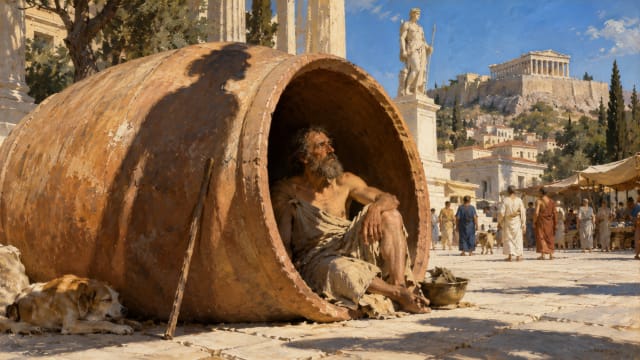
A philosopher said to have lived in a jar once called himself a citizen of the world. More than twenty three centuries later the phrase still cannot be pinned to a single meaning.
Thinkers & Theories3 min
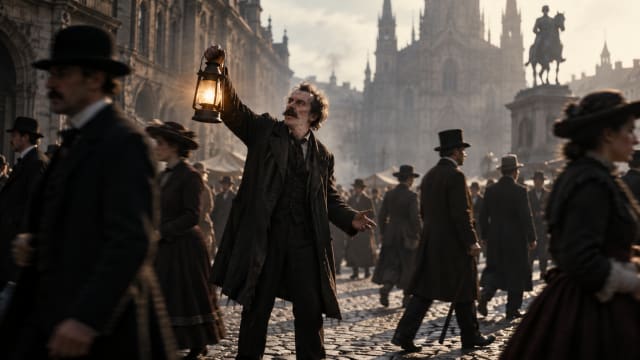
The most famous sentence in modern philosophy is usually heard as a victory cry, yet the parable that contains it is addressed to people who were not grieving at all.
Ethics3 min
The trolley problem began as a footnote in an argument about abortion. Its journey into the engineering of driverless cars may have changed what it was built to ask.
Logic & Probability3 min
A famous paper told basketball fans that streaks were an illusion. A later paper found a flaw in the arithmetic that produced the verdict.
Political Philosophy6 min
The man who made the word famous meant it as a satire. A look at his warning, at India's long argument over merit and reservation, and at what deserving can mean.
Logic & Probability1 min
The statistician Abraham Wald is credited with telling the military to armour the parts of its bombers that showed no bullet holes. The advice sounds backwards until a reader asks which planes were never seen.
Political Philosophy6 min
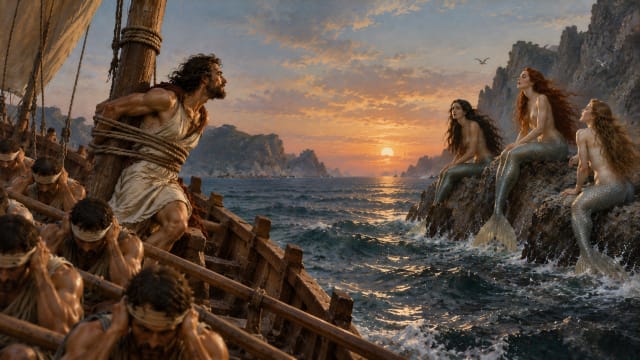
In the Odyssey the hero orders his crew to tie him to a mast so that he can hear a song that has killed every sailor before him. The knots look like the end of freedom, and the story has been used for three thousand years to argue that they are its proof.
Aesthetics3 min
A bowl mended with gold looks like a lesson in embracing flaws. The famous story behind it is thin, and the lesson may have arrived long after the craft.
Philosophy of Language5 min
There is no Hindi word for independence. My mother told me this once, without ceremony. It took years to understand what she meant.
Philosophy of Mind6 min
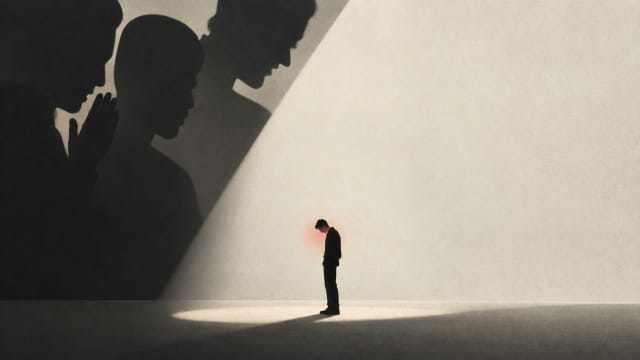
Embarrassment is not shame. It is not guilt. It is the moment the self discovers, with retroactive mortification, that it has been visible all along, and that visibility was never chosen.
Political Philosophy5 min
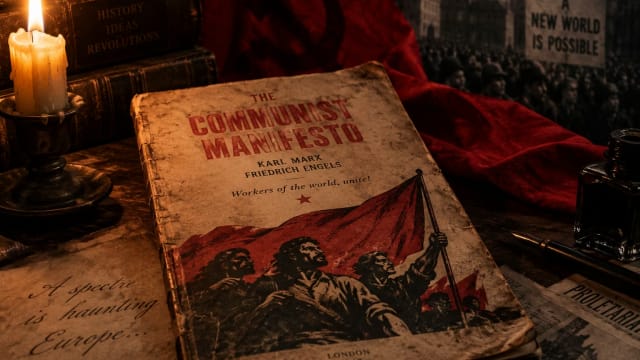
The Manifesto was written in six weeks by two men in their twenties. It inspired revolutions on four continents. The question is not whether its argument is correct. It is why the argument works so well.
Ethics5 min
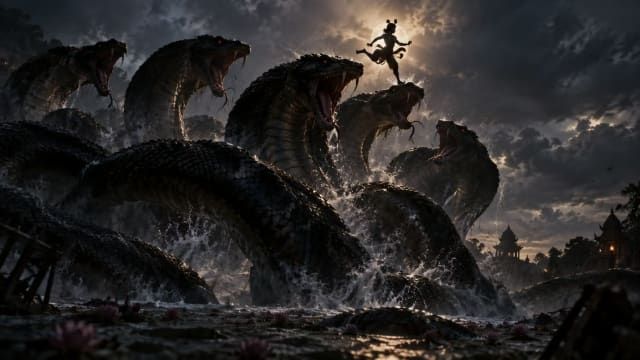
Krishna lies, cheats and engineers deaths. The Mahabharata calls him the fullest embodiment of dharma. This is not a contradiction. It is the most demanding position in Indian moral philosophy.
Philosophy of Mind6 min
Neuroscience reveals how prediction shapes consciousness, surprise, self awareness and our strange dependence on other minds.
Epistemology6 min
The ancient Greeks called it aporia — a lack of passage. It is not the moment when thinking fails. It is the moment when thinking discovers that the question itself was badly formed.
Epistemology6 min
Skepticism is not the rejection of knowledge, but a discipline for deciding how much confidence our evidence deserves.
Philosophy of Mind7 min
Does reading uncover meaning or create it? Explore language, consciousness, Gödel's theorem and predictive processing in this philosophical essay.
Existentialism7 min
Neymar's career reveals why talent alone never guarantees greatness, and why unrealized potential often leaves a more enduring legacy than victory.
Epistemology3 min
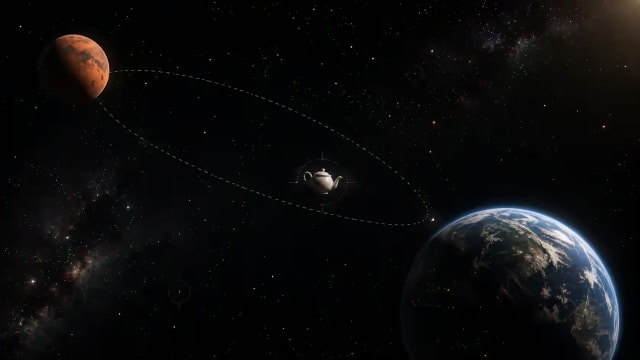
Discover how Bertrand Russell's famous celestial teapot transformed our understanding of evidence, belief and the burden of proof.
Ethics7 min
Why does Hachikō's story still move millions? A philosophical reflection on loyalty, memory, grief, and the kind of love that outlives death itself.
Metaphysics6 min
Copies force us to ask what truly survives through time. The answer may reveal why cultures disagree about authenticity itself.
Ethics6 min
Two men drive home equally drunk. Only one kills a child. Philosophy calls the gap between them moral luck.
Ethics6 min
Confucianism defended inequality by arguing that everyone begins with equal moral potential and that authority should reward virtue rather than birth.
Epistemology6 min
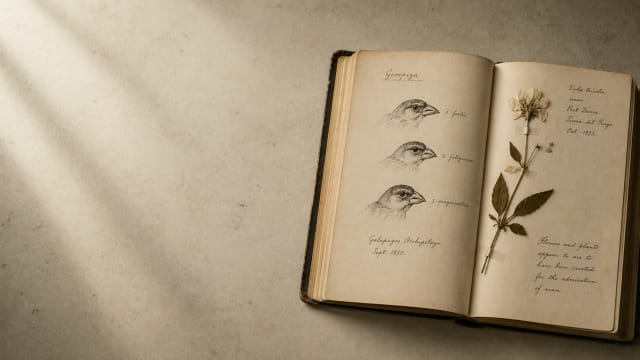
What Charles Darwin's love for Jane Austen reveals about beauty, evolution, art, and the natural world.
Metaphysics5 min
Every choice changes who will exist in the future. A philosophical exploration of possible people, extinction, ancestry, and human destiny.
Meaning & the Good Life5 min
A great story can emerge from a wound. But does that mean the wound was necessary? A reflection on suffering and growth.
Philosophy of Mind5 min
Do we perceive reality as it truly is, or merely as the mind constructs it? A philosophical exploration of idealism, perception and shared belief.
Existentialism6 min
Every choice creates a future and erases countless others. Explore regret, freedom, identity, and the hidden cost of living a single life.
Ethics3 min
A haunting reflection on Kevin Carter’s photograph, moral distance and the unsettling transformation of human suffering into spectacle.
Philosophy of Religion6 min
Why do humans believe in an afterlife? A philosophical essay on death, memory, religion and humanity’s refusal to accept oblivion.
Existentialism6 min
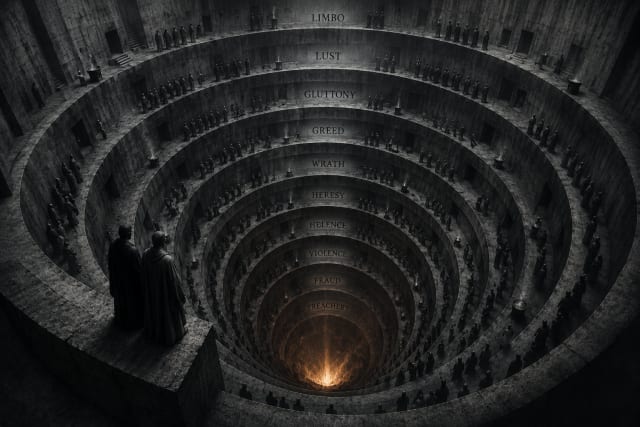
Explore Dante’s Inferno through its nine circles of Hell, moral symbolism, and timeless vision of sin, power, and human corruption.
Political Philosophy5 min
A political philosophy essay exploring why revolutions slowly resemble the regimes they overthrow through power, control and ideology.
Values & Beliefs5 min
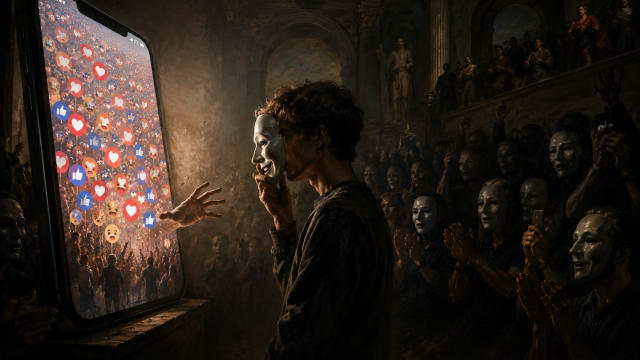
Explore how social media turned morality into performance, where virtue, outrage, and ethics increasingly depend on visibility and online approval.
Metaphysics5 min
How mirrors evolved from mystical objects into digital prisons of identity, vanity, validation, and algorithmic self-surveillance.
Indian & Eastern Philosophy5 min
A philosophical exploration of Brahmaganita, where mathematics becomes a lens to uncover patterns, balance, and the hidden structure of reality.
Epistemology3 min
Beauty feels instinctive yet follows patterns of symmetry and proportion shaped by biology and culture. Its deepest impact lies beyond what numbers can capture.
Philosophy of Mind3 min
A lyrical exploration of how childhood quietly architects adulthood, arguing that our earliest habits of thought and feeling do not fade but govern who we become, even when we believe we have outgrown them.
Existentialism3 min
An exploration of infinite loops from Zeno's paradox to modern science fiction, arguing that repetition is not a trap but a structure.