The Communist Manifesto: An RC Inspired by IIM Indore
The Manifesto was written in six weeks by two men in their twenties. It inspired revolutions on four continents. The question is not whether its argument is correct. It is why the argument works so well.
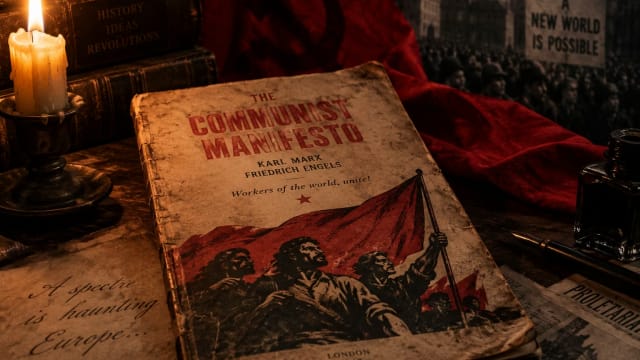
The Communist Manifesto is approximately twelve thousand words long. It was written in six weeks by two men in their twenties. It has been translated into more languages than almost any other document in history, has inspired revolutions on four continents, and remains in print in virtually every country on earth. Whatever one thinks of its conclusions, its rhetorical achievement is difficult to dispute. The question worth asking is not whether its argument is correct. It is why the argument works so well.
The Manifesto opens with a sentence that is almost impossible to forget. A spectre is haunting Europe, the spectre of communism. The choice of spectre is precise. A spectre cannot be argued with, negotiated with or imprisoned. It has no body to attack. It can only be exorcised, and exorcism requires first acknowledging the spectre's existence. The opening sentence forces the reader into a world where communism is already a presence that must be reckoned with rather than an idea that might be dismissed.
What follows is structured as a history. Marx and Engels do not say that communism is a good idea that rational people should adopt. They say that communism is the next stage in a historical process that has been unfolding for centuries and will continue regardless of what any individual thinks about it. The history of all hitherto existing society is the history of class struggle. This framing is not incidental. It converts a political proposal into a description of an inevitable process. The reader is not being asked to choose. They are being told what is going to happen and invited to decide which side of history they wish to be on.
This is the Manifesto's central rhetorical manoeuvre. It borrows the authority of historical necessity. A political programme presented as a preference can be debated, rejected or ignored. A historical inevitability can only be accepted or resisted. Marx and Engels present communism as the former, which means that opposition to it becomes not a legitimate disagreement but a futile attempt to reverse the direction of time.
The enemy the Manifesto constructs is equally deliberate. The bourgeoisie is not a collection of individuals with varying beliefs, circumstances and motivations. It is a class with a single coherent interest, acting with the unified intentionality of a single agent. This simplification is rhetorically essential. An enemy that is diverse, internally conflicted and partially sympathetic is hard to mobilise against. An enemy that is unified, coherent and clearly opposed to your interests is much easier.
One might object that effective rhetoric is not the same as good argument. The Manifesto's rhetorical power might simply be a vehicle for ideas that were independently persuasive. But this objection misses how inseparable form and content are in political writing. The ideas in the Manifesto were not new in 1848. Socialist and communist thought had been circulating in Europe for decades. What was new was the way the Manifesto assembled those ideas into a narrative with a villain, a historical arc, an inevitable conclusion and a call to action. The ideas did not spread because they were true. They spread because they were organised into a story.
Ideas do not spread because they are true. They spread because they are organised into a story that people can inhabit, retell and act inside.
That is the lesson the Manifesto teaches about how ideas move through the world. Not by winning arguments. By becoming narratives that people can inhabit, retell and act inside.
Discussion · 1
Manifesto is rhetorical and shapes narratives, unlike any arugument, it was written in the name of historical necessity which taught people inhabit, retell and act inside.
Sign in to join the discussion.
More in Political Philosophy

The Word Meritocracy Began as a Warning
The man who made the word famous meant it as a satire. A look at his warning, at India's long argument over merit and reservation, and at what deserving can mean.

Freedom Is Not the Absence of Limits but the Choice of Them
In the Odyssey the hero orders his crew to tie him to a mast so that he can hear a song that has killed every sailor before him. The knots look like the end of freedom, and the story has been used for three thousand years to argue that they are its proof.

Why Revolutions Eventually Resemble the Regimes They Destroy
A political philosophy essay exploring why revolutions slowly resemble the regimes they overthrow through power, control and ideology.

The Phenomenology of Embarrassment
Embarrassment is not shame. It is not guilt. It is the moment the self discovers, with retroactive mortification, that it has been visible all along, and that visibility was never chosen.