The Acquittal That Did Not Mean Innocence
Lizzie Borden walked free in 1893, and the verdict shows what a court can and cannot declare.
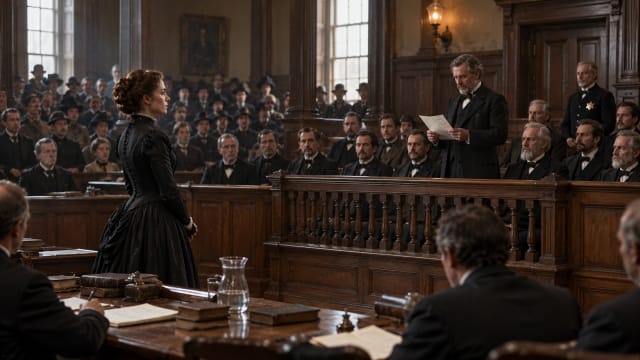
On 4 August 1892, in the Massachusetts town of Fall River, Andrew Borden and his wife Abby were found dead in their home, struck repeatedly with a hatchet like weapon. Suspicion fell quickly on Andrew's younger daughter Lizzie, then thirty two. When she was tried in New Bedford in June 1893, the case against her was entirely circumstantial. No witness had seen the killings, no blood was found on her clothing, and the weapon the prosecution offered, a hatchet head with a broken handle, was one that the defence argued could not be linked to either wound.
The trial also turned on what the jury was not allowed to hear. The judges ruled that Lizzie's own testimony at an earlier inquest, given without a lawyer and full of inconsistencies, was inadmissible at trial, since she had been questioned while effectively a suspect. Evidence that she had tried to buy a poison shortly before the deaths was likewise excluded. The all male jury reached a verdict of not guilty within hours.
An acquittal is not a declaration of innocence. It means only that the prosecution failed to prove guilt beyond reasonable doubt, a standard that exists because the law considers the wrongful conviction of one person a graver error than the escape of another. Lizzie Borden was never convicted of the crime, and no one else was ever charged, yet in popular memory she remains guilty, which shows how differently the courtroom and the public weigh uncertainty.
An acquittal is not a declaration of innocence.
Discussion
Sign in to join the discussion.
More in Law & Justice

The Charter That Failed in Ten Weeks and Won the Centuries
Magna Carta was annulled by a pope within weeks of being sealed. Its afterlife in courts and parliaments has outlasted almost everything it originally said.

Justice Delayed, Science Delivered
Modern forensic science is solving decades old cold cases through DNA, genetic genealogy, and evidence that never forgot the truth.

The Neuro-Legal Gap: Can a Neuron Commit a Crime
Can law judge intent when the brain shapes action? A sharp look at how neuroscience unsettles responsibility and reshapes justice.

The World Is Becoming Medieval Again
Is the nation state losing its monopoly on power? Discover why the twenty first century increasingly resembles the political architecture of the Middle Ages.