The Mind on Paper: LSD and the Illusion of Reality
An exploration of LSD as a lens into the mind, arguing that psychedelics do not distort reality so much as reveal how perception itself is constructed.

A postage stamp dissolves on the tongue, and with it, the illusion that the mind is a sealed room. Walls soften. Time loosens its grip. A thought is no longer a sentence marching forward but a landscape unfolding in all directions at once. This is LSD, a chemical so small it hides on paper, yet vast enough to rearrange the architecture of experience.
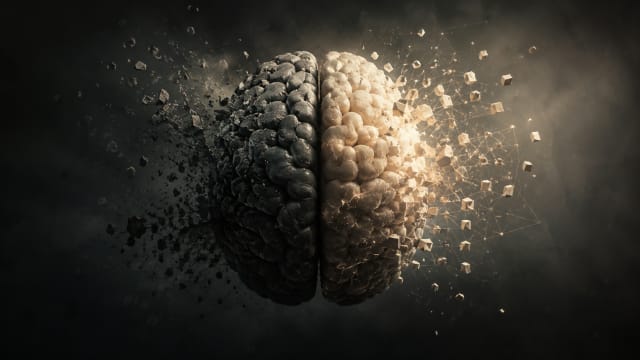
First synthesized in 1938 by Albert Hofmann, LSD does something deceptively modest. It alters signaling in the brain, particularly through serotonin receptors, loosening the usual hierarchy of neural communication. Regions that typically operate in disciplined isolation begin to cross talk. The visual cortex bleeds into memory. Emotion stains perception. The brain's “default mode network,” often associated with the sense of self, quiets down. What emerges is not chaos but a different order, one less constrained by habit.
From this, a sharper claim takes shape. LSD does not fabricate reality out of thin air. It exposes how fabricated ordinary reality already is. What we call perception is a controlled hallucination, a model tuned for survival rather than truth. Evolution prizes utility, not accuracy. You do not see the world as it is. You see what helps you act. LSD loosens that utilitarian filter. Colors intensify, patterns ripple, and the boundary between observer and observed begins to blur. The world feels less like an object and more like a process you are entangled in.
There is, of course, a strong objection. If LSD disrupts perception, then its insights are unreliable, even dangerous. Hallucination is hardly a path to knowledge. People can spiral into confusion, anxiety, or grand illusions of meaning. This critique carries weight. The mind under LSD is suggestible, and not every revelation is real. Yet dismissing the experience entirely is like rejecting dreams because they distort waking life. Distortion can still disclose structure. LSD does not guarantee truth, but it reveals the machinery that produces what we take to be true.
Recent clinical research leans into this paradox. In controlled therapeutic settings, psychedelics show promise in treating depression, addiction, and trauma. Patients often report a dissolution of rigid identity, followed by a reconfiguration of how they relate to their own thoughts. It is not that LSD inserts new beliefs. It temporarily suspends the old ones, allowing alternatives to surface. The effect resembles shaking a snow globe. Patterns that felt permanent reveal themselves as contingent.
The deeper implication is quietly radical. If a molecule can so profoundly alter perception, then certainty was always provisional. The self, that steady narrator we trust, is less a fixed entity and more a pattern sustained by repetition. Break the pattern, and the self flickers. For some, this is terrifying. For others, it is liberating. The same structure that traps a person in cycles of fear or addiction can, under the right conditions, be rewritten.
Perhaps the real lesson is not about psychedelics at all. It is about humility. The mind is not a mirror held up to reality but a lens constantly adjusting its focus. LSD simply turns the dial too far, too fast, forcing us to notice the mechanism. And once seen, it cannot be unseen.
We spend our lives defending the borders of the self, drawing them in ink, guarding them like territory. Yet under the influence of a single molecule, those borders dissolve into something softer, more provisional. The surprise is not that they disappear, but that they were never permanent to begin with.
Discussion
Sign in to join the discussion.
More in Behavioural Psychology

The Smile That Leaves No Bruises
Toxic femininity isn't the opposite of masculinity but the corruption of feminine virtues into emotional coercion, guilt and invisible control.

The “Good Girl” Tax: How the Madonna–Whore Complex Limits Professional Growth
An exploration of the “Good Girl Tax,” showing how the ancient Madonna–Whore archetype still shapes workplace expectations and quietly restricts women's professional advancement.

The Forgotten Third of Our Lives
Why can't we remember our dreams? Discover how REM sleep, memory, and evolution shape the forgotten third of our lives.
What Happens When You Actually Change Your Mind: An RC Inspired by IIM Indore
Most arguments do not change minds. They change voiced positions. Genuine belief revision is neurologically different, phenomenologically distinct and far rarer than it appears.