The Gorilla That Radiologists Looked Straight At: An RC Inspired by IIM Indore
Twenty of 24 radiologists missed a gorilla pasted into a lung scan, and many of them had looked right at it. The result says something uncomfortable about what expertise does to attention.
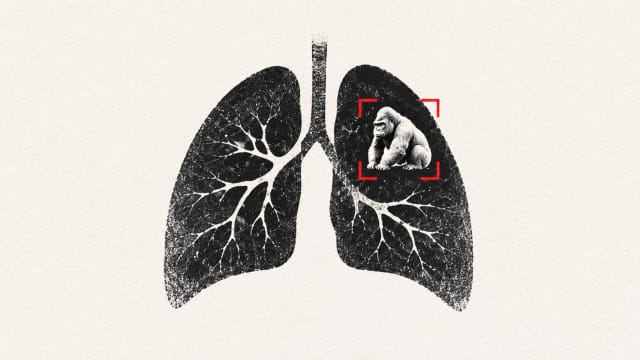
In 2013 a team led by Trafton Drew at Brigham and Women's Hospital in Boston asked 24 radiologists to search lung scans for cancerous nodules, a task they perform for a living. On one late case the researchers had pasted in the image of a gorilla, roughly 48 times the size of a typical nodule, and placed it near the upper right of the lung. Twenty of the 24 radiologists did not mention it. Eye trackers recorded where each volunteer looked.
Those records showed that most of the radiologists who missed the gorilla had looked directly at the place where it sat. What failed lay further along, in the machinery that decides which signals are allowed to become findings. Psychologists call the broader pattern inattentional blindness. Arien Mack and Irvin Rock gave the phenomenon its name in the 1990s, and in 1999 Daniel Simons and Christopher Chabris made it famous with a video in which roughly half of the viewers counting basketball passes failed to notice a person in a gorilla suit walk through the scene.
The radiology result sharpened the puzzle because the volunteers were not students counting passes. They were trained experts, and their training was the very thing under test. A radiologist learns to hold a template of what a malignant nodule looks like and to compare every patch of lung against it at speed. The template makes the search efficient. It also makes everything that does not resemble a nodule easy to discard. Radiology already knows a cousin of this effect, called satisfaction of search, in which finding one abnormality lowers the chance of finding a second.
A natural objection is that the experiment is a trick. No patient carries a gorilla in the lung, and a radiologist told to look for nodules is doing precisely what the job asks. The objection has some force, since a single planted image cannot show how often real scans are misread. Yet it answers only half of the matter. The gorilla was not hidden from the radiologists but filtered out by the same skill that made them good at finding nodules. A real unexpected finding, such as a fractured rib at the edge of an image, faces the same filter.
The gorilla was not hidden from the radiologists but filtered out by the same skill that made them good at finding nodules.
The implication reaches well beyond the reading room. Auditors, pilots, referees, editors and safety inspectors all work from trained templates, and each template buys speed by lowering the price of ignoring the unfamiliar. The usual remedy is to ask experts to try harder, but effort is exactly what the radiologists were already giving. A fuller remedy would have to change what the template permits, through checklists, second readers or deliberate searches for the unexpected, and each of these has its own blind spot.
That leaves a question the experiment cannot close. The radiologists who missed the gorilla were as sure as anyone that they had seen the whole scan, and the eye trackers showed that in a sense they had looked at all of it. If seeing can stop somewhere between the eye and the report without leaving any trace in the one who sees, then no expert can say from the inside which gorilla is sitting on the screen at this moment.
Discussion · 1
The Action of inattentional blindness: Although making the expert fast in their work but can also make the expert / practisoner ignore the unintented and surprise stuffs, which may undermine their skill , as shown through the experiment of gorilla and scan.
Sign in to join the discussion.
More in Cognitive Psychology

The Psychology of Being Confidently Wrong
The Psychology of Being Confidently Wrong

The Horse That Could Count and the Face That Did Not Know
A horse in Berlin tapped out sums to the delight of the crowds, and a psychologist later showed that the arithmetic belonged to the audience.

The Mozart Effect Was Never About Mozart
A 1993 study of 36 students led a US governor to send classical music to every newborn in his state. The effect was small, short and probably not about Mozart at all.
What Sherlock Holmes Gets Wrong About Thinking: An RC Inspired by IIM Indore
Holmes notices everything Watson misses. The passage argues this is not because he observes more. It is because he has a better theory of what is worth observing.