The Decision That Seemed to Come Before the Decider - An RC Inspired by IIM Indore
A famous experiment appeared to show that the brain commits to an action before a person knows they have chosen it, but a later reading suggests the evidence may be an artefact of how it was averaged.
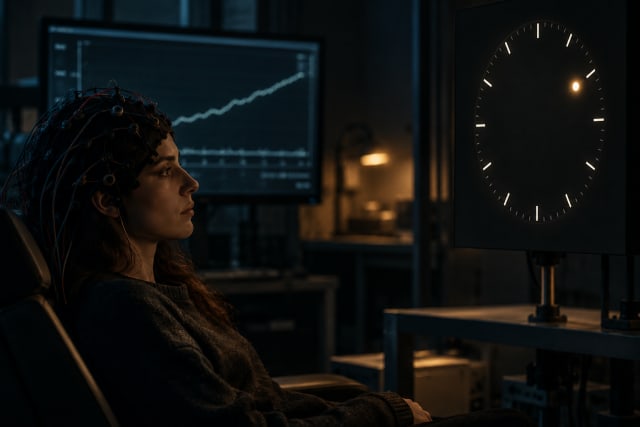
In the early 1980s a neurophysiologist at the University of California, San Francisco, named Benjamin Libet seated volunteers before a fast moving spot of light that circled a clock face and asked them to flex a wrist whenever they felt like it. They were to note where the spot stood at the instant they first felt the urge. Electrodes on the scalp recorded a slow electrical build up over the motor regions, known as the readiness potential, which Hans Kornhuber and Lüder Deecke had described in the 1960s. Libet reported in 1983 that this signal began roughly half a second before the movement, while the volunteers placed their awareness of the urge at only about two hundred milliseconds before it.
The sequence seemed to say that the brain had decided before the person did. The finding travelled far beyond the laboratory. Textbooks, popular science writers and some philosophers, struck by the neatness of the timing, took it as evidence that conscious will is a story told after the fact, a commentator narrating a game already played. Libet himself resisted the conclusion. He pointed out that awareness arrived early enough to leave a window of about a tenth of a second in which the act could still be stopped, and he suggested that free will might work as a veto and not as a trigger.
The deeper trouble lies in what the readiness potential actually is. It is invisible in any single attempt. It emerges only when many trials are averaged and aligned backwards from the moment of movement, which means the analysis already knows where each movement occurred. In 2012 Aaron Schurger, Jacobo Sitt and Stanislas Dehaene proposed a different reading. Neural activity fluctuates constantly, and a movement may occur when a random drift happens to cross a threshold. Averaging backwards from such crossings would produce a slow ramp even if nothing had been prepared in advance. On this account the ramp is a statistical shadow of the waiting, not a decision announced in secret.
On this account the ramp is a statistical shadow of the waiting, not a decision announced in secret.
Defenders of the original reading reply that the case is not closed, and they have not been idle. Recordings from single neurons in patients undergoing surgery have found activity that predicts a choice some moments ahead, and the timing of the urge remains hard to pin down because it depends on volunteers judging a clock while also attending to their own feelings. Critics add, with some justice, that a flick of the wrist on a whim has little in common with deciding to marry, to resign or to forgive, the choices people most wish to call their own.
Even if the experiment is set aside, the puzzle it exposed does not leave. Every account of action must say when a decision happens and who is present at the time. If the decision is the conscious feeling, then the feeling needs a cause that came before it. If the decision is the earlier brain event, then the person seems to arrive late to their own life. Neither answer lets the self sit where it has always assumed it sat, and the instrument that might settle the matter would have to be read by a mind whose timing is the very thing in doubt.
Discussion
Sign in to join the discussion.
More in Consciousness

The Forgotten Third of Our Lives
Why can't we remember our dreams? Discover how REM sleep, memory, and evolution shape the forgotten third of our lives.

What Happens When You Actually Change Your Mind: An RC Inspired by IIM Indore
Most arguments do not change minds. They change voiced positions. Genuine belief revision is neurologically different, phenomenologically distinct and far rarer than it appears.

I Thought Everyone Saw the World This Way
A reflective essay on teenage love, mathematical thinking, and why I instinctively translated people, emotions, and the world into algebra.

The Zipper You Don't Understand
Most people are certain they understand how a zipper works, until asked to explain it. The same gap shows up in political conviction.