Why Love Is More Than Food: An RC Inspired by IIM Indore
A famous laboratory result seemed to show that love is not a debt paid for food, yet the experiment explains less than its legend suggests.
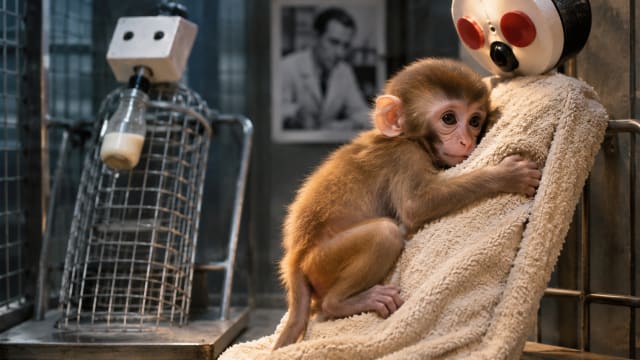
In the late 1950s, in a laboratory at the University of Wisconsin, newborn rhesus monkeys were given two substitute mothers. One was a bare cylinder of wire mesh. The other was a similar form wrapped in soft terry cloth. In one arrangement the milk bottle was fixed to the wire mother, so that the only figure that fed the infant was also the only one that felt like a cage. The experimenter, Harry Harlow, reported that the infants spent most of their hours clinging to the cloth mother and visited the wire figure only to drink.
The result mattered because of the theory it was aimed at. Many psychologists and psychoanalysts of the period treated an infant's love for its mother as a by product of hunger, a learned echo of a drive being satisfied. Harlow argued in his address to the American Psychological Association in 1958 that contact comfort, and not nursing, lay at the root of the bond.
The behaviour of the frightened animals seemed to make the case. When a strange mechanical toy was placed in the cage, infants raised with a cloth mother ran to her, clung to her and then, calmer, began to explore the object. Infants raised with only a wire mother threw themselves on the floor, clutched their own bodies and screamed. The cloth figure appeared to work as a secure base from which the world could be approached.
The cloth figure appeared to work as a secure base from which the world could be approached.
Yet a cloth mother was not a mother. Monkeys raised on surrogates alone, even soft ones, grew up with disturbed social behaviour, and Harlow's group later reported that females deprived in infancy were often poor mothers themselves. Contact with other young monkeys repaired part of the damage, which suggested that comfort was necessary but never sufficient. The cloth was a clue to what a mother provides and not a replica of it.
The experiment also shows less than it seems. The infants had been separated from their real mothers within hours of birth, so the design cannot say how much comfort matters when a living mother is present and feeding as well. The subjects were monkeys, and the step from monkey to child has to be argued and not assumed. The wire mother's milk kept the infants alive, which means that a preference for cloth reveals what they clung to and not what they needed to survive.
A partial answer came from outside the laboratory. The British psychiatrist John Bowlby, studying children raised in institutions, had already argued that attachment could not be reduced to feeding, and Harlow's monkeys gave that claim an experimental form. A clinician's observation and a laboratory result agreeing with each other is a strong reason to take an idea seriously. It is not proof that the same mechanism operates in both.
What the experiment leaves open is what comfort actually is. It may be texture, warmth, a rhythm of response or something in the pattern of being answered when distressed, and Harlow's later work added warmth and motion to the cloth. Generations of parenting advice have swung between rules and tenderness, each swing claiming the authority of science. The cloth mother shows that something was missing from the milk, but what was missing, for the monkey and for the child, still has no agreed name.
Discussion
Sign in to join the discussion.
More in Developmental Psychology

The Marshmallow That Was Never Only About Willpower
A treat on a plate became the most famous test of character in modern psychology. A larger study and a cleverer experiment suggest that the children may have been answering a different question.

Sexiness Is Not a Property of the Body
Beauty can be catalogued but desire keeps slipping out of the list, which suggests that attraction lives in a relationship and not in a body.

The Forgotten Third of Our Lives
Why can't we remember our dreams? Discover how REM sleep, memory, and evolution shape the forgotten third of our lives.
What Happens When You Actually Change Your Mind: An RC Inspired by IIM Indore
Most arguments do not change minds. They change voiced positions. Genuine belief revision is neurologically different, phenomenologically distinct and far rarer than it appears.