The Experiment That Never Happened
A horror story invented in 2010 became a viral fact. The real laboratories, with their disc jockey, schoolboy and rats, offer less drama and a deeper mystery.
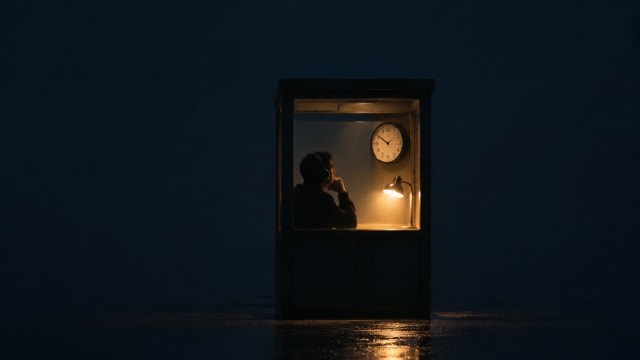
In 2010 a user calling himself Orange Soda posted a short horror story to the Creepypasta Wiki. It described a Soviet laboratory in the late 1940s, five political prisoners sealed inside a chamber, and a stimulant gas meant to keep them awake for fifteen days in return for a promise of freedom. Within days, the story said, the men had turned violent and begun to harm themselves, and all of them eventually died. The tale was fiction, but it was written like a report, and the report style made it travel.
Real attempts to measure sleeplessness began far earlier and look tamer. In 1959 a New York disc jockey named Peter Tripp stayed awake for 201 hours in a glass booth in Times Square while broadcasting to raise money for charity. Tripp developed hallucinations and paranoid beliefs, yet William Dement, a leading sleep researcher, later said that the stimulant Tripp had been given was more likely than the lack of sleep to have caused them.
The story found its largest audience long after it was posted. A Facebook post dated 1 February 2020 spread it as fact, illustrated with a photograph that turned out to be a Halloween prop, and the fact checking site Lead Stories rated the claim false in January 2022, noting that no record of any such experiment exists. Part of its force came from borrowing the look of documented cruelty, since wartime experiments on humans were real, and part from its precise numbers, five subjects and fifteen days, which feel like data.
The tale was fiction, but it was written like a report, and the report style made it travel.
In the winter of 1963 and 1964 a schoolboy in San Diego, Randy Gardner, stayed awake for 264 hours for a science fair, watched during the final days by Dement. By about the fourth day an early observer reported hallucinations and a very short attention span, and Dement noted that his memory, motivation and coordination suffered to varying degrees. No lasting harm was reported.
Animals have been pushed further. In experiments reported in 1983, Allan Rechtschaffen and colleagues at the University of Chicago used a rotating disk over shallow water to wake rats whenever they began to sleep, while a control rat shared the apparatus and slept when it could. The deprived rats ate more yet lost weight, developed sores on their paws and tails, and died after about two to three weeks. Reviews have reported that no single cause of death has been identified.
Humans cannot be tested that way, and the nearest evidence is uncomfortable. In 1997 Guinness stopped monitoring records for staying awake, citing the danger and noting that brief lapses into sleep, called microsleeps, cannot be detected without continuous brain recordings, so past claims cannot be verified. A rare inherited disease, fatal familial insomnia, destroys sleep progressively and usually ends in death within months to a few years, but the damage in that disease reaches far beyond sleep, so it cannot show what sleeplessness alone would do.
The invented experiment therefore answers a question that the real ones cannot. It supplies a cause, a jailer and a count of days. The laboratories supply a rat that dies for reasons unknown, a schoolboy who recovered, and a disc jockey whose madness may have come from a pill. Whether sleep loss alone can kill a person, and what it would do inside the body if it did, is a question that no ethical experiment can finish asking.
Discussion
Sign in to join the discussion.
More in Sleep & Dreams

The Forgotten Third of Our Lives
Why can't we remember our dreams? Discover how REM sleep, memory, and evolution shape the forgotten third of our lives.

Sexiness Is Not a Property of the Body
Beauty can be catalogued but desire keeps slipping out of the list, which suggests that attraction lives in a relationship and not in a body.
What Happens When You Actually Change Your Mind: An RC Inspired by IIM Indore
Most arguments do not change minds. They change voiced positions. Genuine belief revision is neurologically different, phenomenologically distinct and far rarer than it appears.

I Thought Everyone Saw the World This Way
A reflective essay on teenage love, mathematical thinking, and why I instinctively translated people, emotions, and the world into algebra.