The Psychologist Who Asked What Mystics Were For
William James judged mystical states by what they did for a life and not by where they came from. The method is generous, and it leaves the oldest question unanswered.
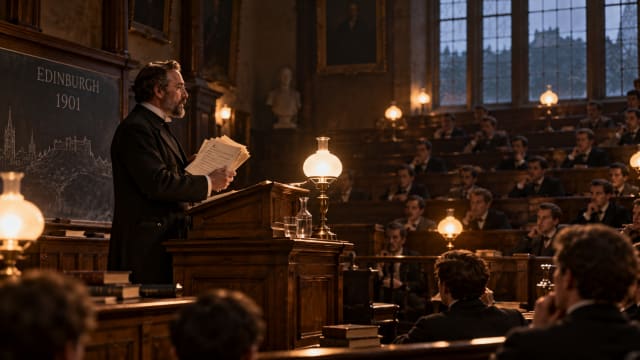
In 1901 and 1902 the American psychologist William James stood in Edinburgh to deliver the Gifford Lectures, which were published in 1902 as The Varieties of Religious Experience. He did not ask whether God exists. He asked what happens to a person who believes that something greater has touched them, and he collected the private testimony of converts, saints and sufferers as a naturalist collects specimens.
James set institutions and theology aside on purpose. Churches, he said, live at second hand on the experience of their founders, and the founders' own moments are where the evidence lies. From many examples he drew four marks of mystical states. They resist description, they feel like knowledge, they pass quickly and they seem to come from outside the will.
The most provocative move was a refusal. A critic might say that a vision is merely a disturbance of the brain, and James conceded that some religious experiences had morbid origins. Yet he rejected the argument from origin, which he called medical materialism, since every state of mind, including a scientist's belief, has a physical origin. A belief should be judged by its fruits and not its roots, and the fruits of these experiences were often steadier lives.
A belief should be judged by its fruits and not its roots, and the fruits of these experiences were often steadier lives.
The strategy is clever and it has costs. Judged by fruits, a comforting delusion and a genuine contact would look the same, since both leave a person calmer and kinder. James accepted that his method proved nothing about truth. Religion could be overwhelmingly beneficial and still say nothing about whether its claims are correct. Critics seized on the gap. George Santayana complained that the book tended to disintegrate the idea of truth, while Charles Peirce praised its penetration into the human heart.
The deeper difficulty is the nature of the evidence. A mystic reports a moment of insight that carries complete conviction for the one who had it and none whatever for anyone else. James held that such states are authoritative for the person who has them and not binding on anyone outside.
The result is a strange standing for private proof. A person may be rationally entitled to trust an experience that no one else can examine, and a community may be rationally entitled to withhold belief, and both may be right. The book leaves open whether an experience that cannot be shared can ever count as knowledge, or whether it can count only as a reason to live as though it were.
Discussion
Sign in to join the discussion.
More in Spirituality

The Forgotten Third of Our Lives
Why can't we remember our dreams? Discover how REM sleep, memory, and evolution shape the forgotten third of our lives.

What Happens When You Actually Change Your Mind: An RC Inspired by IIM Indore
Most arguments do not change minds. They change voiced positions. Genuine belief revision is neurologically different, phenomenologically distinct and far rarer than it appears.

I Thought Everyone Saw the World This Way
A reflective essay on teenage love, mathematical thinking, and why I instinctively translated people, emotions, and the world into algebra.

The Zipper You Don't Understand
Most people are certain they understand how a zipper works, until asked to explain it. The same gap shows up in political conviction.