The Dark Night Sky
A simple argument says the night sky should glow like the Sun, and the reasons it does not are still being weighed.
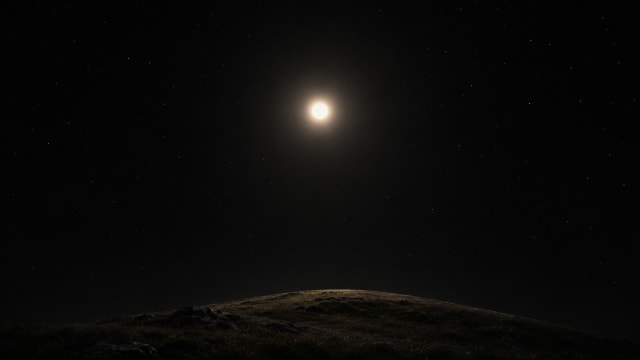
The darkness of the night sky looks like a fact that needs no explanation, and in truth it needs a great deal. The argument that makes it strange is short. Suppose the universe is infinite, unchanging and filled evenly with stars. A thin shell of stars at any given distance sends less light to the Earth the farther away it lies, because light thins out with the square of the distance. But the number of stars in the shell grows with the square of the distance as well, so every shell delivers the same total. With endless shells the sum should be endless, every line of sight should end on a stellar surface, and the whole sky should glow as brightly as the surface of the Sun.
The puzzle carries the name of Heinrich Olbers, who set it out in 1823, though he was far from the first to notice it. Kepler had used the dark night in 1610 to argue that the stars could not be infinite in number, and Halley and Jean Philippe de Chéseaux gave the problem a mathematical form in the eighteenth century. Olbers himself suggested that dust between the stars absorbs the light. That answer fails, as was pointed out later, because dust that absorbs starlight must warm up and in time glow as brightly as the light it swallowed.
A better answer came, oddly, from a poet. In Eureka, a prose work of 1848, Edgar Allan Poe guessed that the sky is dark because the light of the most distant stars has not yet had time to reach the Earth. Lord Kelvin gave the idea firmer footing in 1901 by noting that stars have shone for a limited time, so that only a limited region of space can have sent light here.
Modern textbooks usually credit the expansion of the universe, which stretches the light of distant sources to longer wavelengths and drains its energy. Edward Harrison, whose book Darkness at Night of 1987 remains the standard history of the problem, argued that this puts the emphasis in the wrong place. His case was one of accounting. To make the sky blaze like a stellar surface, the stars would have had to radiate far more energy than they could have produced in the lifetime of the universe. On this reading it is the finite supply of starlight that keeps the sky dark, and a static universe of the same finite age would still be dark.
To make the sky blaze like a stellar surface, the stars would have had to radiate far more energy than they could have produced in the lifetime of the universe.
The disagreement shows how much work a plain observation can do. A dark night is evidence about the age of the cosmos, the finite speed of light and the finite lifetimes of stars, all at once, and each of these was in dispute when the puzzle was first stated. It also shows that a right answer can be reached on thin grounds, since Poe had no cosmology behind his guess. What remains open is how the credit should be divided between age and expansion, because the division depends on which model of the universe is assumed.
CAT VARC practice
This passage is written in the CAT style. Its 4 questions are just below, and you can take them on the real CAT exam screen.
Also writing other exams? Solved XAT verbal PYQs, IPMAT verbal PYQs, CLAT English PYQs and GMAT reading, all free.
Discussion
Sign in to join the discussion.
More in Cosmology
What Dark Matter Tells Us About Scientific Knowledge: An RC Inspired by IIM Indore
Dark matter has never been directly observed. We are nonetheless highly confident it exists. The gap between these two facts reveals something important about how science actually works.
Would a Fourth Dimensional Being Be a God?
A thought experiment in higher dimensions asks whether what looks like a miracle might simply be reality viewed from a geometry we cannot perceive.

Why Humans Have the Largest Penis Among All Primates: An RC Inspired by IIM Indore
Desmond Morris had a simple answer. Modern biology has a more complicated one. What changed between 1967 and now reveals as much about science as it does about human anatomy.
The Exam Einstein Never Failed: An RC Inspired by IIM Indore
The story of Einstein failing his exams has survived a century of correction. The reason it survives tells you more about human psychology than it does about Einstein.