The Chemistry of Belief
Explore the placebo effect and how belief, psychology and modern medicine together shape healing, pain and human biology.
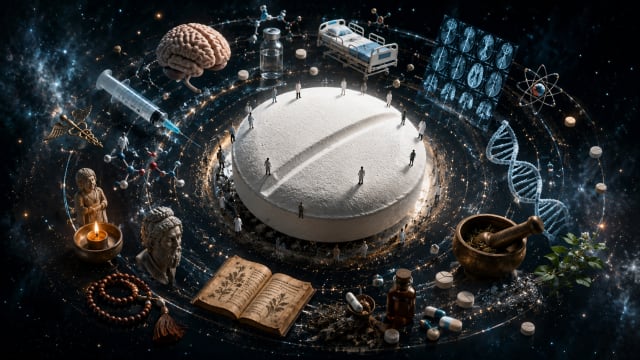
Beginning in the middle of the 20th century, modern medicine advanced a powerful new idea. Disease, according to this view, was fundamentally mechanical. The human body resembled an intricate biochemical machine governed by material causes alone. Drugs worked because molecules interacted with receptors. Surgery succeeded because anatomy obeyed physical laws. Within this framework, belief and ritual belonged to the superstitious past of medicine. They appeared to be relics from an earlier world of shamans, sacred herbs and miracle tonics. Yet one stubborn phenomenon refused to disappear. Patients who received medically inert substances often improved nevertheless. A sugar pill eased pain. A saline injection reduced anxiety. Sleep returned, appetite returned and suffering softened. The placebo effect, once dismissed as a statistical inconvenience, slowly evolved into a philosophical problem for medicine itself.
For scientific medicine, the implications proved deeply uncomfortable. If recovery could be shaped by expectation, then healing was not reducible to chemistry alone. Researchers in neuroscience and psychology increasingly found that belief alters measurable biological processes. Anticipation changes hormone release, stress responses and pain thresholds. A reassuring doctor often improves outcomes more effectively than an indifferent one, even when both prescribe identical treatments. The body, it seemed, responded not merely to drugs but also to symbols. The white coat, the framed medical degree and the polished machinery of the hospital were not neutral accessories to treatment. They formed part of medicine’s hidden architecture of persuasion.
The more rigorously science studies the body, the more it rediscovers the ancient power of belief.
A century ago, such claims would probably have been dismissed as romantic mysticism disguised as science. After all, placebos cannot eliminate bacterial infections or dissolve malignant tumours. Modern medicine earned its authority through genuine triumphs over disease. Antibiotics transformed once-fatal infections into minor inconveniences. Anaesthesia conquered surgical agony. Vaccination altered the demographic destiny of entire civilizations. Critics therefore warn, quite rightly, that fascination with placebo medicine can drift toward hostility against evidence-based treatment itself. Human history contains enough graves built by magical thinking and false hope.
Yet defenders of placebo research argue that this criticism misunderstands the issue. Their claim is not that belief replaces biology. Instead, they suggest that biology itself may be more psychologically porous than modern rationalism once assumed. Pain, after all, is never merely physical. Two patients with nearly identical injuries may experience radically different suffering depending on fear, loneliness, expectation or trust. A frightening diagnosis can worsen symptoms before disease progresses biologically, while reassurance can relieve distress before any medicine enters the bloodstream. The boundary between mind and body, once imagined as firm and scientific, now appears increasingly unstable.
Unlike earlier generations that dismissed ritual healing as primitive theatre, contemporary researchers increasingly suspect that medicine has always depended partly upon performance. Ancient healers understood instinctively what laboratories are now rediscovering experimentally. Human beings are creatures for whom meaning itself becomes physiological. Hope changes chemistry. Fear accelerates decay. The placebo effect therefore exposes a strange irony at the heart of scientific medicine. The more rigorously science studies the body, the more it rediscovers the ancient power of belief.
Discussion · 1
Belief and psychology can influence biological processes through the placebo effect. Our expectations can affect pain, stress, hormones, and the body’s response to treatment. This shows that mind and body are deeply interconnected. However, belief should support, not replace, evidence-based medicine.
Sign in to join the discussion.
More in Medicine & Health

The Dancers of Strasbourg and the Cure That Fed the Plague
In the summer of 1518 a street in Strasbourg filled with people who could not stop dancing, and the official remedy may have made things worse.

The Pump Handle and the Epidemic Already Fading
Removing a pump handle is said to have stopped a cholera outbreak in London. The truth is quieter, and it matters more.

The Placebo That Knew It Was a Placebo
Patients in a 2010 Harvard trial were handed a bottle labelled placebo and told that the pills held no medicine. Many of them improved anyway, and medicine has not yet agreed on why.

The Stink That Saved London
In 1858 a wrong theory of disease pushed London to build the sewers that ended its cholera. The success was real, and it may be the most dangerous kind of evidence.