Kiki with African Mask
Why does a carved mask seem alive? Man Ray's iconic photograph reveals why humans instinctively project consciousness onto faces, real or imagined.
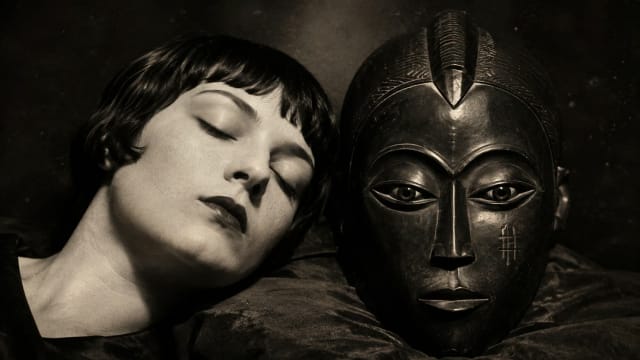
A woman sleeps with her eyes closed. Beside her lies another face, carved from dark wood, expressionless yet strangely alert. One breathes, the other does not. Yet the longer we look, the harder it becomes to decide which possesses the greater presence. In Noire et Blanche (1926), Man Ray's photograph of Kiki de Montparnasse beside an African mask does more than juxtapose two objects. It reveals a peculiarity of human perception. We do not merely recognize faces. We negotiate with them.
The human brain evolved to detect faces with astonishing efficiency. A few shadows arranged in the right pattern become a pair of eyes and a mouth. We see faces in clouds, electrical sockets and the front of cars. Neuroscientists call this pareidolia. Evolution rewarded those who mistook a rock for a lurking predator more often than those who ignored a real threat. Better to imagine a face where none exists than fail to notice one that does. The result is that faces command our attention before reason has a chance to intervene.
Yet Noire et Blanche is unsettling for a deeper reason. The African mask is not merely shaped like a face. It was created to embody one. Across many African cultures, masks have never been decorative sculptures. They mediate between ancestors and the living, the visible and the invisible, the individual and the community. Detached from ritual and displayed in European galleries, however, the mask acquires an entirely different meaning. It becomes an aesthetic object, admired for its form rather than its function. The photograph captures precisely this moment of transformation.
We do not wait for certainty before granting the world a mind. We infer it. We imagine it. We create it.
Modernists celebrated such encounters. Picasso, Matisse and Man Ray found in African art a visual language that shattered European conventions of realism. They believed these objects offered a more fundamental understanding of human expression. Critics today, however, argue that admiration often concealed appropriation. Europe borrowed the mask's beauty while stripping away the world that gave it significance. The debate is not merely historical. It asks whether art can ever be separated from the culture that created it.
Still, reducing the photograph to a story of cultural appropriation misses its most enduring insight. The image is compelling because it exposes how quickly the boundary between person and object dissolves. Kiki closes her eyes until she resembles a sculpture. The mask, though carved from wood, appears intensely conscious. The living becomes still. The lifeless appears awake. Our perception oscillates because humanity is something we project as much as something we observe.
This tendency extends far beyond art. We apologize to robots that bump into us, assign personalities to virtual assistants and mourn the destruction of fictional characters. Engineers designing social robots carefully place two eyes above a mouth because they know that a face is not merely decoration. It is an invitation to empathy. Once we perceive a face, we instinctively search for intention, emotion and consciousness, even when none exists.
Perhaps the true subject of Noire et Blanche is not race, modernism or surrealism, important though each remains. It is the remarkable generosity of human perception. A carved mask, a marble statue, or a machine with blinking LEDs can all awaken the same ancient circuitry. We do not simply see the world. We populate it with minds.
A photograph that appears to contrast two faces ultimately reveals only one. The other has always been our own, endlessly reflected onto the objects we encounter. The mask does not become human because it resembles us. It becomes human because we cannot resist seeing ourselves within it.
Discussion
Sign in to join the discussion.
More in Visual Arts

The Thief Who Made the Mona Lisa Famous
When a former worker walked out of the Louvre in 1911 with a modest portrait under his smock, he removed a painting and, by most accounts, helped create an icon.

Why Madhubani Paintings Refuse Empty Space
Explore the history, symbolism and cultural significance of Madhubani paintings, the vibrant folk art tradition of Mithila rooted in Indian mythology.

The Birth of Venus and the Problem of Beauty
An introspective take on Botticelli’s Birth of Venus, where beauty unsettles, lingers, and reshapes perception rather than offering simple meaning.
The Monkey's Paw
The Monkey's Paw is more than a horror story. It foreshadowed AI alignment by exposing the danger of systems that obey words but ignore intent.