The Rapture of Psyche
A nineteenth century painter who was once the most successful in France was later dismissed for polish, and the dispute depends on what a painting is expected to do.
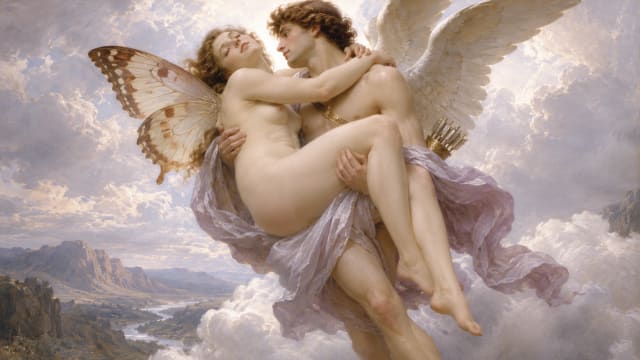
Academic painting, the manner taught and rewarded by the French Académie des Beaux Arts in the nineteenth century, prized finish, idealised form and a subject drawn from myth or history, and it tested a painter by mastery of a shared standard and not by novelty. William Adolphe Bouguereau was its most successful practitioner, and Le Ravissement de Psyché, painted in 1895 when he was about seventy, shows the manner at its most complete. A nude Psyche is carried upward in the arms of Cupid through clouds that lighten towards the top, while a rocky landscape and a river fall away below. She has the wings of a butterfly, for the Greek word psyche means both soul and butterfly.
The subject comes from the tale of Cupid and Psyche in the Metamorphoses of Apuleius, a Latin novel of the second century. In that tale Psyche, left on a mountain to be married to a monster, is lifted by the west wind and set down in a palace. Bouguereau gives the task of carrying her to Cupid himself, and he changes the mood, for his Psyche has closed her eyes and wears a faint smile. The terror that opens the story has been removed, and what remains is the allegory the tale has long been read as, the soul raised by love. The picture resolves its myth before it begins.
In his lifetime Bouguereau stood as high as a painter could. He entered the Académie in 1876, and taught for decades at the Académie Julian. The Impressionists, who painted modern life with visible brushwork, wanted exactly what he refused to supply, and Edgar Degas is said to have mocked overpolished pictures as bouguerated. After his death in 1905, critics who told the story of modern art as a march towards the new left academic painters outside it, and a smooth surface came to be read as an empty one.
That judgement has since been challenged, though not settled. Exhibitions in the 1970s and 1980s brought academic painters back into view.Defenders point to the labour that the smoothness conceals. The progression of violets and whites and the weight of two bodies that nonetheless appear to rise are not accidents. To make a surface show no trace of effort demands more effort than to make it show every stroke. Sceptics reply that a picture in which nothing is difficult for the figures, the painter or the viewer has chosen comfort over inquiry.
To make a surface show no trace of effort demands more effort than to make it show every stroke.
The dispute turns on the standard applied. If originality is the measure, the painting is a refined repetition of an old ideal, and it fails. If the measure is how fully a shared ideal can be realised, it succeeds. Nothing on the canvas can decide between the two standards, which come from outside it. The fall and recovery of Bouguereau's reputation may therefore say less about the painting than about the periods that judged it, and they leave open whether recent admiration is a discovery of merit that earlier critics overlooked or only a change in what a generation is prepared to find beautiful.
CAT VARC practice
This passage is written in the CAT style. Its 4 questions are just below, and you can take them on the real CAT exam screen.
Also writing other exams? Solved XAT verbal PYQs, IPMAT verbal PYQs, CLAT English PYQs and GMAT reading, all free.
Discussion
Sign in to join the discussion.
More in Visual Arts

The Urinal That Became Art and the Artist Who May Not Have Made It
A porcelain urinal entered the history of art in 1917 as an argument about choosing, and a century later the argument has turned on who did the choosing.

The Thief Who Made the Mona Lisa Famous
When a former worker walked out of the Louvre in 1911 with a modest portrait under his smock, he removed a painting and, by most accounts, helped create an icon.
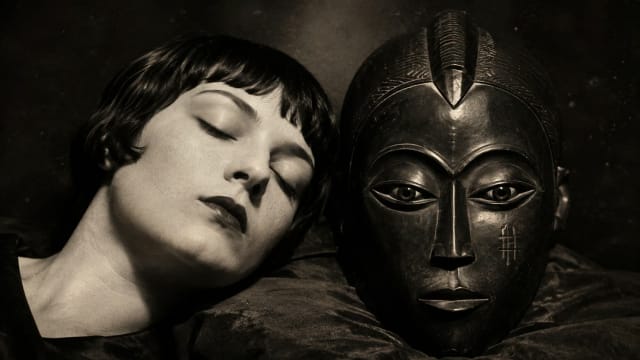
Kiki with African Mask
Why does a carved mask seem alive? Man Ray's iconic photograph reveals why humans instinctively project consciousness onto faces, real or imagined.

Why Madhubani Paintings Refuse Empty Space
Explore the history, symbolism and cultural significance of Madhubani paintings, the vibrant folk art tradition of Mithila rooted in Indian mythology.