Diwali: The Many Stories Behind a Festival of Light
Millions explain Diwali lamps by Rama's return to Ayodhya. The texts, the regions and the other faiths that light the same lamps tell a messier and more interesting story.
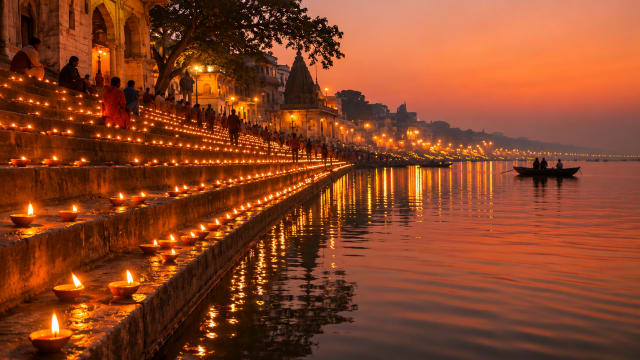
Every autumn, millions of Indian households explain their rows of clay lamps with a single sentence, that Rama returned to Ayodhya after fourteen years in exile and the city lit the way home. The account is told in schools, on television and in picture books, and it feels as old as the festival itself. Its reasonableness is easy to see. Lamps suit a homecoming, the epic is among the best loved texts in the subcontinent, and a festival gains authority when it carries a famous story.
The story also fits the calendar well enough. Diwali falls around the new moon of the month of Kartika, in the dark half of the lunar month when light is most welcome, and a return after a long darkness maps onto it naturally. Retellings in the north and west treat the lamps as a direct memorial, and few families feel a need to look further. The pairing also gives children a story they can act out, with a hero, a villain and a happy ending, which helps it spread. For the purpose of ordinary devotion nothing more is required.
Yet the account begins to loosen on contact with other regions. In much of the south the first morning is Naraka Chaturdashi, which is associated with Krishna and Satyabhama and the defeat of the demon Narakasura. In Bengal and Assam the night belongs to Kali, worshipped at midnight. Texts such as the Padma Purana link the festival with Lakshmi, who is said to have risen from the churning of the ocean, and in Kerala some traditions remember the king Bali. None of these requires Ayodhya, and each region has made the festival answer its own questions.
Other communities tell other stories again. Jain tradition holds that Mahavira attained liberation on this night, and Sikhs observe Bandi Chhor Divas for the release of Guru Hargobind from the fort at Gwalior, an event placed in the reign of Jahangir. The festival is thus held in common by communities whose sacred histories differ, and each reads the same lamps differently. A shared practice has accumulated several explanations, and no single explanation appears to have produced it.
A shared practice has accumulated several explanations, and no single explanation appears to have produced it.
The textual record sharpens the difficulty. Neither Valmiki's Ramayana nor Tulsidas's Ramcharitmanas is reported to mention Diwali, which suggests that the popular link was made later. References to the festival under names such as Deepotsava occur in several Puranas whose dates are debated, and in King Harsha's seventh century play Nagananda. Some scholars have suggested older roots in a night of Yaksha worship, and others point to a post harvest festival tied to fertility and soil. None of these readings is established as the original.
That reverses the usual order of explanation. The Rama story may not have given rise to the lamps. The lamps were perhaps already there, and stories gathered around them like moths, each lending the practice a reason that a particular community needed. In December 2025 UNESCO inscribed Deepavali on its Representative List of the Intangible Cultural Heritage of Humanity, which treats it as a living practice and not as a single remembered event. Whether the festival has no origin, or only an origin that no text records, is a question the lamps themselves do not answer.
CAT VARC practice
This passage is written in the CAT style. Its 4 questions are just below, and you can take them on the real CAT exam screen.
Also writing other exams? Solved XAT verbal PYQs, IPMAT verbal PYQs, CLAT English PYQs and GMAT reading, all free.
Discussion · 2
The Interpretation of festival "Diwali" has been different across different culture ranging from return of rama to Ayodhya to release of Guru Hargobind from the fort at Gwalior , hence it is multifacted seeing the lighting of lamps through their own cultural practices.
Spot on. Many stories, one festival of light. Thank you for reading!
Sign in to join the discussion.
More in Rituals & Celebrations

The Soda Company That Did Not Dress Santa in Red
Many people believe that a soft drink company gave Santa Claus his red suit. The older record shows a more interesting story about how a tradition gets its single shape.
Why Festivals Survive Modernity: An RC on Rakshabandhan
Every generation predicts that urbanisation and busy schedules will kill traditional festivals. Every generation is wrong. The reason has less to do with sentiment than with function.
The God of Obstacles: An RC Inspired by IIM Indore
Ganesha removes obstacles. Ganesha places them. The same deity, the same tradition, the same prayer. This is not a contradiction. It may be the most honest theology ever written about the nature of difficulty.
Why Lizzie Borden Was Acquitted: An RC Inspired by IIM Indore
The evidence against Lizzie Borden was strong. The jury acquitted her in ninety minutes. What happened in that room had very little to do with the evidence.