The Machine That Cured Nothing - An RC Inspired by IIM Indore
A popular story says Victorian doctors invented the vibrator to treat hysterical women. The tale has been repeated in films, plays and classrooms, and its own evidence is far thinner than its fame.
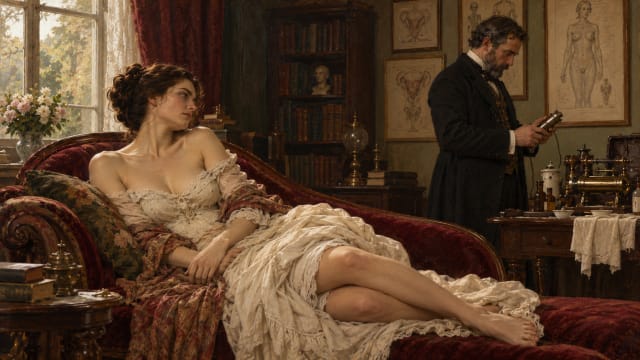
In 1999 the historian Rachel Maines published a book arguing that Victorian physicians had routinely treated hysteria by manually inducing a paroxysm in female patients, and that the vibrator was devised to spare tired doctors the labour. The claim was vivid, a little scandalous and perfectly shaped for retelling. It reached a Broadway play, a feature film and countless articles, and it settled into popular memory as a fact about the nineteenth century. Few of its retellers had read the book that began it.
The story flatters its audience. Victorian doctors appear as prudish men who could not see what they were doing, patients as women whose distress was invented by a profession that misunderstood them, and the modern reader as the one who finally understands. Hysteria was indeed a sprawling diagnosis applied to women with an enormous range of complaints, and physicians did prescribe massage, baths and other manipulations. The tale begins from real materials, which is part of why it persuades.
The trouble lies in the joints. Maines drew her central claim largely from medical texts that recommended pelvic massage, but those texts rarely described the procedure as the induction of a climax, and she inferred the intent from what they omitted. Later historians, most notably Hallie Lieberman and Eric Schatzberg, examined the same sources and the early electromechanical devices and found no clear evidence that physicians used vibrators to induce orgasm in patients with hysteria. The earliest devices were marketed for muscle complaints and general health, and were sold to doctors for a range of ailments. Maines herself has said that her argument was a hypothesis and not a settled finding.
The tale begins from real materials, which is part of why it persuades.
Defenders of the popular version reply that medical writers of the period were famously evasive about sexuality, so silence in the record proves little. The reply has force, since an absence of evidence is not always evidence of absence. Yet it proves too much. If the lack of documents counts as confirmation, then no document could ever count against the claim, and a theory that cannot be contradicted has stopped being a finding and become a posture. The honest position is that the question is open and the sources are thin.
What the episode really shows is how a story can outlive its evidence by satisfying a need. The modern audience wanted a comic example of medical ignorance, and the Victorians, who left no way to answer back, made a safe target. Mockery of the past carries a quiet assurance that the present is wiser, and an assurance of that kind seldom invites checking. The tale also reduced a real history of women whose suffering was dismissed to a punchline about an appliance, which obscured the more serious matter.
The irony is complete. A claim about doctors who mistook a pattern of symptoms for a disease was itself adopted because it fit a pattern the audience already held. Whether a future age will find our own favourite stories about the past equally convenient is not a question that can be settled by consulting the sources, since the sources are read by people who have already decided what they hope to find.
Discussion
Sign in to join the discussion.
More in History of Ideas
Why the Berlin Wall Fell Because of a Miscommunication: An RC Inspired by IIM Indore
Gunter Schabowski had not been briefed. The decision he announced had not been implemented. The gates he declared open were still closed. Within hours, the Berlin Wall had ceased to exist.

The Soldier Who Didn't Know the War Was Over: An RC Inspired by IIM Indore
Hiroo Onoda fought in the Philippine jungle until 1974, twenty-nine years after Japan surrendered. He was not deluded. He was doing exactly what a loyal soldier should do.

The Search Before the Search
The Greenbrier Ghost helped reopen a murder case. What followed reveals a deeper truth about evidence, belief, and knowledge.

The Grain Before the Word
The world's first writing wasn't poetry or prayer. It was an invoice for barley, and that changes what writing's origin actually tells us.