Why the Berlin Wall Fell Because of a Miscommunication: An RC Inspired by IIM Indore
Gunter Schabowski had not been briefed. The decision he announced had not been implemented. The gates he declared open were still closed. Within hours, the Berlin Wall had ceased to exist.
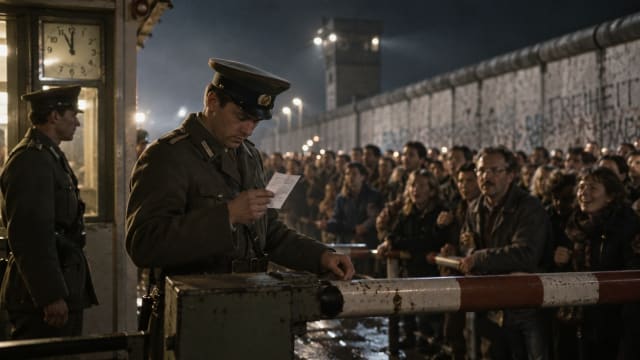
On the evening of 9 November 1989, an East German Communist Party spokesman named Gunter Schabowski sat down at a press conference in East Berlin and announced, to a room full of journalists, that citizens of the German Democratic Republic would be permitted to cross the border into West Germany. When asked when this would take effect, he shuffled through his papers, found nothing helpful, and said: immediately, without delay. He had not been briefed. The decision he announced had not yet been implemented. The gates he declared open were still closed. Within hours, crowds had gathered at the checkpoints, the guards had stood down rather than fire into the mass of people, and the Berlin Wall had effectively ceased to exist. One of the most consequential moments in twentieth century history had been produced by a man reading from the wrong piece of paper.
The standard account of the Wall's fall emphasises the deep structural forces. The Soviet economy was failing. Mikhail Gorbachev had signalled that Moscow would no longer use force to prop up Eastern European regimes. Mass protests had been building across East Germany for weeks. All of this is true. It is also a retrospective narrative that turns a specific accident into an inevitable outcome. The structural conditions created the pressure. What they did not determine was when the rupture would occur, at which checkpoint, or whether the guards would shoot. Those outcomes were determined by a forty-minute press conference in which a tired bureaucrat answered a question he did not know the answer to.
Historians call this the contingency problem. Large historical events have structural causes, economic, political, demographic forces that build over years or decades. But large historical events also have triggers, and triggers are often accidental. The assassination of Archduke Franz Ferdinand in Sarajevo in 1914 was the trigger for a war that the structural conditions of European power politics had made likely. But it was also the result of a wrong turn by a driver and a chance encounter on a bridge. Remove the wrong turn and the First World War may still have happened, but not in July 1914, not from that specific cause, and possibly not in the form it took.
The structural conditions created the pressure. What they did not determine was when the rupture would occur, at which checkpoint, or whether the guards would shoot.
The counterargument is that accidents only work when the structural conditions are ready. If the Soviet economy had been healthy, if Gorbachev had been a hardliner, if the East German population had not already been in open revolt, then Schabowski's mistake would have produced a clarification the following morning and nothing more. The Wall would have fallen eventually, this argument runs, because the forces demanding its fall were overwhelming. The specific night was an accident. The outcome was not.
This is a reasonable position and a slightly dishonest one. It is true that structural conditions constrain what accidents can produce. But the form that historical events take is not incidental to their meaning. The Berlin Wall fell peacefully, with crowds rather than soldiers deciding the outcome, because it fell the way it did. A planned military operation, an organised uprising, or a negotiated withdrawal would have produced different precedents, different international responses, and a different shape for German reunification. The accident was not merely the timing. It was the mode, and the mode mattered.
Schabowski gave another interview decades later in which he described the moment without apparent regret. He had not known what he was announcing. He had read from a note he had not read before sitting down. The journalist who asked the follow-up question about timing did so because it seemed like a reasonable thing to ask. The guards at the checkpoints stood down because the crowds were too large and they had no orders to fire. Each person in this chain made a local decision based on local information, and the aggregate of those decisions ended a structure that had divided a continent for twenty-eight years. History, at its hinge points, is often this: a series of small, contingent choices that nobody involved understood to be historic until they were already over.
Discussion · 1
According to the passage, one of the most consequential events in twentieth century history had been produced by a man reading from the wrong piece of paper. Even after that the event turns into an inevitable outcome. A retrospective narrative is that structural condition created the pressure. what it does not determine was when that particular event would occur, at which checkpoint. Historians call this the contingency problem. Large historical events have triggers and triggers are often accidental; a particular event would cease to happen but on which trigger, that is unknown.The counterarguement is that accidents only work when the structural conditions are ready. It is a reasonable position but not totally true, the form that historical events take is not incidental to their meaning. A planned event could have generated different outcome from the event that was accidental. The accident was not merely timing, It was the mode and the mode mattered.
Sign in to join the discussion.
More in Modern History

The Emperor Who Was Not Short
For two centuries the autopsy figure has been cited as proof that Napoleon was small. A look at the units, the cartoons and the nicknames tells a different story.

The Queen Who Never Offered Cake
Her most famous sentence was probably never hers. The story of how it stuck says more about the people who believed it.
The Press Did Not Start the Reformation: An RC Inspired by IIM Indore
The printing press spread the Reformation. It did not cause it. The soil was prepared long before Gutenberg printed a single page.

The Search Before the Search
The Greenbrier Ghost helped reopen a murder case. What followed reveals a deeper truth about evidence, belief, and knowledge.