The Zebra's Stripes
Camouflage, heat and recognition were all offered to explain the zebra's stripes, but field work now points towards a smaller enemy, the biting fly.
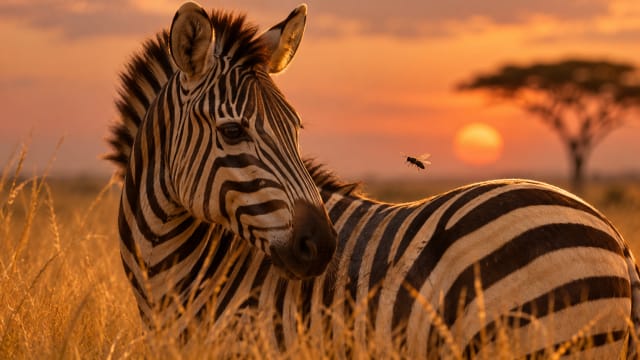
Few animal patterns have collected as many explanations as the black and white stripes of the zebra. Early naturalists suggested that the stripes work as camouflage, since a herd standing in tall grass at dusk may be hard for a lion to pick out. Others proposed that the stripes confuse a predator trying to single out one animal from a moving herd, that they help the body lose heat, or that they let zebras recognise one another. Each idea sounded sensible, and for many years none of them could be clearly tested.
A different line of work began by looking at where stripes occur. In 2014 Tim Caro of the University of California, Davis, and colleagues compared the striping of several kinds of wild horse, zebra and ass with the places where each lives. They found that the strength of striping matched, more closely than anything else they tried, the regions where biting flies such as horseflies and tsetse flies are common. Lion range and tree cover showed little link with striping. A match across a map is only a correlation, but it gave the fly idea a head start.
The next step was to watch flies at close range. In 2019 Caro, Martin How and colleagues filmed horseflies around captive zebras and domestic horses at a stable in North Somerset, England. The flies circled both kinds of animal at about the same rate. The difference came at the last moment. Flies approaching horses slowed down and landed, but flies approaching zebras did not slow down in the usual way, and they tended to make clumsy landings or none at all, so far fewer landed. Flies that did land on a zebra also stayed for a shorter time.
The flies circled both kinds of animal at about the same rate.
In a second test the researchers dressed horses in coats that were plain black, plain white or striped like a zebra. The striped coats attracted fewer landings than the plain ones. This suggests that the pattern itself, and not something peculiar to a zebra's skin or smell, interferes with the way a fly judges its landing.
The result does not close the case. The experiments show that stripes reduce landings, but they do not show how. One suggestion is that the pattern confuses the fly's judgement of motion as it comes in to land, so that it fails to slow down. The researchers themselves describe the mechanism as a proposal and not as a proven fact.
The fly explanation is therefore the best supported of the ideas tested so far, though it is not the only one still standing. Camouflage and social recognition have not been ruled out, and stripes may serve more than one purpose. A pattern that looks like a simple puzzle may have an answer that is less tidy than any of the early explanations promised.
IPMAT verbal practice
This passage is written in the IPMAT style. Its 6 questions are just below in exam mode.
Discussion
Sign in to join the discussion.
More in Animals
The Emu War and the Problem Soldiers Could Not Shoot
In 1932 machine guns were sent against emus in Western Australia, and the birds won the first round. The story is usually told as comedy, yet it hides a real question about what kind of problem an army can solve.
The Cliff That Was Built: An RC Inspired by IIM Indore
A famous film showed lemmings marching to their deaths in 1958. The scene was staged, and the myth it fed says more about the audience than about the animal.

The Leopard That Moved Back to Mumbai: An RC Inspired by IIM Indore
Dozens of leopards live inside Sanjay Gandhi National Park, entirely surrounded by Mumbai, and attacks on people have been recorded for decades. Neither the city nor the leopards are going anywhere.
The Parrot That Bets Everything on One Fig: An RC Inspired by IIM Indore
The Dracula Parrot eats almost nothing but figs from a single genus of tree. Its beauty is the product of extreme specialisation. So is its vulnerability.