The Leopard That Moved Back to Mumbai: An RC Inspired by IIM Indore
47 leopards live inside Sanjay Gandhi National Park, entirely surrounded by Mumbai. They have killed more than thirty people since 2002. Neither the city nor the leopards are going anywhere.
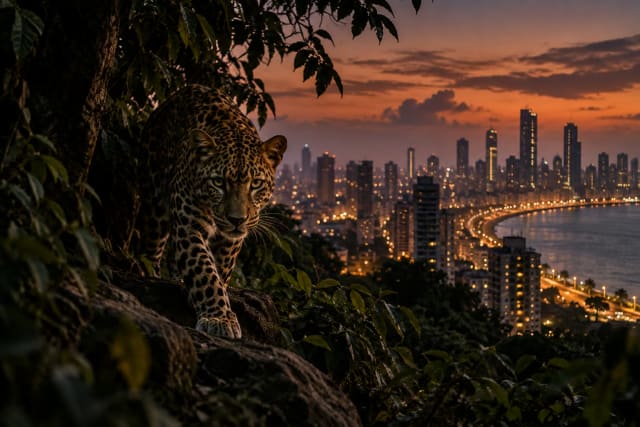
On a January morning in 2021, a leopard walked through the gate of a housing society in Aarey Colony, padded across the parking lot, and disappeared into a cluster of trees behind the building. A security guard filmed it on his phone. The video went briefly viral. Residents called the forest department. By the time officials arrived, the leopard was gone. This happens several times a year in Mumbai, and has for decades.
Sanjay Gandhi National Park occupies 104 square kilometres in the northern part of the city. It is entirely surrounded by one of the densest urban agglomerations on earth. Inside it live approximately 47 leopards, confirmed by camera traps, though the actual number is thought to be higher. They hunt deer, monkeys, dogs and domestic animals at the park's edges. Occasionally they take people. Since 2002, leopards from the park have killed more than thirty people in Mumbai, most of them children taken while sleeping near open doors or walking at night near the forest boundary.
"These are not man-eaters," said Vidya Athreya, a wildlife biologist who has studied the Sanjay Gandhi leopard population for over fifteen years. "They are opportunistic. A child sleeping near an open doorway looks like prey. A dog on a leash looks like prey. The leopard is not targeting humans. It is doing what leopards do." Athreya's research has consistently found that leopards living near dense human settlements are not more aggressive than those in remote forests. They are in fact more cautious.
The coexistence of leopards and twelve million humans in a single city is not an accident. It is the result of geography, history and a legal framework that has, so far, held. The park was established in 1969, when Mumbai's northern suburbs were far less developed than they are today. The city has since grown around it on all sides. The leopards did not move into human territory. The humans moved into leopard territory, and the leopards stayed.
What makes Mumbai unusual is not the presence of large carnivores in an urban setting, rarer than it once was but not unique. What is unusual is that the coexistence has persisted. In most cities where wildlife conflicts occur, the response is removal. The animal is captured and relocated, or killed. In Mumbai, the forest department's position has, for the most part, been that leopards inside the park's boundary are park animals, and park animals are not to be relocated simply because they are inconvenient.
The leopards did not move into human territory. The humans moved into leopard territory, and the leopards stayed.
Athreya believes this policy, however imperfectly implemented, is the reason the population has survived. "If you relocate a leopard, you create a vacancy," she said. "Another leopard moves in to fill it. You have not solved the problem, you have spent resources and added stress to an animal for no long-term benefit." The argument against relocation is both ecological and practical. A relocated leopard in unfamiliar territory is more likely to come into conflict with humans than one that knows its home range.
The residents of the settlements bordering the park have not been asked whether they consent to sharing their neighbourhood with apex predators. Many of them have no choice about where they live. The leopard question is, among other things, a question about whose interests count when wildness and poverty occupy the same geography.
There is no clean resolution to this. The leopards are not leaving. The city is not shrinking. What Mumbai offers is not a solution but a condition: an uneasy, occasionally fatal proximity between two kinds of creature that have learned, imperfectly, to tolerate each other's presence.
Discussion · 2
Mumbai has faced attacks of lepords from national park like the one mentioned,sevral times, though it is not the only city to share space with carnivore, but rhe diffrence is the action taken on such incidents in mumbai as comp to other cities , animals causing inconvinience are killed or transported in other cities but in mumbai they are take back to parks. Author critisizes action of remoing animals as unfruitful and stressful for animals as well as authority ,because a substitute animal will be more concerning than a familiar one. The solution to the problem of human-carnivore shared geography remins unresolved in mumbai.
Tone - Analytical AND slightly critical
Sign in to join the discussion.
More in Animals
The Emu War and the Problem Soldiers Could Not Shoot
In 1932 machine guns were sent against emus in Western Australia, and the birds won the first round. The story is usually told as comedy, yet it hides a real question about what kind of problem an army can solve.
The Cliff That Was Built - An RC Inspired by IIM Indore
A famous film showed lemmings marching to their deaths in 1958. The scene was staged, and the myth it fed says more about the audience than about the animal.
The Parrot That Bets Everything on One Fig: An RC Inspired by IIM Indore
The Dracula Parrot eats almost nothing but figs from a single genus of tree. Its beauty is the product of extreme specialisation. So is its vulnerability.

When Whales Learn to Sing: An RC Inspired by IIM Indore
Whale songs reveal how isolation, imitation and migration can create, preserve and erase cultural differences within animal populations.