CSAT Comprehension Set on Groundwater, the GST Council and Antibiotic Resistance
Three short passages on farm power subsidies, shared tax decisions and the economics of antibiotics, with six questions in the style of UPSC Prelims Paper II.
Passage 1
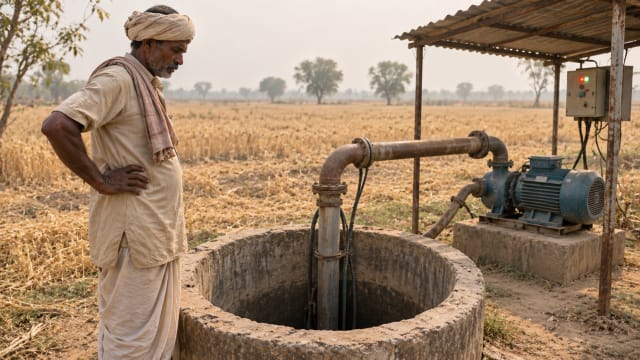
In several Indian states, electricity for agricultural pumps is supplied free or at a nominal price, and the cost is carried by state budgets and by other consumers. Farmers who pay little or nothing per unit of power have little reason to count the water that each unit lifts. Rice and sugarcane, which need far more water than millets or pulses, are assured procurement or a stable market in many regions, so the returns to growing them are predictable. Together these arrangements make the thirstiest crops the safest choice, even where the water table falls every year. Wells are then dug deeper, which needs more power, which adds to the subsidy bill. Attempts to meter or price electricity are resisted, because a farmer who has already invested in a deep borewell regards free power as part of the cost of staying in business. Reform is therefore less a technical problem of measurement than a problem of political trust, since farmers will accept new rules only if they believe that the support removed will be replaced by something reliable.
Passage 2
Article 279A of the Constitution, inserted in 2016, set up the Goods and Services Tax Council, in which the Union and the states sit together to decide the rates and rules of a tax that both levy. Every decision needs a three fourths majority of the weighted votes cast. The Union holds one third of the weight and the states together hold two thirds. The arithmetic gives the Union a veto, since its one third exceeds the one fourth that suffices to block a decision, and the states together hold a veto as well. No decision can pass without both. Most decisions have reportedly been taken by consensus and not by counting votes. Critics argue that this has also made decisions slow, and that states have given up the independent power to change tax rates on a large part of their revenue. Defenders reply that a single national market with shared rules was possible only because sovereignty was pooled.
Passage 3
Each course of antibiotics given to a patient or to a farm animal kills susceptible bacteria and leaves behind those that happen to resist the drug. These survivors multiply, and resistance can pass between bacteria of different species. The more a drug is used, the faster resistance emerges, yet restraint is hard to enforce. A doctor who withholds an antibiotic risks a patient's anger and a possible complication, whereas the cost of overuse falls on future patients who are not in the room. Economics adds to the difficulty. A new antibiotic is ideally used rarely and for short courses, which means that its maker sells little of it, so the return on research is low compared with a medicine taken daily for a chronic disease. Many large firms have therefore reduced their work on new antibiotics. Stewardship programmes that restrict the use of last resort drugs can slow the spread of resistance, but they do not remove the underlying shortage of new drugs.
UPSC CSAT comprehension practice
This passage is written in the CSAT style. Its 6 questions are just below in exam mode.
Discussion
Sign in to join the discussion.
More in Energy & Sustainability

The Jevons Trap: The Hidden Cost of Doing Better
Efficiency can increase total consumption as lower costs drive higher demand, revealing why saving resources is harder than it seems.
When Whales Learn to Sing: An RC Inspired by IIM Indore
Whale songs reveal how isolation, imitation and migration can create, preserve and erase cultural differences within animal populations.
The Animal With a Thousand Plans
The honey badger is often portrayed as the animal kingdom's fearless rebel. Yet its greatest strength is neither aggression nor toughness.

Nature Does Not Speak. We Do.
How does language shape our understanding of nature? Discover why animal behaviour, evolutionary biology and human perception are deeply intertwined.