Why Confucianism Believed Inequality Could Be Moral
Confucianism defended inequality by arguing that everyone begins with equal moral potential and that authority should reward virtue rather than birth.
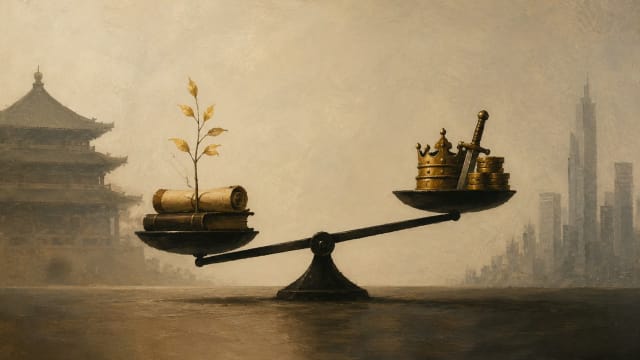
Every unequal society tells itself a story. Some societies appeal to noble blood. Others invoke divine will or the invisible hand of the market. The story changes across civilizations but its purpose remains remarkably constant. It explains why some people command authority while others obey. More than two thousand years ago, Confucianism developed one of history's most sophisticated versions of this narrative. Inequality, it argued, is not only unavoidable. It can also be morally justified when it reflects differences in virtue rather than differences in birth.
Confucius lived during an age of political violence and institutional collapse. Rival kingdoms fought relentlessly while rulers competed for power with little regard for moral restraint. He believed that the roots of disorder lay not in flawed institutions but in flawed character. A peaceful society therefore required morally cultivated individuals who could govern with wisdom and restraint. Politics began with ethics because governments merely reflected the quality of the people who led them.
This vision rested upon an unexpectedly egalitarian foundation. Confucius rejected the idea that moral excellence belonged exclusively to aristocrats. Every human being possessed the capacity for self cultivation through education, discipline and ritual practice. Birth determined neither virtue nor destiny. Anyone could improve through sustained effort. Mencius later expanded this claim by arguing that every person carries within them the natural potential for goodness. Human beings begin from the same moral starting point even if they finish in very different places.
"The most persuasive defence of inequality is not that people begin unequal but that everyone begins equal."
Yet this equality of potential produced a strikingly unequal conclusion. If everyone shares the same opportunity for moral growth then unequal outcomes become evidence of unequal commitment. Those who cultivate compassion, judgment and self restraint deserve positions of authority because they have earned them through discipline rather than inheritance. Confucianism therefore transforms hierarchy into a reward for character. Political power belongs not to the privileged but to the worthy.
Critics often view this argument as an elegant defence of elitism. They point out that opportunities are rarely distributed equally. Wealth, family background and education shape people's chances long before personal effort enters the picture. If starting conditions differ so dramatically then outcomes cannot simply reflect virtue. Meritocracy risks becoming a comforting myth that disguises inherited advantage as earned success.
This criticism exposes a genuine weakness but it also overlooks the distinctive ambition of the Confucian project. Confucian thinkers were less interested in describing existing societies than in prescribing standards for legitimate rule. Their question was not whether rulers happened to possess power. Their question was whether they deserved it. By demanding continuous moral cultivation they imposed obligations upon elites that hereditary aristocracies rarely accepted. Authority required ethical excellence rather than noble ancestry alone.
The deeper consequence of this philosophy emerges once virtue becomes the measure of status. Inequality acquires a moral language. Success appears to reflect discipline while failure begins to resemble personal deficiency. Social hierarchies no longer seem arbitrary because they present themselves as the visible expression of invisible character. The fortunate become admirable not simply because they possess more but because they appear to deserve more.
Perhaps this explains why Confucianism continues to resonate in modern societies that rarely mention virtue at all. Today's language celebrates productivity, resilience, talent and performance instead of ritual and moral cultivation. Yet the underlying grammar remains remarkably familiar. We continue to believe that open competition transforms unequal outcomes into just outcomes. The vocabulary has changed but the logic has endured. The most persuasive defence of inequality has never been that some people are born above others. It is the far more powerful belief that everyone began at the same place and that every difference which followed was earned.
Discussion · 4
Confucian started with the objective of holding people in power accountable morally, but their assumption that everyone started at the same level is incorrect as not all people start the same and birth plays a significant factor. Though their intention was noble and Mencius assumption of everyone having a potential for goodness holds through, their process or approach of evaluation of who was worthy was incorrect which is similar to contemporary times. Because even in contemporary times, it praises productivity, and performance more than the underlying thought, deed, and action.
according to confucius , inequality can be morally justified when it reflects difference in virtue instead of differences in birth,every human can gain knowledge through education and discipline, humans beings start from the same moral starting point . yet , critics argue that opportunity are rarely distributed equally. unavailability of same opportunity changes people's efforts. however confucius was interested in describing legitmate rule , authority require ethical excellence and not merely through inheritance or noble lineage.
B should be the answer of 3rd question
Confucianism teaches that everyone can become a better person through learning and good behavior. People with better character should lead because they earn it, not because of their birth. Critics say this is unfair because not everyone gets the same chances in life. Even today many people believe success comes only from hard work, which can make inequality seem fair..
Sign in to join the discussion.
More in Ethics

Why Krishna Is the Most Philosophically Dangerous Character in Indian Literature
Krishna lies, cheats and engineers deaths. The Mahabharata calls him the fullest embodiment of dharma. This is not a contradiction. It is the most demanding position in Indian moral philosophy.

Hachikō and the Weight of Waiting
Why does Hachikō's story still move millions? A philosophical reflection on loyalty, memory, grief, and the kind of love that outlives death itself.

Moral Luck
Two men drive home equally drunk. Only one kills a child. Philosophy calls the gap between them moral luck.

The Strange Prestige of Suffering
A great story can emerge from a wound. But does that mean the wound was necessary? A reflection on suffering and growth.