Why Krishna Is the Most Philosophically Dangerous Character in Indian Literature
Krishna lies, cheats and engineers deaths. The Mahabharata calls him the fullest embodiment of dharma. This is not a contradiction. It is the most demanding position in Indian moral philosophy.
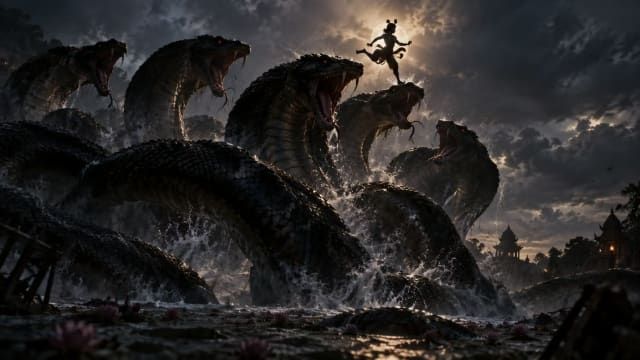
Krishna lies. He counsels Yudhishthira to deceive Drona about his son's death. He engineers the killing of Karna when Karna is disarmed. He advises Bhima to strike Duryodhana below the belt, violating the rules of mace combat that both sides had sworn to uphold. He does these things deliberately, with full knowledge of what he is doing, and the Mahabharata presents him not as a flawed hero who sometimes fails his principles but as the fullest embodiment of dharma available to human understanding.
This is not a minor theological inconvenience. It is a direct challenge to the most intuitive assumption in moral philosophy, which is that a good person is one who acts by good rules and that moral excellence consists in reliably following those rules regardless of consequences. Krishna does not follow rules. He reads situations. And the text treats his situational judgment not as moral compromise but as moral mastery.
The contrast with Western moral philosophy is instructive. Kant argued that the moral worth of an action derives entirely from the principle behind it. A lie told to save a life is still a lie and therefore wrong, because if lying were universalised the very institution of truth-telling on which the lie depends would collapse. The rule is what matters, not the outcome. Krishna would find this position not merely incorrect but naive, a category confusion between the map and the territory.
What the Mahabharata proposes instead is something far more demanding. Dharma is not a set of rules to be followed but a quality of attentiveness to what a situation actually requires. A person of dharma perceives the moral structure of a situation directly, the way a musician hears what a melody needs next, rather than consulting a rulebook and applying its instructions. The rules that ordinary people follow are approximations, useful for those who cannot yet perceive situations with full clarity. For someone who can, the rules become unnecessary and sometimes obstructive.
This is dangerous for two reasons. The first is obvious. It requires a very high confidence in one's own judgment, a confidence that most people do not deserve and that, once assumed, is very difficult to dislodge from outside. The second danger is subtler. If dharma is situational and requires exceptional perception to grasp, then it cannot be taught through precepts. It can only be transmitted through relationship with someone who already possesses it.
Krishna is not a role model. He is a horizon.
Which is exactly what the Gita is. Not a rulebook but an attempt to transmit, through a single conversation at the edge of a catastrophic battle, the quality of perception that makes right action possible. Arjuna does not emerge from the Gita with a list of principles. He emerges with a transformed understanding of what action, identity and consequence actually mean.
The danger Krishna represents is therefore not the danger of a bad man who does bad things. It is the danger of a genuinely good person whose goodness operates at a level that cannot be verified from outside and cannot be safely imitated by those who have not reached it. He is not a role model. He is a horizon.
Discussion · 4
When I first studied the philosophy of Jeremy Bentham and Niccolò Machiavelli, I always viewed it through the lens of Krishna. In many ways, Krishna is the ultimate personification of these two philosophies. Even though he predates both thinkers by millennias, the resemblance is truly uncanny. When he convinces Yudhishthira to speak a deceptive truth to Drona, we see utilitarianism in action; when he steers the war toward a necessary victory, he embodies the Machiavellian truth that the ends justify the means. But Krishna doesn’t stop there—he goes far beyond them. He teaches that it isn't merely the actions you perform that make the difference, but the state of being in which you perform them. For him, this isn't a collection of rigid philosophies, theories, or ethics. He simply lives it. To Krishna, existence isn't a moral trial; it is a cosmic play—Lila. He exists above constructed morality because he is pure, unfiltered life itself. This is exactly why he is my role model. In any situation life throws at me, I don't want to be bound by a rigid, fragile definition of being 'right.'(Immanuel Kant) I want to be like him: fluid, effective, and profoundly relevant.
The author talks about oug perception towards what action is morally correct or wrong he compares western thaught of having certain rules which make something morally good or bad, and krishna's thaught about any actions' moral identity, author says that according doing correct thing according to situation is morrally right and vice versa,and this req person to be highly confident and able to make correct judgements and krishna teaches this through gita. tone - Slightly Persuassive and analytical Sir please check this sumary and tone.
The passage starts with a statement that Krishna lies and lists all the flawed things he does and how he does it with full knowledge of what he's doing yet the Mahabharata depicts him as an embodiment of dharma. Then it discusses how the depiction is a challenge to moral philosophy as a person with good moral values is somebody who follows the rules no matter the consequences and how Krishna doesnt do the same and rather he judges the situation yet again the text considers his situational judgements with moral mastery. Krishna's judgements and moral values are then contrasted with the West where Kant believes that a lie is a lie no matter the reason and how Krishna would find it to be incorrect and naive. Then it discusses how the Mahabharat is more demanding than considered and how Dharma is not a set of rules but a quality of attention to what a situation requires which has no rulebooks and cannot be taught through percepts but rather it can be transmitted through relationship with somebody who already has it but then its considered to be dangerous as ordinary people usually follow a rule book which is nothing but approximations for those who dont have full clarity but for somebody to reach the perceptual level of judgement as Krishna is dangerous as it requires high confidence in their own judgement but there is no sure way of verifying it from outside or imitating it as it might be high confidence in their judgement which might actually be an error.
sir, i have read the bhagvad gita, in the start of the gita they tells that you have to read gita by considering krishna as a param gyani which means that you have to consider perspective of krishna as a truth , some people might not like it, beacuse krishna does not talk considering rules insted he talk considering situation which you also mentioned in passage.
Sign in to join the discussion.
More in Ethics

Hachikō and the Weight of Waiting
Why does Hachikō's story still move millions? A philosophical reflection on loyalty, memory, grief, and the kind of love that outlives death itself.

Moral Luck
Two men drive home equally drunk. Only one kills a child. Philosophy calls the gap between them moral luck.

Why Confucianism Believed Inequality Could Be Moral
Confucianism defended inequality by arguing that everyone begins with equal moral potential and that authority should reward virtue rather than birth.

The Strange Prestige of Suffering
A great story can emerge from a wound. But does that mean the wound was necessary? A reflection on suffering and growth.