The Streak That Statisticians Said Never Existed - An RC Inspired by IIM Indore
A famous paper told basketball fans that streaks were an illusion. A later paper found a flaw in the arithmetic that produced the verdict.
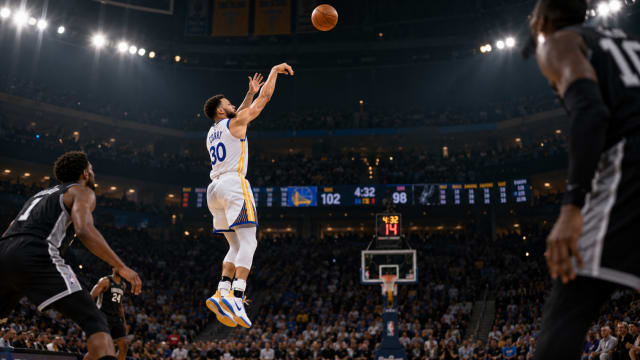
In 1985 three researchers published a paper that told basketball fans they were wrong about something they had watched for years. Thomas Gilovich, Robert Vallone and Amos Tversky studied shooting records from the Philadelphia 76ers and reported that a player who had just made a shot was no more likely to make the next one. Fans they questioned had said the opposite, and most believed that a player who has scored several times in a row is likely to score again. The paper called this belief the hot hand fallacy, and it became a standard exhibit in the case that human beings see patterns in randomness.
The argument was elegant. A fair coin produces runs of heads, and nobody credits the coin with momentum. If long streaks of made baskets occur about as often as chance predicts, then the feeling of heat is an illusion kept alive by memory, which preserves the streaks and forgets the many sequences that looked like nothing. The researchers also ran a controlled experiment with college players taking shots, which removed the influence of defenders who might crowd a shooter seen as hot. It too found no sign of streakiness. Coaches and players, by most accounts, remained unmoved.
The finding stood for three decades, and it shaped how behavioural economists described human error. The hot hand became shorthand for overconfidence drawn from small samples, and the label was applied to fund managers, gamblers and sports bettors alike. A result so useful and so widely repeated gathers a kind of authority that has little to do with how often anyone checks it.
In 2018 two economists, Joshua Miller and Adam Sanjurjo, reported a flaw in the method. Take a short sequence of fair coin flips, then look only at the flips that follow a head. In a finite sequence, the proportion of heads among those flips is expected to fall below one half, even though every flip is independent. Anyone who measures streakiness by averaging this proportion across sequences therefore builds in a downward bias. When the two economists corrected for it, the original data reportedly showed a modest hot hand effect, and the reanalysis was published in Econometrica.
Anyone who measures streakiness by averaging this proportion across sequences therefore builds in a downward bias.
Defenders of the original paper replied that the corrected effect is small, that it does not rescue fans who believed in dramatic streaks, and that real games contain defensive adjustments which hide any heat. Miller and Sanjurjo answered that a small effect found with a biased tool still reverses the verdict. Neither side has claimed that the matter is closed. A player who feels hot may also take harder shots, which would erase the very evidence that confirms the feeling.
What the dispute exposes is how often a test of human error carries its own assumptions about randomness. The researchers who diagnosed a bias in the fans did not suspect that a subtler form of the same bias lay in their own arithmetic. A mistaken intuition and a mistaken proof can both feel like clear sight from the inside. If experts trained to detect illusions can build one into a calculation that went unchallenged for thirty years, it is not obvious which of the many other findings that rest on similar reasoning deserve the confidence they receive.
Discussion
Sign in to join the discussion.
More in Logic & Probability

Abraham Wald and the Missing Bullet Holes
The statistician Abraham Wald is credited with telling the military to armour the parts of its bombers that showed no bullet holes. The advice sounds backwards until a reader asks which planes were never seen.

The Phenomenology of Embarrassment
Embarrassment is not shame. It is not guilt. It is the moment the self discovers, with retroactive mortification, that it has been visible all along, and that visibility was never chosen.

Moral Luck
Two men drive home equally drunk. Only one kills a child. Philosophy calls the gap between them moral luck.

Why Krishna Is the Most Philosophically Dangerous Character in Indian Literature
Krishna lies, cheats and engineers deaths. The Mahabharata calls him the fullest embodiment of dharma. This is not a contradiction. It is the most demanding position in Indian moral philosophy.