Tomorrow's Mothers Will Never Meet a Man
In an imagined state run by women to end male domination, children chant the crimes of the Old Era and men wait on a list, and the justification for both quietly repeats the logic it was built to abolish.

Every morning, a government clerk in an imagined Republic of Mothers examines a list of men awaiting reproductive assignments. Beside each name appear three numbers for genetic compatibility, fertility and permitted offspring. The clerk stamps the document and moves to the next file. Somewhere beyond her office a man waits to learn whether he will become a father. He has no right to know the woman, let alone choose her. Two centuries earlier such an arrangement would have seemed absurd. Now it is called civilisation.
Outside the office the Republic looks orderly. Women sit in the assemblies, own the land and command the army. Men live in state facilities on the edges of towns, where they cook, repair and farm under supervision, where a bell divides their day and where their movements are logged at every gate. Their fertility is counted as a public resource, like grain or water, and a number on a list is the nearest thing a man has to a vote.
Ordinary life follows from this. A birth is announced at the registry in two lines, one naming the mother and one giving the father's number. Once a year every school holds a lesson called Remembrance, in which the Old Era is read aloud. Children learn that it lasted thousands of years and ended within a single generation, and they chant its crimes the way earlier children chanted multiplication tables. A girl may grow up to be a judge, a general or a farmer without ever meeting a man as a neighbour or a friend, only as a doctor, a guard or an image on a screen.
Ask a teacher there whether this is fair and she will not hesitate. She will point to the figures. Crime has fallen, wars have become rare and reproductive technology has reduced deaths in childbirth. She will say, with some justice, that men once held disproportionate power and that centuries of violence and exclusion demand institutional correction. Liberty, she will add, is a luxury bought at the expense of collective security, and the Republic has chosen security. Her class listens, as classes do, to the answer they are expected to repeat.
The reply is neat and does not hold. It confuses the absence of visible conflict with the presence of justice, because a prison can be peaceful without being free. The more revealing fact lies in the teacher's own classroom. The state has not simply confined one population. It has engineered the imagination of another, and what citizens cannot experience they eventually struggle to recognise as a legitimate possibility.
It confuses the absence of visible conflict with the presence of justice, because a prison can be peaceful without being free.
The Republic has inherited exactly what it claims to have abolished, the assumption that biological difference can justify political hierarchy. There is an apparent logic in its case, since historical injustice does demand correction. But correction becomes another injustice when it punishes individuals for belonging to a category instead of holding them accountable for what they have done. Perhaps the final test of equality is not whether the formerly powerless can acquire power but whether they can refuse to turn power into a hereditary entitlement. The revolution changed who occupied the throne. It never asked why anyone needed one, and the children chanting the lesson are not yet old enough to notice that nobody did.
Discussion
Sign in to join the discussion.
More in Political Philosophy
The Word Meritocracy Began as a Warning
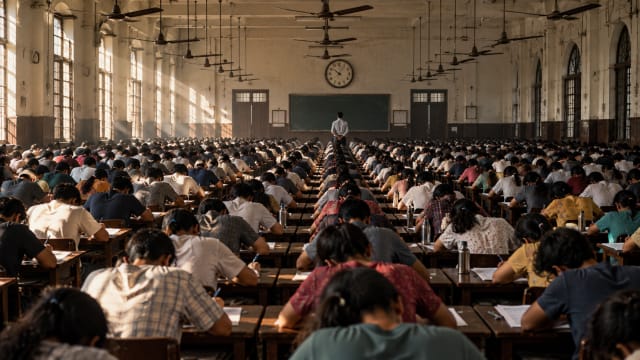
The man who made the word famous meant it as a satire. A look at his warning, at India's long argument over merit and reservation, and at what deserving can mean.

Freedom Is Not the Absence of Limits but the Choice of Them
In the Odyssey the hero orders his crew to tie him to a mast so that he can hear a song that has killed every sailor before him. The knots look like the end of freedom, and the story has been used for three thousand years to argue that they are its proof.
The Communist Manifesto: An RC Inspired by IIM Indore
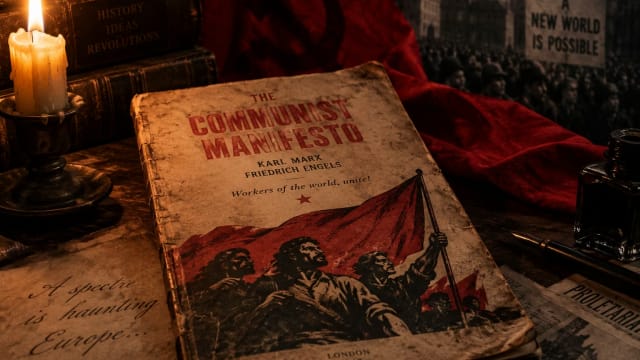
The Manifesto was written in six weeks by two men in their twenties. It inspired revolutions on four continents. The question is not whether its argument is correct. It is why the argument works so well.

Why Revolutions Eventually Resemble the Regimes They Destroy
A political philosophy essay exploring why revolutions slowly resemble the regimes they overthrow through power, control and ideology.