Can Water Become a Weapon?
Water is rarely a weapon by itself. But when control over its flow creates unequal dependence, rivers can become instruments of geopolitical power.
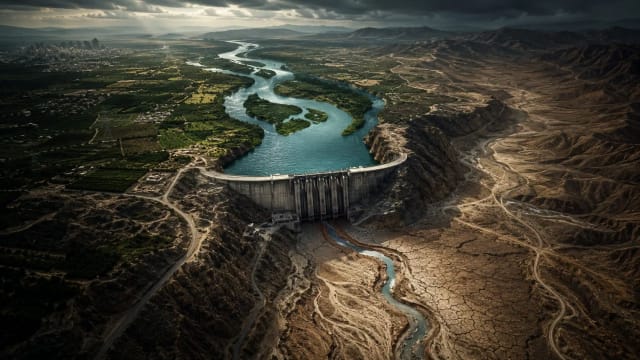
A river does not recognise a border. It crosses mountains, cuts through valleys and carries whatever falls into its current. Yet somewhere along its journey, human beings draw lines across the map and declare the water on one side a national resource. The contradiction is ancient but increasingly consequential. Water appears to be the most elemental of necessities, something too fundamental to politics. In practice, precisely because people cannot live without it, controlling its flow can become a form of power.
The weaponisation of water does not necessarily require a country to turn off a tap. It can begin with infrastructure. A dam built upstream can alter the quantity and timing of water reaching communities downstream. Irrigation systems can redirect rivers towards farms, cities or industries. During conflict, attacks on reservoirs, treatment plants and pumping stations can deprive civilians of drinking water without a conventional battle being fought. The strategic value of water therefore lies not merely in its scarcity but in the ability to control the systems through which it moves.
The weapon is not necessarily the water. It is the ability to control its flow.
This makes rivers politically peculiar. Oil can be stored in tanks and grain can be stockpiled in warehouses, but a river is simultaneously a resource and a relationship. Its use by one state can affect another state further downstream. The result is a geography of dependence. An upstream country may possess physical control over a river while a downstream country possesses political, economic or military leverage of its own. What looks like a natural resource dispute can therefore become a negotiation over sovereignty.
Yet it would be misleading to imagine every dam as a weapon or every water dispute as an impending war. States also cooperate over shared rivers, construct treaties and exchange information because mutual dependence can make conflict irrational. An upstream country that deliberately starves its neighbour may eventually create instability that crosses the border. Pollution, ecological degradation and mass migration rarely respect sovereignty. Water can punish its controller as easily as its target.
Water becomes geopolitics when unequal dependence turns geography into bargaining power.
The deeper problem, then, is not simply scarcity. It is asymmetry. Two societies may depend upon the same river while possessing radically different capacities to influence its course. One may control the dam. Another may control the market through which electricity or agricultural goods move. A third may possess the diplomatic power to internationalise the dispute. Water becomes geopolitics when unequal dependence turns geography into bargaining power.
This is why the familiar phrase “water wars” can obscure more than it reveals. The future may not be defined by armies marching towards rivers. It may be defined by quieter struggles over dams, pipelines, irrigation networks, treaties, technology and access. The decisive question will not always be who owns the water. It will be who controls the conditions under which others can reach it.
Power rarely requires possession. Sometimes it requires only the ability to decide what flows, where it flows and who must wait.
Water, then, does not become a weapon simply because it is scarce. It becomes a weapon when dependence can be controlled. The river remains indifferent, but the infrastructure around it is not. And perhaps that is the unsettling lesson of resource politics: power rarely requires possession. Sometimes it requires only the ability to decide what flows, where it flows and who must wait.
Discussion
Sign in to join the discussion.
More in Geopolitics

The Country That Replaced the Mirror with a Portrait: An RC Inspired by IIM Indore
North Korea did not ban mirrors. It did something more precise. It ensured that the only reflection available to its citizens was the one the state had prepared for them.

The World Is Becoming Medieval Again
Is the nation state losing its monopoly on power? Discover why the twenty first century increasingly resembles the political architecture of the Middle Ages.

The Strait of Gibraltar: Where Geography Becomes Power
A narrow strait that shapes global trade, migration, and power, showing how geography quietly controls the flow of the modern world.

The Art of Corporate War
An exclusive extract from Abhishek Leela Pandey's The Art of Corporate Power, exploring how capitalism transformed warfare into strategic competition.