The Country That Replaced the Mirror with a Portrait: An RC Inspired by IIM Indore
North Korea did not ban mirrors. It did something more precise. It ensured that the only reflection available to its citizens was the one the state had prepared for them.
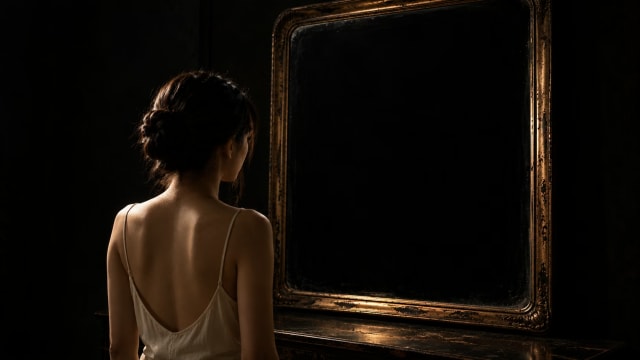
In North Korea, mirrors are not banned. This needs to be said at the outset, because the claim that they are is itself a kind of myth, and this essay is partly about how myths of control are sometimes more revealing than the actual mechanisms of control. What North Korea does instead is more precise and more interesting. It controls the surfaces on which citizens encounter their own reflection, the quality of glass available, the size of mirrors permitted in public spaces, the images through which citizens are encouraged to understand themselves. The regime does not need to ban mirrors. It needs only to ensure that the reflection a citizen sees is the one the state has prepared for them.
Every political system manages the images through which its citizens understand themselves. Democracies do it through advertising, media, and the construction of national narratives. Authoritarian regimes do it more directly. What distinguishes North Korea is the totality of the project. The state controls not just what citizens see in the world but what they see when they look at themselves. The approved self-image is highly specific. Citizens are encouraged to understand themselves as part of a collective, as participants in a historical struggle, as members of a family whose father is the Supreme Leader. The individual self, understood as something separate from this collective identity, is not a category the state makes available.
Psychologists who study identity formation argue that the self is not discovered but constructed, and that it is constructed through reflection, literally and metaphorically. You understand who you are by seeing yourself as others see you, by encountering your own image, by comparing that image against the images your culture makes available. Remove access to accurate reflection and you do not eliminate the self. You make the self dependent on the images the surrounding culture provides. In a closed system with total control over those images, the self that emerges is the self the system designed.
The regime does not need to ban mirrors. It needs only to ensure that the reflection a citizen sees is the one the state has prepared for them.
The counterargument is that this describes every society, not just authoritarian ones. Every culture shapes the images through which its members understand themselves. Every media environment constructs a version of the self and makes it available for identification. The difference between North Korea and a liberal democracy is one of degree, not of kind. This argument has genuine force. Where it falls short is in underestimating what degree means when it reaches totality. A citizen in a democracy who finds the dominant self-image inadequate can encounter alternatives. They can travel, read, find communities that offer different mirrors. The citizen in a closed system cannot. When there is only one available reflection, it becomes indistinguishable from reality.
The philosopher Charles Taylor wrote that the self is always dialogical, it is formed through encounter with others, through the recognition we receive and the recognition we withhold. What North Korea has done, more systematically than almost any other modern state, is to control the terms of that dialogue. The others through whom the self is formed are the state, the collective, the Supreme Leader. The recognition available is the recognition the system offers. This is not a ban on mirrors. It is something more subtle and more effective: the replacement of the mirror with a portrait.
Defectors from North Korea describe a specific disorientation upon arriving in South Korea or China. It is not primarily about material abundance, though that is part of it. It is about encountering a world in which the self is expected to have preferences, opinions, and a private interior life that is not the state's concern. Several defectors have described the experience as having to learn, for the first time, who they are. The mirror had been there all along. It had simply been showing them someone else.
Discussion
Sign in to join the discussion.
More in Geopolitics
Can Water Become a Weapon?
Water is rarely a weapon by itself. But when control over its flow creates unequal dependence, rivers can become instruments of geopolitical power.

The World Is Becoming Medieval Again
Is the nation state losing its monopoly on power? Discover why the twenty first century increasingly resembles the political architecture of the Middle Ages.

The Strait of Gibraltar: Where Geography Becomes Power
A narrow strait that shapes global trade, migration, and power, showing how geography quietly controls the flow of the modern world.

The Art of Corporate War
An exclusive extract from Abhishek Leela Pandey's The Art of Corporate Power, exploring how capitalism transformed warfare into strategic competition.