The Boat Trip That Gave the Earth Its Missing Time - An RC Inspired by IIM Indore
A cliff on the Scottish coast carries no date, yet it persuaded a few men in a boat that the Earth was far older than scripture allowed. The puzzle is whether the rock or a later sentence about it did the persuading.
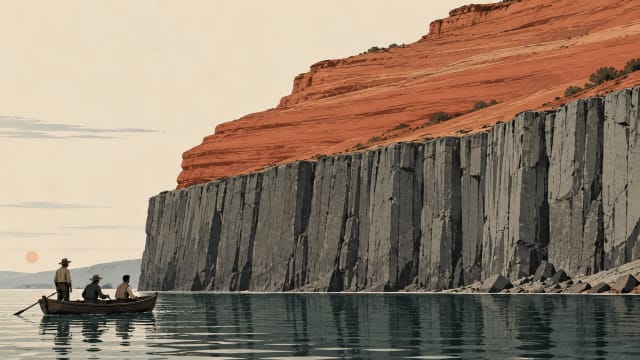
In 1650 James Ussher, the Archbishop of Armagh, reckoned from scripture that creation began in 4004 BCE, and his date found its way into the margins of English Bibles. In June 1788 three men in a small boat off the Berwickshire coast looked at a cliff that seemed to ask for a far larger number. James Hutton, the Edinburgh natural philosopher and farmer, had brought the mathematician John Playfair and the young baronet Sir James Hall to Siccar Point to show them a theory made of stone.
At the water's edge the older rock stood in thin, almost vertical layers, and above it lay gently sloping beds of red sandstone. Modern dating puts the lower layers at about 435 million years and the upper at about 370 million. Hutton had no such figures. He had a sequence. The lower layers must first have settled flat on a sea floor, then hardened, tilted upright and worn down, and only afterwards could new sediment be laid across the stump. Each step belongs to a process that can still be watched, and each is slow.
His principle was therefore simple and radical. The Earth should be explained by forces observable now, given enough time, and not by catastrophes summoned for the purpose. Time became the missing ingredient rather than the missing evidence. In his 1788 paper Hutton wrote that in the Earth's rocks he could find 'no vestige of a beginning, no prospect of an end'.
Time became the missing ingredient rather than the missing evidence.
The case against is easy to state. Siccar Point is a single junction, and one junction shows only that a gap exists, not how long the gap lasted. Rivers and storms can cut and pile rock far faster in places than Hutton assumed, and nothing at the cliff carries a date. Many contemporaries preferred the older view that a great flood or a vanished ocean had formed the rocks, and for decades Hutton's version stayed a minority taste, partly because his prose was dense. It took Charles Lyell's Principles of Geology in the 1830s to make it doctrine.
Yet the argument never needed a date. It needed only a ratio. If the visible processes are slow and the sequence of events at the cliff is long, the age of the Earth must be vast, whatever the exact figure, and no one at the cliff needed to name it. The unconformity did not measure time. It made short chronologies impossible to defend, which is a different and sturdier achievement.
The best known description of that afternoon is not Hutton's. It comes from Playfair, who published it in 1805, seventeen years afterwards and eight years after Hutton's death. Playfair wrote that the mind 'seemed to grow giddy by looking so far into the abyss of time'. The giddiness belongs to a follower recalling the scene, and the plain geology of the junction does not mention it.
That leaves an uncomfortable question. The rock at Siccar Point is real and measurable, yet the sense of depth that made it matter survives in a sentence composed long after the boat had gone home. If the feeling of vastness persuaded readers, and the rock alone persuaded few for decades, it is not obvious which of the two actually discovered deep time.
Discussion
Sign in to join the discussion.
More in Deep Time

Would a Fourth Dimensional Being Be a God?
A thought experiment in higher dimensions asks whether what looks like a miracle might simply be reality viewed from a geometry we cannot perceive.

Why Humans Have the Largest Penis Among All Primates: An RC Inspired by IIM Indore
Desmond Morris had a simple answer. Modern biology has a more complicated one. What changed between 1967 and now reveals as much about science as it does about human anatomy.

The Biggest Problem with Time Travel Is Not Time
What if the biggest obstacle to time travel isn't physics but identity? Before bending spacetime, we may need to answer who actually travels.

Why Einstein Failed His Exams: An RC Inspired by IIM Indore
The story of Einstein failing his exams has survived a century of correction. The reason it survives tells you more about human psychology than it does about Einstein.